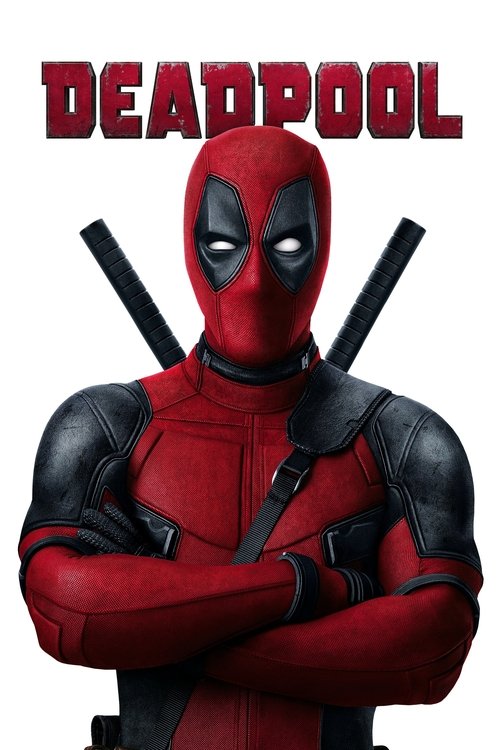
Deadpool (2016) is a superhero film adapted from Marvel Comics, directed by Tim Miller and starring Ryan Reynolds and Morena Baccarin. The film is part of the X-Men Universe and was released by 20th Century Fox. Runtime: 1h 48m. Rated R. Audience rating: 8.0/10.
What is Deadpool (2016) about?
Former Special Forces operative turned mercenary Wade Wilson dons a new identity as Deadpool after a rogue experiment leaves him with accelerated healing powers and a very dark, twisted sense of humor.
Released in 2016, Deadpool was directed by Tim Miller and produced under the 20th Century Fox banner. The film occupies a significant place within the X-Men Universe — contributing to the ongoing narrative and mythology of that cinematic universe.
The film features lead performances from Ryan Reynolds, Morena Baccarin, Ed Skrein, among others, anchoring a story that adapts characters first brought to life in Marvel Comics. Its source material gives the film a foundation rooted in decades of published storytelling, which Miller and the creative team interpret through a cinematic lens.
With an audience rating of 8.0, Deadpool is generally praised as a strong entry in the superhero genre — its strengths in storytelling, performance, and production design regularly cited by viewers.
What happens in Deadpool (2016)? — Full Plot
Cold open. A frozen mid-air taxi cab — paused at the apex of a barrel-roll — sits suspended over a Manhattan freeway. The camera floats through the interior in slow motion: bullets paused mid-flight, a glasses case mid-fall, a Wham CD floating loose. The film's opening credits roll. The lead actor is listed as "GOD'S PERFECT IDIOT." The director is "AN OVERPAID TOOL." The villain is "A BRITISH VILLAIN." The supporting cast is "COMIC RELIEF." The studio is described in the credits as "USED TO BE THE FOX, PEOPLE." The film breaks the fourth wall in its first ninety seconds and never goes back. After the credits, the action resumes in real-time. Inside the falling taxi, Deadpool — Ryan Reynolds in full red-and-black suit with the iconic katana sheaths and the white-eye-painted mask — is mid-decapitation of two of three mercenaries with the third about to grab his crotch. He's been on his way to assassinate a man named Francis.
He's on the freeway overpass moments later. Twelve mercenaries in dark SUVs are pulling onto the bridge. Deadpool stands on the overpass railing in his suit, twin katanas drawn, with a hand-drawn bullet-count panel on screen reading "BULLETS USED: 12" as he checks his ammo. He fires a handgun. He kills six of them in single shots, leaving a clean panel reading "BULLETS USED: 6/12 — three for the road." He drops onto a moving SUV, decapitates two mercenaries with one swing of a katana, gets shot in the kidney, regenerates, takes another mercenary's leg off at the knee, and rolls under a third SUV that pancakes him into hamburger and immediately regenerates. He has the kind of fight where you can watch his hand grow back from a stump in real time. The fight ends with him hanging upside down from the bridge holding the last mercenary by the throat. He spares the man, walks off the bridge, and the film cuts to flashback. The audience needs to know who the hell this is.
Two years earlier. Sister Margaret's School For Wayward Girls — a back-alley New York mercenary bar where freelance hitmen pick up odd jobs and Weasel, Deadpool's friend (T.J. Miller), tends bar. Wade Wilson is a former Special Forces operator turned freelance mercenary for hire, taking small jobs that don't bother his conscience: roughing up a stalker for a teenage girl, slapping around a drunk husband. He's in his late thirties, all wisecracks, no romantic prospects. At Sister Margaret's one night, Vanessa Carlysle — Morena Baccarin, dark hair, sharp eyes, a sex worker by trade — walks in to settle a tab Wade owes her. They lock eyes. She challenges him to a one-up dueling-pain-thresholds banter contest and wins. They go home together. The next three months play out in a montage to Neil Sedaka's "Calendar Girl" — Vanessa and Wade celebrating every weird holiday on the calendar (International Women's Day, Lunar New Year, Tax Day) in increasingly creative bedroom set pieces that the studio's marketing team famously refused to print on a poster.
Wade proposes to Vanessa. She says yes. They're in bed laughing. He stands up to make pancakes for her and doubles over coughing blood onto the floor. Stage IV terminal cancer. Liver, lungs, prostate, brain. The doctor gives him weeks to months. He has nothing in savings. He won't be at his own wedding. He walks out of the appointment in a daze and gets stopped on the street by a man in a suit who hands him a business card and a pitch: an experimental clandestine program that can cure his cancer AND give him superhuman abilities, all in one go. Wade says no, of course not. He goes home, puts on a brave face, almost tells Vanessa the diagnosis, doesn't. He sneaks out of the apartment in the middle of the night, leaving her a Wham cassette tape labeled "YOU'LL HATE ME WHEN YOU FIND OUT" and a goodbye note. He walks into the recruitment center in a dark warehouse.
The Workshop. The director of the operation is Francis Freeman — Ed Skrein, British, no eyebrows, all menace, called himself "Ajax" by the staff. Francis is mid-30s, ex-British military, augmented with synthetic nerve-damage that makes him incapable of feeling physical pain. His assistant is Angel Dust — Gina Carano, super-strong, also pain-immune from the Workshop's protocol — and they run a research lab in a converted Fortune 500 building. The Workshop's actual purpose is not to cure cancer. It's to torture-trigger mutant genes in willing test subjects and then sell the resulting living super-soldiers to the highest bidder for assassination contracts. They've been doing it for years. Wade is the next subject.
Wade is strapped to a metal table. Francis injects him with a serum that activates dormant mutant DNA but only if subjected to extreme physiological stress. Francis tortures him for three days straight — beatings, electric shocks, sleep deprivation, drowning. Wade's mutant gene refuses to express. On day four, Francis seals him in a hypobaric oxygen-deprivation chamber and slowly suffocates him over forty-eight hours. Wade's body, finally pushed past survival threshold, manifests the mutation. His healing factor activates. Every cell in his body now regenerates faster than damage can be inflicted. His cancer cells regenerate too — they spread to every part of his body and his skin becomes a maze of permanent tumor-scarring across his entire face and body. He no longer looks like Ryan Reynolds. He looks like, in Weasel's words later, "an avocado that had sex with an older, more disgusting avocado." He's immortal. He's hideous. He's furious.
Wade chokes Angel Dust with a chain, breaks Francis's nose, and burns the entire Workshop down with the staff still inside. He escapes the firestorm wearing only a hospital gown. He spends the next year hunting every man who worked at the Workshop. He won't see Vanessa because he can't bear her to look at his face. He squats in the run-down apartment of Blind Al — Leslie Uggams, an elderly blind cocaine dealer — who can't see him and thus can't judge his face. He sews himself a red-and-black mercenary costume to hide his scars in public. Weasel, his bartender friend, points out that the red suit's color helps because it doesn't show blood. "You look like an avocado had sex…" Weasel cycles back to it through the film. Wade adopts the name Deadpool — from the betting pool at Sister Margaret's that named which mercenary was going to die next. Deadpool starts cutting his way through every contact who ever sold a subject to the Workshop, looking for Francis specifically.
The X-Men show up to recruit him. Colossus — Russian metal-man, Stefan Kapičić's voice work in motion-capture, voiced with deeply earnest moral authority — and Negasonic Teenage Warhead — Brianna Hildebrand, sixteen years old, perpetually checking her phone, capable of generating cataclysmic explosive bursts from her body — try to bring Deadpool into the X-Men officially. Colossus delivers a five-minute speech about superhero responsibility and morality and a teaching moment about how revenge isn't the way. Deadpool spends most of it staring at his iPhone and making jokes about Colossus's chest dimples. He refuses. He's after Francis. He doesn't care about the X-Men.
Weasel finds Francis. He's at the wreckage of a SHIELD Helicarrier — the one that crashed into the Potomac in The Winter Soldier (2014) — now floating in a Brooklyn scrapyard. Francis is using its hold as his new Workshop, with Angel Dust and a small army of mutant test subjects he's been culturing. Deadpool, Colossus, and Negasonic head over. Francis, sensing the attack, has Vanessa kidnapped from her job at the strip club and chained to the Helicarrier's deck as bait. Deadpool arrives. "He's like a hot dog with the bun on the wrong way around," Wade comments about the helicarrier from a distance. "Don't look at his face. He's hideous." He swings into action.
The final battle on the Helicarrier is the most satisfying R-rated superhero throwdown of 2016. Colossus and Angel Dust fight in the engine room — Angel Dust crushing Colossus into the bulkhead, Colossus standing back up unfazed and politely punching her into next week. Negasonic Teenage Warhead explodes a chain reaction through the entire Helicarrier's deck, blowing the structure in half. Deadpool engages Francis on the upper deck. They fight with katanas, fists, and finally just brute strength. Wade is unkillable but slower; Francis is faster but vulnerable to his own pain-immunity (he can't feel that his arm is broken). Wade catches Francis in a chokehold. Francis pants out that the mutation is permanent — there is no cure. There is no way to fix Wade's face. Wade nods. He shoots Francis through the head at point-blank range. Colossus stops him — "FOUR — FIVE MOMENTS THE HERO HAS A CHANCE TO MAKE A REAL CHOICE" — but Wade has already pulled the trigger.
Vanessa is freed. She has spent the last year mourning him. He stands in front of her in the Deadpool mask. He pulls it off. She sees his face for the first time — the maze of cancer-scarring and tumor-tissue. She walks up to him in her own black-leather dress and looks him in the eye. "After a brief adjustment period and a couple of drinks, it's a face I'd happily sit on." She kisses him on the lips. They walk off the Helicarrier together as it slowly sinks behind them.
Coda. Wade, in a bathrobe, walks out the front door of his apartment in a perfect homage to the closing scene of Ferris Bueller's Day Off (1986). He addresses the camera. "Are you still here?" He explains in 4th-wall-breaking dialogue that the film is over. He hints at the sequel. "Cable. In the next one. Big guy from the future. Metal arm. Time travel." He suggests the studio cast someone good. He floats Mel Gibson, Dolph Lundgren, Keira Knightley with a flat-top haircut. He waves to the camera. "Go home." He shuts the door. End credits. Fox's logo melts off the screen.
Who stars in Deadpool (2016)?
Find Deadpool (2016) on Amazon
Watch Deadpool on Prime Video, browse the original Marvel Comics source material, and discover Blu-rays, soundtracks, and related merchandise on Amazon.
As an Amazon Associate, I earn from qualifying purchases. Link clicks do not affect editorial coverage — see our disclaimer.
What are some facts about Deadpool (2016)?
Deadpool released in 2016, placing it within the 2010s era of comic book cinema — a decade that saw superhero films become the dominant force at the global box office.
Directed by Tim Miller, the film was produced by 20th Century Fox and adapts source material from Marvel Comics.
The principal cast features Ryan Reynolds and Morena Baccarin, with key supporting roles played by Ed Skrein, T.J. Miller.
The film belongs to X-Men Universe — 20th Century Fox's X-Men film franchise, now absorbed into the MCU multiverse.
Deadpool carries an audience rating of 8.0 — a strong critical benchmark that few comic book films have achieved.
The Marvel Comics source material for Deadpool has been in continuous publication for decades, giving filmmakers a rich well of storylines, character arcs, and iconography to draw upon.
Modern superhero films like this one use a mix of practical effects and digital VFX, with entire sequences often shot against volume walls or LED stages pioneered by shows like The Mandalorian.
Deadpool is catalogued on Movies on Comics among our collection of 164 comic book films spanning 48 years of cinema — from Richard Donner's 1978 Superman to the present day.
Easter Eggs & Hidden Details in Deadpool (2016)
The leaked test footage that became a film. Ryan Reynolds spent 11 years championing the project. The deep cuts include the test reel's commercial impact and the studio's reluctant approval.
Ryan Reynolds and director Tim Miller had been pitching Deadpool for almost a decade. Fox repeatedly rejected it for being too R-rated. In 2014, a 90-second test reel from a 2012 Comic-Con presentation leaked online — getting 16 million views in 48 hours. Fox greenlit the film within a week. Without that leak, this film does not exist.
Brianna Hildebrand's character was an extremely obscure comic-book character. Ryan Reynolds publicly admitted he chose her solely because the name was the most absurd-sounding superhero name in Marvel's catalog. Her actual on-screen powers (precognitive explosions) were made up by the screenwriters because the comic powers were too complicated to adapt.
Ryan Reynolds, Rhett Reese, and Paul Wernick co-wrote the script. The film's distinctive fourth-wall-breaking voice was largely Reynolds's contribution. Reese and Wernick had previously written for Zombieland (2009). The trio has remained the franchise's writing team across all three films.
Wade's facial disfigurement was deliberately made grotesque — moving away from the franchise's tradition of preserving leading-actor attractiveness. Reynolds reportedly insisted on the realistic prosthetic-makeup approach over CGI smoothing. The result became the character's defining visual feature.
Deadpool was produced on a $58 million budget — small by 2016 superhero standards. The relative production thrift was a deliberate choice; Reynolds had argued for a smaller budget to maintain creative control. The film grossed $782 million globally — making it the highest-grossing R-rated film of all time at the time of release.
Wade's description of his disfigured face as 'avocado had sex with an older, more disgusting avocado' was largely Reynolds's improvisation. The line became one of the franchise's most-quoted moments.
The film's opening credits — labeled 'Some Asshole's Movie' instead of the standard director credit — were widely cited as Reynolds's deliberate inside joke acknowledging the 2014 Comic-Con leak. The credits' deliberately-absurd labeling became part of the franchise's tonal identity.
Stan Lee cameos as the announcer at the strip club where Wade meets Vanessa. The cameo was Lee's first R-rated MCU/Marvel appearance — the cameo had to be cleared for the strip-club setting.
Wade's suicide attempts throughout the first film foreshadow his much-deeper grief in Deadpool 2 (2018) after Vanessa's death. The franchise's commitment to its dark emotional core was deliberately seeded in the first film.
Colossus and Negasonic Teenage Warhead's cameos — and their reluctance to recruit Wade to the X-Men — established that Deadpool operated within the X-Men franchise universe, despite being R-rated. The continuity was canonical until the franchise's eventual Disney acquisition.

💬 Reader Comments