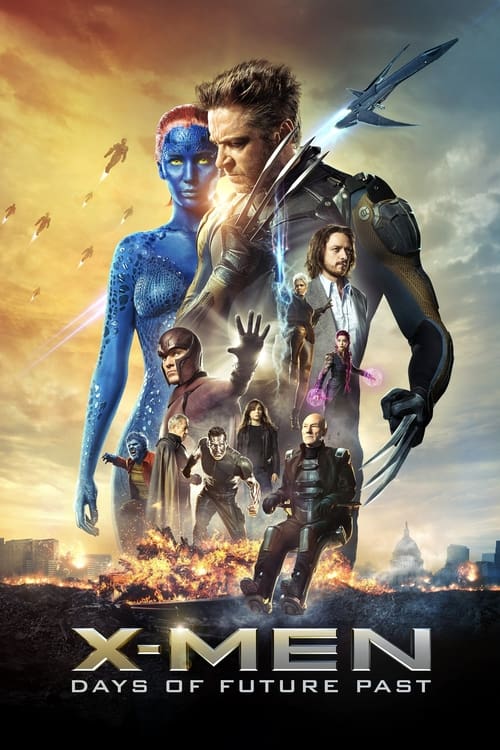
X-Men: Days of Future Past (2014) is a superhero film adapted from Marvel Comics, directed by Bryan Singer and starring Hugh Jackman and James McAvoy. The film is part of the X-Men Universe and was released by 20th Century Fox. Runtime: 2h 12m. Rated PG-13. Audience rating: 7.9/10.
What is X-Men: Days of Future Past (2014) about?
The X-Men send Wolverine back in time to the 1970s to prevent a catastrophic event: the assassination that triggered the creation of the Sentinels, relentless mutant-hunting machines.
Released in 2014, X-Men: Days of Future Past was directed by Bryan Singer and produced under the 20th Century Fox banner. The film occupies a significant place within the X-Men Universe — contributing to the ongoing narrative and mythology of that cinematic universe.
The film features lead performances from Hugh Jackman, James McAvoy, Michael Fassbender, among others, anchoring a story that adapts characters first brought to life in Marvel Comics. Its source material gives the film a foundation rooted in decades of published storytelling, which Singer and the creative team interpret through a cinematic lens.
With an audience rating of 7.9, X-Men: Days of Future Past is generally praised as a strong entry in the superhero genre — its strengths in storytelling, performance, and production design regularly cited by viewers.
What happens in X-Men: Days of Future Past (2014)? — Full Plot
The year 2023. A dystopian future Earth. Sentinels — autonomous mutant-hunting robots originally designed by Bolivar Trask in the 1970s and continuously upgraded over five decades — have wiped out most of mutant-kind and most mutant-sympathetic humans alongside them. The opening shots show a global apocalypse: ruined Manhattan skyscrapers, mass-grave concentration camps in former American suburban neighborhoods, military Sentinel hovercraft patrolling the rubble. The remaining X-Men — Professor X (Patrick Stewart), Magneto (Ian McKellen), Wolverine (Hugh Jackman), Storm (Halle Berry), Iceman (Shawn Ashmore), Blink (Bingbing Fan), Sunspot, Bishop, Warpath, and the time-projecting Kitty Pryde (Ellen Page) — have been hiding in a remote Chinese mountain monastery. They are the last meaningful resistance.
The Sentinels have been hunting the resistance through coordinated drone-attack patterns. Kitty Pryde has been protecting the team using her newly-emerged ability to project a single person's consciousness backward in time — when the Sentinels approach the monastery, she has been sending Bishop's consciousness back several days, warning the resistance about the attack, allowing them to relocate before it occurs. The technique has been keeping them alive but is unsustainable; the Sentinels keep finding new ways to track them. The team realizes they cannot win the war through tactical evasion. They need to prevent the war from ever starting. Specifically: they need to prevent Mystique from assassinating Bolivar Trask in 1973 — the murder that triggered the Sentinel program's political funding and military authorization.
Charles Xavier and Magneto, having been ideological enemies for fifty years, have now reconciled in the face of mutant extinction. They have specifically asked Kitty to project Wolverine's consciousness back to 1973 because Wolverine — having canonical regenerative healing — is the only person capable of surviving the temporal shock of a 50-year consciousness transfer. (Any other mutant would have their mind shattered by the temporal stress.) Kitty agrees. Wolverine, in the monastery's central meditation chamber, lies on a stone altar while Kitty places her hands on his temples and begins the projection. The consciousness-transfer scene is visually striking — Wolverine's body remains in 2023 in a sleeping state while his consciousness enters his 1973 body across five decades.
Wolverine awakens in 1973. He is in a Brooklyn waterbed in a small apartment near Coney Island. The apartment belongs to a Mafia girlfriend whose mob boss father is about to walk in on them — Wolverine is briefly preoccupied with surviving the immediate scene before remembering his mission. He extricates himself from the apartment via the fire escape (with the Mafia father chasing him through the streets brandishing a shotgun). He realizes immediately that this is his pre-adamantium 1973 body — his claws are still bone, his memory is fragmentary, and he doesn't have the metallic skeletal augmentation that wouldn't be installed until later in his canonical timeline. He has to operate at significantly reduced combat power. He heads for Westchester, New York, to find the young Charles Xavier.
The Westchester mansion is in disrepair. Charles Xavier (James McAvoy, 38 years old, in the same role as X-Men: First Class (2011)) has been living in seclusion since the events of First Class. He has been depressed for over a decade. His school has been closed. He has been injecting himself with a serum developed by Hank McCoy / Beast (Nicholas Hoult) that suppresses his telepathic abilities — and incidentally, his mutation entirely. The serum allows Charles to walk on his paralyzed legs but eliminates his most powerful telepathic capabilities. Charles is functionally retired. He is also drinking heavily. Hank, who has been living at the mansion as Charles's caretaker, has been quietly trying to encourage Charles back to active service for ten years.
Wolverine convinces Charles to help him. Charles is initially skeptical — he doesn't believe Wolverine's claim about being from the future, and his mutation-suppressed state means he cannot verify it telepathically. But Wolverine has specific knowledge only Charles's older self could have given him (about Charles's late mother, about specific childhood memories Charles never shared). Charles agrees to stop the serum, restore his telepathic abilities, and help. Hank, freshly motivated, helps the team plan their next move. The Sentinel-prototype designer Bolivar Trask (Peter Dinklage, 44 years old, with the canonical comics-Trask short stature being deliberately cast and embraced rather than concealed) will be in Paris within ten days demonstrating his prototype to Vietnamese government officials. Mystique is already in Paris tracking him.
The Pentagon prison break. Magneto / Erik Lehnsherr (Michael Fassbender) has been imprisoned in a Pentagon-basement cell since 1963 for the JFK assassination — the film implies Magneto was framed by the actual assassin, but Erik's metallic-mutation made him the convenient scapegoat. The cell is buried 100 floors beneath the Pentagon, with no metal in the entire cell structure (to prevent Erik from using his abilities). The team needs Magneto to help intercept Mystique. They enlist a new mutant — Peter Maximoff / Quicksilver (Evan Peters) — to extract him. Quicksilver is a teenage punk who can move at superhuman speeds (specifically faster than human perception). His role: get into the cell, smash the wall, and lead Erik out before security responds. The break-in is filmed in approximately 90 seconds of slow-motion footage that became iconic.
The team flies to Paris on a chartered jet. Charles, Wolverine, Hank, Magneto, and Quicksilver land at Orly Airport on the morning of Trask's prototype demonstration. Trask is presenting the prototype Sentinel at the Hôtel d'Évreux — a private Paris diplomatic residence. Mystique (Jennifer Lawrence) — Charles's adopted sister, who has been working as a freelance Nazi-hunter assassin since the events of First Class — is hiding in the hotel's plumbing crawlspace, planning to ambush Trask during the demonstration. Charles enters the hotel telepathically, locates Mystique, and confronts her in a hallway sequence that is pure family melodrama. Charles pleads with her not to assassinate Trask. He explains the Sentinel war and the apocalyptic future. Mystique, unconvinced, attempts to complete the assassination.
The Paris hotel sequence is chaotic. Mystique attacks Trask in the demonstration hall. Charles intervenes telepathically, stopping her bullet mid-flight. Wolverine engages Trask's security detail. Magneto, having decided that the elimination of Trask is in fact mutant-kind's best path forward, suddenly turns on Charles — Magneto fires a bullet from his pistol toward Mystique to ensure her assassination attempt does not survive intervention. Charles deflects the bullet at the last moment but cannot prevent it from grazing Mystique. The mutated x-gene-carrying blood spills onto the marble floor. Trask's research team, having seen Mystique's shape-shifting demonstration during the chaos, captures a sample of her DNA from the spilled blood. The DNA becomes the genetic basis for the Sentinels' canonical adaptive shape-mimicking abilities.
The team has 72 hours to prevent the next assassination attempt. They travel to Washington D.C., where Trask is scheduled to testify before a U.S. Senate hearing about the Sentinel program. Mystique, having escaped from Paris, is planning to attack Trask at the Senate hearing. Magneto, having reached his own ideological conclusion, has decided to hijack the Sentinel prototype directly — he intends to use the prototype to attack the U.S. presidential residence and assassinate Richard Nixon during the same Senate hearing. The team approach the situation from multiple angles. Charles enters the Senate hearing via telepathy to track Mystique. Wolverine searches for the Sentinel prototype. Magneto has already infiltrated the location and is preparing his attack.
The Senate hearing climaxes. Magneto hijacks the Sentinel prototype mid-demonstration and uses its onboard targeting systems to attack the White House. The film's third-act setpiece is approximately 20 minutes of choreographed chaos: Magneto controlling the prototype, Wolverine and Hank attempting to disable it, Mystique sneaking through the Senate ventilation to reach Trask. The setpiece's most-iconic shot — Magneto lifting an entire baseball stadium (RFK Stadium) and dropping it around the White House perimeter to seal the Nixon administration inside — was the film's largest single VFX sequence. Marvel's VFX team spent approximately 18 months on the stadium-lifting sequence; the work has been widely cited as one of the most-elaborate single VFX moments in any 2014 release.
Mystique enters Trask's office during the chaos. She has Trask cornered. She is about to fire. Charles, having been telepathically searching for her, reaches her in time. He doesn't try to control her with telepathy. He simply asks her, calmly, to make her own choice. He shows her — telepathically — the apocalyptic 2023 future. He shows her how her assassination directly causes the Sentinel program. He shows her the deaths of every mutant she has ever loved. Mystique, who has been ideologically committed to her assassination plan for over a decade, finally lowers her weapon. She chooses, in the final moment, to spare Trask — a deliberate inversion of her future-self's decision. Trask is arrested for unrelated charges (his Vietnamese black-market weapons sales). The Sentinel program loses its political momentum.
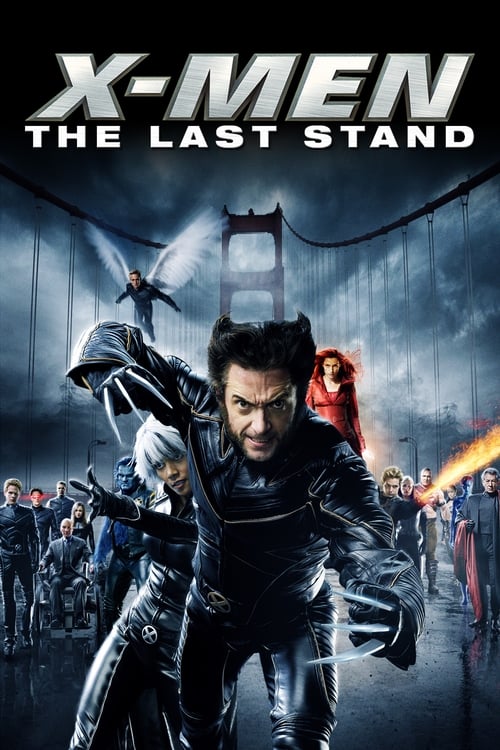
Wolverine wakes up in his original 2023 body. He is on the stone altar in the Chinese monastery. Kitty Pryde is standing beside him with her hands still on his temples. The future has been rewritten. Wolverine is briefly disoriented before fragments of the new continuity flood his mind — he was no longer assassinated, the Sentinel program never received funding, his X-Men teammates from The Last Stand (2006) are alive in the new timeline. He walks downstairs to find the rebuilt Westchester mansion fully functional. Charles Xavier (Patrick Stewart) is teaching a class. Jean Gray (Famke Janssen) is alive. Cyclops (James Marsden) is alive. Storm is teaching the same group of students Wolverine had remembered as dead. The film's most-emotional moment is Wolverine's quiet reaction shot as he understands the full implications of the new continuity.
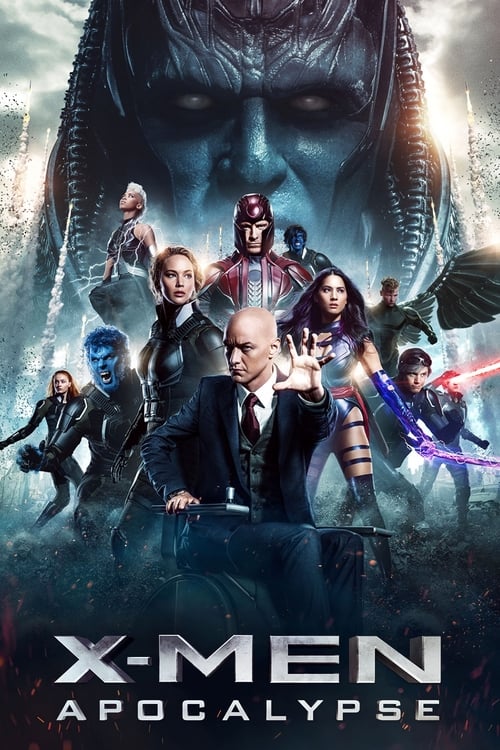
Commercial and critical aftermath. X-Men: Days of Future Past grossed approximately $748 million worldwide — the highest-grossing X-Men film at the time of release and one of the most commercially successful franchise installments in modern superhero cinema. Critical reception was overwhelmingly positive (Rotten Tomatoes 90%); critics widely praised Bryan Singer's directorial choice to integrate both X-Men casts (the original and the prequel cast) into a single coherent narrative. The film also retroactively erased The Last Stand (2006)'s controversial character deaths from canonical continuity — Cyclops, Jean Gray, and Charles Xavier are all alive in the post-Days-of-Future-Past timeline. Singer would direct the sequel X-Men: Apocalypse (2016); his subsequent legal issues led to his departure from the franchise after Apocalypse.
Who stars in X-Men: Days of Future Past (2014)?
Find X-Men: Days of Future Past (2014) on Amazon
Watch X-Men: Days of Future Past on Prime Video, browse the original Marvel Comics source material, and discover Blu-rays, soundtracks, and related merchandise on Amazon.
As an Amazon Associate, I earn from qualifying purchases. Link clicks do not affect editorial coverage — see our disclaimer.
What are some facts about X-Men: Days of Future Past (2014)?
X-Men: Days of Future Past released in 2014, placing it within the 2010s era of comic book cinema — a decade that saw superhero films become the dominant force at the global box office.
Directed by Bryan Singer, the film was produced by 20th Century Fox and adapts source material from Marvel Comics.
The principal cast features Hugh Jackman and James McAvoy, with key supporting roles played by Michael Fassbender, Patrick Stewart, Ian McKellen.
The film belongs to X-Men Universe — 20th Century Fox's X-Men film franchise, now absorbed into the MCU multiverse.
X-Men: Days of Future Past carries an audience rating of 7.9 — putting it in the solid-to-excellent tier of the genre.
The Marvel Comics source material for X-Men: Days of Future Past has been in continuous publication for decades, giving filmmakers a rich well of storylines, character arcs, and iconography to draw upon.
Modern superhero films like this one use a mix of practical effects and digital VFX, with entire sequences often shot against volume walls or LED stages pioneered by shows like The Mandalorian.
X-Men: Days of Future Past is catalogued on Movies on Comics among our collection of 164 comic book films spanning 48 years of cinema — from Richard Donner's 1978 Superman to the present day.
Easter Eggs & Hidden Details in X-Men: Days of Future Past (2014)
Bryan Singer's return and the franchise's most-effective continuity bridge. The deep cuts include the Quicksilver kitchen sequence and the dual-cast integration.
The Pentagon prison break features Peter Maximoff / Quicksilver using super-speed to rearrange a kitchen full of bullets and armed guards in slow motion. The sequence — set to Jim Croce's 'Time in a Bottle' — was shot at 3,600 frames per second and took weeks of post-production. Widely cited as the franchise's best action sequence.
Days of Future Past is the rare X-Men film that includes both the original cast (Patrick Stewart, Ian McKellen, Hugh Jackman, Halle Berry) from X-Men (2000) and the prequel cast (James McAvoy, Michael Fassbender, Jennifer Lawrence) from X-Men: First Class (2011). The bridge was widely cited as the franchise's most-effective continuity decision.
Bryan Singer returned to direct Days of Future Past after his X2 (2003) franchise departure. Singer's direction was widely celebrated as a return to the franchise's earlier serious-cinema register. His subsequent legal issues forced his exit after this film.
Bolivar Trask's Trask Industries — established in this film — became the franchise's longest-running corporate villain. The Trask program's Sentinel-mutant-hunting robots have been seeded across multiple X-Men films.
The dystopian-future Sentinels — autonomous mutant-hunting robots — were widely cited as the year's most-impressive practical-effects rebuild. The CGI work was supplemented by life-size Sentinel models for closeup shots.
Omar Sy's Bishop — Kitty Pryde's protégé in the dystopian future — was the franchise's first explicit time-travel role. Bishop's character has been quietly established as the future X-Men's primary time-tracker.
Hugh Jackman's Wolverine — established as the original X-Men trilogy's lead — became the primary character for Days of Future Past. His narrative tour through both eras was widely cited as the film's most-effective character arc.
Jennifer Lawrence's Mystique's choice to spare Bolivar Trask — rather than assassinating him as her future-self had originally planned — retroactively saved the X-Men franchise's continuity. The Sentinel program loses its political momentum, preventing the dystopian future.
Days of Future Past retroactively erased The Last Stand (2006)'s controversial character deaths from continuity. Cyclops, Jean Grey, and Charles Xavier are alive in the new timeline established by the film's time-jump.
X-Men: Days of Future Past grossed $748 million globally — the highest-grossing X-Men film at the time of release. Critics widely praised its time-travel structure and the integration of both casts.



💬 Reader Comments