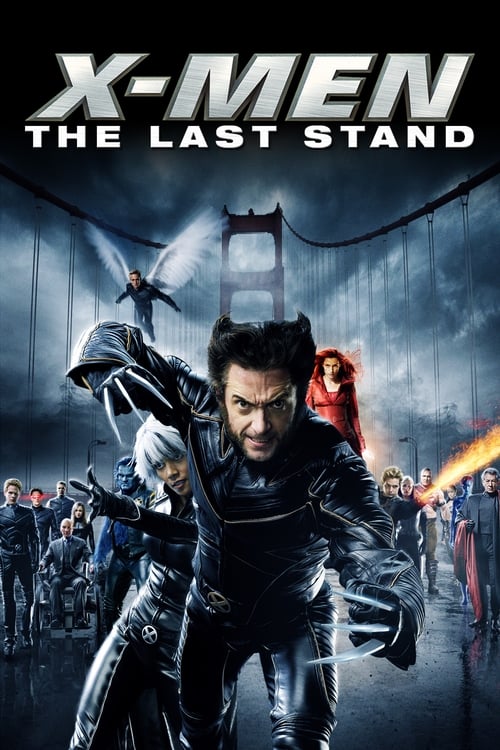
X-Men: The Last Stand (2006) is a superhero film adapted from Marvel Comics, directed by Brett Ratner and starring Hugh Jackman and Halle Berry. The film is part of the X-Men Universe and was released by 20th Century Fox. Runtime: 1h 44m. Rated PG-13. Audience rating: 6.8/10.
What is X-Men: The Last Stand (2006) about?
The emergence of a 'mutant cure' sparks a war between the X-Men, Magneto's powerful army, and the renegade Jean Grey now reborn as the virtually omnipotent Dark Phoenix.
Released in 2006, X-Men: The Last Stand was directed by Brett Ratner and produced under the 20th Century Fox banner. The film occupies a significant place within the X-Men Universe — contributing to the ongoing narrative and mythology of that cinematic universe.
The film features lead performances from Hugh Jackman, Halle Berry, Ian McKellen, among others, anchoring a story that adapts characters first brought to life in Marvel Comics. Its source material gives the film a foundation rooted in decades of published storytelling, which Ratner and the creative team interpret through a cinematic lens.
Its 6.8 rating reflects a film that divided audiences — appreciated for its ambition and spectacle by some, criticized for pacing and execution by others. Its place in the genre remains a frequent discussion point.
What happens in X-Men: The Last Stand (2006)? — Full Plot
The film opens with a flashback. Twenty years earlier (approximately 1986), Professor Charles Xavier (Patrick Stewart, briefly de-aged) and Magneto / Erik Lehnsherr (Ian McKellen, also de-aged) visit a young Jean Gray at her family's suburban Massachusetts home. The two were friends at this point; their ideological split would occur later. They detect extreme telepathic ability in 9-year-old Jean. Charles places extensive telepathic blocks on Jean's mind to protect her — and the world — from her own emerging cosmic-level abilities. The blocks are described as 'cages' for an entity within Jean that Charles privately names the Phoenix Force. The flashback establishes the film's central conflict before any contemporary scenes begin.
Cut to: present day, after the events of X2 (2003). Cyclops (James Marsden), grieving Jean's apparent death at Alkali Lake, has been visiting the lake daily. He is functionally non-operational as an X-Men team member; the team has been telling him to take time off. Jean reappears at the lake — alive, transformed by the Phoenix Force, having survived the flood through the cosmic entity's emergence from her body. She does not remember most of her recent life. Cyclops embraces her in the lake water. Jean kills Cyclops with a thought; the cosmic-fire telekinesis destroys him at a molecular level. His glasses fall to the water. He is gone. The death is the franchise's first major character casualty.
Meanwhile, the U.S. government has approved a corporate mutant-cure program. A pharmaceutical company called Worthington Labs — led by Warren Worthington II (Michael Murphy) — has developed a chemical agent that suppresses the X-gene in human carriers. The cure transforms mutants into 'normal' humans permanently. The cure is offered as voluntary medication. Many mutants line up to receive it, particularly those whose mutations have made them socially marginalized. Many more, led by Magneto, see the cure as the existential threat they have been warning about for decades — the literal genetic erasure of mutant identity.
Warren Worthington III / Angel (Ben Foster), the son of Worthington Labs's CEO, has been hiding his own bird-winged mutation from his father since childhood. When the cure is being publicly announced, Warren's father attempts to forcibly administer it to him. Warren escapes through the laboratory's window using his wings — the franchise's first significant Angel character moment. Warren's defection to the X-Men becomes one of the film's quieter character subplots; he serves as the team's late-film recruitment but never quite finds his footing as a major X-Men member due to the film's broader narrative pressures.
Phoenix-empowered Jean kills Charles Xavier in the film's most-controversial single sequence. Charles attempts to neutralize her with his own telepathic abilities at the Gray family home, where Jean has retreated. The two have a telepathic confrontation that runs approximately 4 minutes of on-screen dialogue. Charles attempts to re-establish the mental blocks he had placed twenty years earlier. Jean refuses. Charles tries to overpower her. She destroys his physical body before his consciousness can leave it — Charles is disintegrated by Phoenix-fire telekinesis. Patrick Stewart's Charles Xavier is gone. The film proceeds without its central anchor for the second half. The death was widely cited at release as one of the most-controversial single character deaths in any major superhero film.
Magneto recruits a small army of mutants and prepares for war against the U.S. government and Worthington Labs. He visits various recruitment camps for marginalized mutants — many of whom have been planning the cure-resistance for months. His Brotherhood of Mutants expands to several hundred members. The recruitment montages are some of the film's more-character-driven sequences. Magneto's specific tactical plan: capture Phoenix-empowered Jean, secure her as a weapon, then attack Worthington Labs on Alcatraz Island to destroy the cure's only production facility.
Mystique (Rebecca Romijn) is accidentally hit by the cure during a prison-break sequence. Her mutation is permanently neutralized. She loses her shape-shifting abilities, her blue skin, her superhuman reflexes — she becomes a normal middle-aged woman. Magneto, upon witnessing this, abandons her on the spot. The Mystique character — one of the franchise's most-iconic supporting figures — is canonically retired from active service. Romijn has stated in interviews that filming the cure-induced de-mutation was 'one of the strangest professional experiences' of her career; she had been playing Mystique for six years and her character was retired in a single scene.
The film's middle act is consumed by parallel character arcs. Wolverine's obsession with retrieving the resurrected Jean Gray — Logan is determined to save her rather than kill her, despite the team's collective recognition that the Phoenix Force is fundamentally uncontrollable. Storm's elevation to school leadership after Charles's eventual death — she has been positioned as Charles's heir-apparent across the franchise. Iceman (Shawn Ashmore) and Rogue's (Anna Paquin) romantic problems — Rogue is considering taking the cure to be able to physically touch Iceman without absorbing his powers. Iceman's growing flirtation with Kitty Pryde (Ellen Page) — a younger student who can phase through walls.
The final battle takes place on Alcatraz Island, where Worthington Labs has been operating its cure-production facility. Magneto's mutant army attacks the island in a coordinated assault using helicopter-transported mutants for aerial deployment. The X-Men intervene with a smaller force. The fight is approximately 35 minutes of multi-mutant action sequences. The choreography is overwhelmingly CGI-driven; the multiple mutant powers being deployed simultaneously created significant continuity-coherence problems. Critics widely cited the final battle as visually-impressive but narratively-confusing.
Jean Gray, fully consumed by the Phoenix Force, arrives at the Alcatraz battle and begins destroying everything within line-of-sight. Mutants on both sides are killed in her cosmic-fire telekinetic outbursts. Magneto is shot with multiple cure-darts by a U.S. Marines team and loses his powers; he becomes a powerless old man on a park bench in the film's epilogue. The X-Men team is reduced to functionality only by Wolverine's regenerative healing factor. The film's third-act stakes escalate to genuinely-apocalyptic levels — Jean's Phoenix Force is canonically threatening to consume the entire world.
Wolverine, the only mutant capable of physically regenerating from Phoenix-level attacks, walks up to Jean during the climax and stabs her with his adamantium claws. The act is the only way to kill her — the only physical intervention that can stop the Phoenix from consuming the world. Jean, in her final lucid moment, thanks him. She dies in Wolverine's arms. The death is the franchise's most-emotionally-devastating single moment through 2006; Hugh Jackman's performance in the sequence has been widely cited as one of his strongest individual acting moments in the entire X-Men franchise.
The film's epilogue. Charles Xavier's funeral is held at the rebuilt Xavier mansion. The X-Men have suffered enormous losses: Charles is dead, Jean is dead, Cyclops is dead, Magneto is depowered. Wolverine, having killed the woman he loved, leaves the team. Storm assumes school leadership permanently. The X-Men's team is fundamentally diminished. The mid-credits scene shows a coma patient in the school's medical wing — a hint that Charles transferred his consciousness into the body of a brain-dead man before his death. The implication is that Charles is canonically alive in another body; the franchise would later return to this thread in The Wolverine (2013)'s mid-credits scene.
Commercial and critical aftermath. X-Men: The Last Stand grossed $460 million worldwide on a $210 million production budget — strong commercial success despite scathing reviews. Critical reception was widely negative; Rotten Tomatoes 57%, with critics widely citing the film as a failure of franchise continuity — too many character deaths, too compressed a narrative, and a disrespect for the source material. The film's controversial creative choices were canonically reversed by X-Men: Days of Future Past (2014), which retroactively erased The Last Stand's most-controversial character deaths from continuity through a time-travel reset. Brett Ratner's directorial reputation never fully recovered from the film's reception; he has not directed another major studio film since the late 2010s.
Who stars in X-Men: The Last Stand (2006)?
Find X-Men: The Last Stand (2006) on Amazon
Watch X-Men: The Last Stand on Prime Video, browse the original Marvel Comics source material, and discover Blu-rays, soundtracks, and related merchandise on Amazon.
As an Amazon Associate, I earn from qualifying purchases. Link clicks do not affect editorial coverage — see our disclaimer.
What are some facts about X-Men: The Last Stand (2006)?
X-Men: The Last Stand released in 2006, placing it within the 2000s era of comic book cinema — a decade that marked the modern superhero cinema revolution.
Directed by Brett Ratner, the film was produced by 20th Century Fox and adapts source material from Marvel Comics.
The principal cast features Hugh Jackman and Halle Berry, with key supporting roles played by Ian McKellen, Kelsey Grammer, Famke Janssen.
The film belongs to X-Men Universe — 20th Century Fox's X-Men film franchise, now absorbed into the MCU multiverse.
X-Men: The Last Stand carries an audience rating of 6.8 — a middling reception but one that hasn't prevented its cultural footprint.
The Marvel Comics source material for X-Men: The Last Stand has been in continuous publication for decades, giving filmmakers a rich well of storylines, character arcs, and iconography to draw upon.
Films from this era combined practical stunts with the rising CGI industry — many sequences would be impossible with either technology alone.
X-Men: The Last Stand is catalogued on Movies on Comics among our collection of 164 comic book films spanning 48 years of cinema — from Richard Donner's 1978 Superman to the present day.

💬 Reader Comments