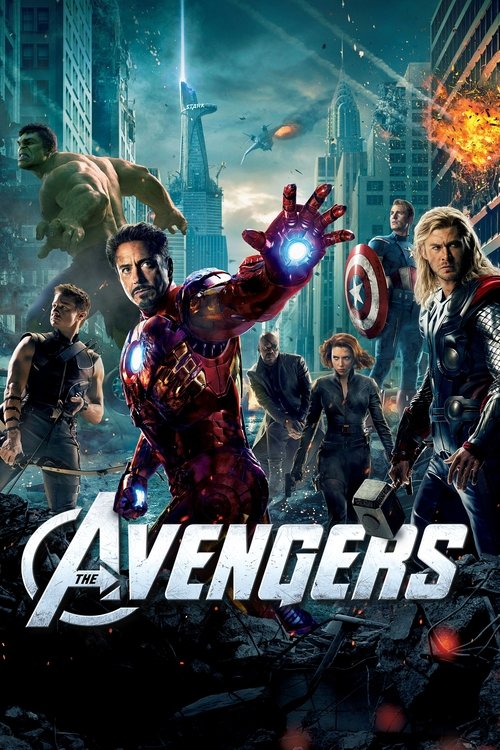
The Avengers (2012) is a superhero film adapted from Marvel Comics, directed by Joss Whedon and starring Robert Downey Jr. and Chris Evans. The film is part of the MCU and was released by Marvel Studios. Runtime: 2h 23m. Rated PG-13. Audience rating: 8.0/10.
What is The Avengers (2012) about?
Earth's mightiest heroes — Iron Man, Captain America, Thor, Hulk, Black Widow, and Hawkeye — are assembled by S.H.I.E.L.D. to stop Loki's alien invasion of Earth.
Released in 2012, The Avengers was directed by Joss Whedon and produced under the Marvel Studios banner. The film occupies a significant place within the MCU — contributing to the ongoing narrative and mythology of that cinematic universe.
The film features lead performances from Robert Downey Jr., Chris Evans, Chris Hemsworth, among others, anchoring a story that adapts characters first brought to life in Marvel Comics. Its source material gives the film a foundation rooted in decades of published storytelling, which Whedon and the creative team interpret through a cinematic lens.
With an audience rating of 8.0, The Avengers is generally praised as a strong entry in the superhero genre — its strengths in storytelling, performance, and production design regularly cited by viewers.
What happens in The Avengers (2012)? — Full Plot
We open in deep space. Loki (Tom Hiddleston), tired and battered from his fall into the void at the end of Thor (2011), kneels before a cloaked figure called the Other — emissary of an extraterrestrial race called the Chitauri. Loki strikes a bargain: he'll deliver Earth as a conquest in exchange for the Tesseract, the cosmic Cube the Other's master needs to retrieve. The cloaked figure agrees. Loki is dispatched with a Chitauri scepter, glowing blue, that lets him bend minds to his will. Cut to: a SHIELD research facility in the New Mexico desert. Director Nick Fury (Samuel L. Jackson) and his deputy Maria Hill (Cobie Smulders) are inspecting the Tesseract — pulled from Captain America's frozen aircraft decades ago — when it suddenly spits unstable energy and rips open a portal in mid-air. Loki steps through, kills several agents on the spot, and uses his scepter to enslave Hawkeye (Jeremy Renner) and astrophysicist Erik Selvig (Stellan Skarsgård). He walks out with the Tesseract as the entire facility implodes behind him.
Fury makes a phone call. Several phone calls, actually. He activates a shelved program he'd been quietly assembling for years called the Avenger Initiative. Natasha Romanoff / Black Widow (Scarlett Johansson) is pulled out of a Russian-mob interrogation in Calcutta — tied to a chair, in a black dress, beating answers out of her own captors with the ropes still on her wrists — to recruit Bruce Banner (Mark Ruffalo). Banner has been on the run from the U.S. military for years, hiding among the poorest residents of Kolkata, treating sick children as a fugitive doctor. She convinces him SHIELD needs his expertise in tracking gamma-radiation signatures emanating from the Tesseract. Meanwhile, Phil Coulson (Clark Gregg) corners Tony Stark (Robert Downey Jr.) at the rooftop of his newly-completed Manhattan tower, dropping a briefcase of mission files in his lap. Fury himself visits Steve Rogers (Chris Evans) at a Brooklyn boxing gym where Steve has been punching bags into walls trying to adjust to the 21st century. The pitch to each Avenger is different. The desperation is the same.
Loki resurfaces in Stuttgart, Germany. He crashes a black-tie symphony gala, drags an elderly German scientist outside, carves out his eye with a probe to bypass a biometric scanner, and steals a rare iridium sample needed to stabilize the Tesseract's portal-energy. The crowd outside is forced to kneel. A single old man stands up: 'Not to men like you.' Loki raises the scepter to kill him — and Cap (Steve Rogers, in his original 1940s costume) drops in front of the blast, deflecting it with the shield. 'You know, the last time I was in Germany and saw a man standing above everybody else, we ended up disagreeing.' Iron Man arrives from above, AC/DC's 'Shoot to Thrill' blaring from external speakers. Black Widow drops into the standoff in a Quinjet. Loki, badly outmatched, surrenders quietly. As the Quinjet flies him to SHIELD custody, Thor (Chris Hemsworth) tears through the cabin roof, yanks his brother out, and lands in a remote forest to talk sense into him. Stark, irritated, flies down and tackles Thor mid-sentence. The brief, beautifully-staged forest brawl between Thor's hammer and Stark's repulsors ends only when Cap drops between them with the shield: 'Are we done here?' The three of them return — sulking, jaw-clenched, freshly bruised — to SHIELD's flying aircraft carrier, the Helicarrier.
Aboard the Helicarrier, the team does not get along. Cap thinks Tony is an arrogant brat. Tony thinks Cap is a museum exhibit. Banner is afraid of his own pulse. Thor refuses to accept Loki is beyond saving. Fury is hiding something: Phase 2 — SHIELD has been secretly reverse-engineering the Tesseract for weapons research, partly because Asgard's involvement in Earth made the World Security Council demand its own deterrent. Loki, locked in a glass cell originally designed to drop the Hulk into freefall, doesn't need to physically escape. He needs the team to break itself. He whispers to Romanoff (almost confesses his plan, then dares her to use her own monstrous past against herself). He plants doubts. He weaponizes their mutual distrust. The cell's surveillance feed makes him look like a calmly-amused chess player. Stark and Banner — left alone in the laboratory tracking gamma signatures — find SHIELD's hidden Tesseract-weapons files. The team explodes into a full-scale shouting match in the lab. Banner, gripping the scepter without realizing what he's doing, almost transforms.
That's when Hawkeye — still under Loki's mental conditioning — leads a covert assault on the Helicarrier. An exploding arrow takes out one engine. Banner does transform; the Hulk emerges in the lab, slams Romanoff into a wall hard enough to break her arm, and rampages through the carrier in pursuit. Thor confronts the Hulk in the cargo bay, the two of them tearing through bulkheads while Stark and Cap fight to restart the failing engine — Stark suspended in the rotor with Cap working a manual switch above him. The Hulk crashes through the carrier's hull and free-falls miles into the earth below. Thor is blasted out of the carrier in a steel containment cage Loki rigged. Romanoff, recovering from her wounds, fights Hawkeye through the cargo bay's catwalks and finishes him with a head-strike to the metal grating — a deliberate concussion to break Loki's psychic conditioning. Coulson, intercepting Loki's escape with a prototype Asgardian-grade rifle, takes a spear through the chest. 'You're going to lose. It's in your nature.' Coulson dies on the deck, the rifle smoking in his hand.
Fury uses Coulson's death as a deliberate emotional lever. He tells the broken survivors — Cap, Stark, Romanoff in the briefing room — that Coulson believed in them. The line is blunt and manipulative and they all know it, but it lands. Stark figures out where Loki is going. Stark Tower in midtown Manhattan, where Loki has been having Selvig build a Tesseract-powered portal generator atop the building's spire. Stark arrives at his own tower first, suited and ready, only to find Loki already there. Loki tries to mind-control Stark with the scepter — the tip taps against the arc reactor in Stark's chest and bounces off, the cosmic energy unable to pierce his palladium-replacement element. Stark warns Loki, with eerie precision, that even if he wins the next ten minutes, he has just personally united every superhuman on Earth against him. Loki throws him out the window of the penthouse. Stark falls fifty stories before his Mark VII suit, summoned automatically by sensors implanted in his arms, catches him mid-descent. The portal opens above his tower. The Chitauri pour through — armored troops on hovercraft, massive whale-like leviathans, and a Mothership glittering beyond the stars. The Battle of New York begins.
What follows is the first true superhero ensemble action sequence in MCU history. Hawkeye — fully de-conditioned, back in his Avengers colors — perches on a rooftop with his bow and starts methodically picking off Chitauri runners. Cap directs civilian evacuations with hand-signal precision, coordinating with NYPD on the ground. Thor and Stark take aerial duty, with Thor channeling lightning through Stark's suit to send a megavolt pulse out of his chest cannon. Romanoff, with no flight tech, leaps onto a Chitauri hovercraft mid-flight and rides it toward the rooftop portal. Banner arrives last — on a small civilian motorcycle, in his stained shirt, having walked across half the city. Cap turns to him: 'Doctor Banner, now might be a really good time for you to get angry.' Banner turns to face the leviathan bearing down on them and replies: 'That's my secret, Cap. I'm always angry.' He transforms mid-stride and punches the leviathan's snout — sending it cartwheeling backward into the side of a building. From the rooftop, Cap delivers the mission's defensive plan in one continuous shot: hold the perimeter, evacuate civilians, push the fight up the avenue. In the film's most-quoted moment, the Hulk catches a boasting Loki by the leg in Stark Tower's penthouse and slams him repeatedly against the marble floor like a rag doll, ending with the immortal one-word verdict: 'Puny god.'
Meanwhile, the U.S. World Security Council, panicking from a remote bunker, decides to nuke Manhattan — better to lose a city than the planet. They launch a single nuclear missile at the heart of Midtown. Stark intercepts it mid-air over the East River, locks the warhead under his arm, and steers it up through the open Chitauri portal into the Mothership above New York. The Mothership detonates. The shockwave ripples outward in deep space. Back on Earth, every Chitauri soldier collapses simultaneously as the hive-mind connection severs. The portal begins to close. Romanoff, using the scepter blade against the energy field, prepares to shut it down — and Stark plummets back to Earth through the closing aperture, his suit's systems offline. He free-falls limp through the sky. He's not going to make it. The Hulk catches him mid-air, hugging him into the side of a building. The team gathers around. Stark isn't breathing. Hulk roars in his face. Stark coughs awake and asks, with no apparent panic: 'Please tell me nobody kissed me.' The team smiles for the first time in the entire film.
Loki, defeated and broken, surrenders without a word. The film ends with the Avengers parting ways at a private airfield in Manhattan: Thor takes a muzzled Loki and the Tesseract back to Asgard via a portable Tesseract-stabilizer Selvig built; the others scatter to their separate lives, knowing they'll be called again. Fury, in a quiet aside, tells the Council that the Avengers will assemble whenever the world needs them — 'because they'll need us to.' In the mid-credits scene, the cosmic puppet master who originally lent Loki the army is revealed: a purple-skinned figure on a floating throne, smiling at the news of the Chitauri's defeat. Six years and many films later, audiences would learn his name was Thanos. In the now-iconic post-credits coda, the exhausted heroes silently eat shawarma in the wrecked Manhattan restaurant Stark mentioned mid-battle — a small, intimate moment that closed the film by reminding viewers these were ultimately just people.
The Avengers grossed $1.518 billion globally — the third-highest-grossing film of all time at release. It validated Kevin Feige's long-game strategy of building films into a shared universe. Joss Whedon's screenplay struck a balance between earned character beats and crowd-pleasing setpieces; the rooftop circling shot of all six Avengers facing outward, weapons drawn, became one of the most-discussed images in modern cinema. Every ensemble film since — Age of Ultron (2015), Justice League (2017), the Suicide Squad films, the X-Men ensembles — exists in the wake of what The Avengers proved possible. For an entire generation, this is the film where the Marvel Cinematic Universe stopped being a marketing slogan and became real. The Battle of New York would be referenced for the next decade across the MCU, shaping every character it touched — especially Tony Stark, whose post-traumatic stress would drive most of his arc through Iron Man 3 (2013) and beyond.
Who stars in The Avengers (2012)?
Find The Avengers (2012) on Amazon
Watch The Avengers on Prime Video, browse the original Marvel Comics source material, and discover Blu-rays, soundtracks, and related merchandise on Amazon.
As an Amazon Associate, I earn from qualifying purchases. Link clicks do not affect editorial coverage — see our disclaimer.
What are some facts about The Avengers (2012)?
The Avengers released in 2012, placing it within the 2010s era of comic book cinema — a decade that saw superhero films become the dominant force at the global box office.
Directed by Joss Whedon, the film was produced by Marvel Studios and adapts source material from Marvel Comics.
The principal cast features Robert Downey Jr. and Chris Evans, with key supporting roles played by Chris Hemsworth, Scarlett Johansson, Mark Ruffalo, Jeremy Renner.
The film belongs to MCU — the Marvel Cinematic Universe — the highest-grossing film franchise of all time.
The Avengers carries an audience rating of 8.0 — a strong critical benchmark that few comic book films have achieved.
The Marvel Comics source material for The Avengers has been in continuous publication for decades, giving filmmakers a rich well of storylines, character arcs, and iconography to draw upon.
Modern superhero films like this one use a mix of practical effects and digital VFX, with entire sequences often shot against volume walls or LED stages pioneered by shows like The Mandalorian.
The Avengers is catalogued on Movies on Comics among our collection of 164 comic book films spanning 48 years of cinema — from Richard Donner's 1978 Superman to the present day.
Easter Eggs & Hidden Details in The Avengers (2012)
The Avengers was Marvel's bet that a shared-universe team-up film could work commercially. Joss Whedon's screenplay seeded callbacks to every prior film and post-credits beats that paid off across the entire Infinity Saga.
Mark Ruffalo improvised the famous 'That's my secret. I'm always angry' line when Banner transforms in the Manhattan battle. Joss Whedon kept it. The line became one of the most-quoted MCU moments and defined Banner's Smart-Hulk arc through Endgame (2019).
The post-credits scene of the Avengers silently eating shawarma was not in the original cut. Robert Downey Jr. improvised the 'shawarma' line during the Manhattan battle. Joss Whedon liked it so much he shot the post-credits sequence the day after the film's Hollywood premiere. Audiences at opening-weekend screenings often hadn't seen it yet.
The mid-credits Thanos reveal was played by stunt actor Damion Poitier, not Josh Brolin. Brolin took over the role from Guardians of the Galaxy (2014) onward. Poitier's brief grin became the seed of a six-year villain arc.
Jeremy Renner's Hawkeye first appeared in Thor (2011) as a SHIELD sniper aiming at Mjolnir during the crater scene. Marvel had already decided Hawkeye would be an Avenger by the time Thor was filming — Renner's cameo was deliberately planted a full year before this film.
Phil Coulson's death was a deliberate emotional lever that anchored the team's reformation. The character was later resurrected for ABC's Agents of SHIELD (2013-2020) — making him the franchise's longest-running supporting character across MCU media.
The Manhattan rooftop circling shot — all six Avengers facing outward in defensive formation — was widely cited as the most-iconic single image of any 2012 film. The shot was filmed in a single take with the camera mounted on a circling crane.
Joss Whedon has said in interviews that Robert Downey Jr.'s comedic dialogue throughout the Helicarrier scenes was largely improvised. Whedon let Downey run the dialogue during the table read and incorporated his best lines into the final shooting script.
Hulk grabbing Loki and slamming him through the marble floor — 'Puny god' — was largely improvised on set. Mark Ruffalo did most of the physical work himself before CGI extension. Loki's dialogue was deliberately limited to make his defeat feel total.
Joss Whedon also ghostwrote the climactic Mjolnir-return sequence in Thor (2011). The 'worthy' concept established there pays off enormously in this film when Hawkeye tries (and fails) to lift Mjolnir during a brief party-scene gag.
Original drafts had Loki's army being the Skrulls — but Fox owned the Skrulls' film rights at the time. Marvel changed the antagonists to the Chitauri specifically because they were creator-owned. The Skrulls eventually appeared in Captain Marvel (2019) after Disney's Fox acquisition.

💬 Reader Comments