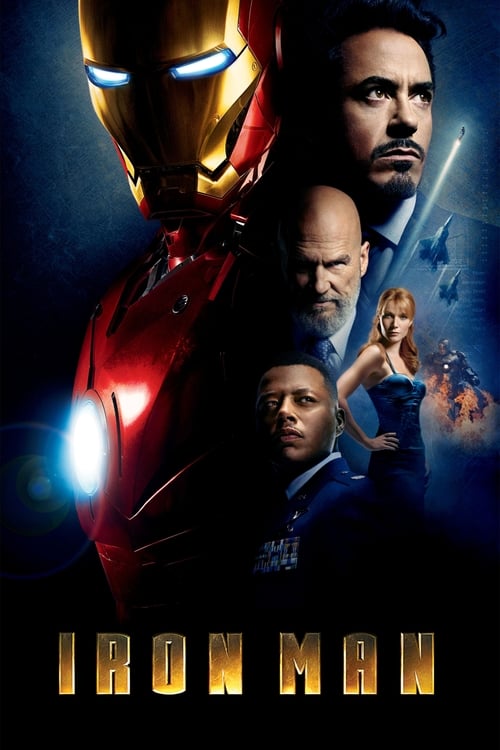
Iron Man (2008) is a superhero film adapted from Marvel Comics, directed by Jon Favreau and starring Robert Downey Jr. and Gwyneth Paltrow. The film is part of the MCU and was released by Marvel Studios. Runtime: 2h 6m. Rated PG-13. Audience rating: 7.9/10.
What is Iron Man (2008) about?
Billionaire weapons manufacturer Tony Stark is captured by terrorists and builds a powered suit of armor to escape. He then uses the technology to become Iron Man, protector of the world.
Released in 2008, Iron Man was directed by Jon Favreau and produced under the Marvel Studios banner. The film occupies a significant place within the MCU — contributing to the ongoing narrative and mythology of that cinematic universe.
The film features lead performances from Robert Downey Jr., Gwyneth Paltrow, Jeff Bridges, among others, anchoring a story that adapts characters first brought to life in Marvel Comics. Its source material gives the film a foundation rooted in decades of published storytelling, which Favreau and the creative team interpret through a cinematic lens.
With an audience rating of 7.9, Iron Man is generally praised as a strong entry in the superhero genre — its strengths in storytelling, performance, and production design regularly cited by viewers.
What happens in Iron Man (2008)? — Full Plot
Tony Stark is the most arrogant arms dealer alive — and we open the film with him riding in a U.S. military Humvee through Kunar Province, Afghanistan, sipping scotch, cracking jokes at soldiers half his age. He's just demoed his new Jericho missile system to the brass. He's untouchable. And then a mortar shell hits the convoy, his bodyguards die in seconds, and a shrapnel-loaded Stark Industries-branded explosive lodges itself in his chest. Cut to: him waking up in a cave, a car battery wired to his sternum, filming a hostage video at gunpoint. That's the first ten minutes. Welcome to the MCU.
The cave is run by a terrorist group called the Ten Rings, led by a man named Raza. A captured surgeon named Yinsen has kept Tony alive by jamming an electromagnet over the shrapnel — anything else and the metal reaches Tony's heart. The Ten Rings want him to build them a working Jericho missile. Tony agrees in front of the cameras, then quietly tells Yinsen he has no intention of doing that. Yinsen, who has lost his entire family to people exactly like Tony's clients, looks at him and asks: this is your life now, billionaire — what are you actually going to do with it? Tony decides, on the spot, to build something else.
Tony spends weeks pretending to build the Jericho while actually constructing two things: a miniature arc reactor to replace the car battery in his chest, and a suit of armor. Yinsen helps him with both. When the Ten Rings figure out the deception and storm the workshop, Yinsen takes the heat — literally drawing the gunmen down a corridor with a stolen rifle — to buy Tony the ninety seconds his suit needs to boot up. Before he dies, Yinsen tells Tony: don't waste this. Don't waste your life. Tony, in a hulking gray practical-effects suit straight out of a Saturday morning cartoon, walks out of the cave on fire, kills everyone, and burns the Ten Rings' weapon stockpile before flying away.
U.S. forces, including Tony's military-attaché best friend Lt. Colonel James 'Rhodey' Rhodes (Terrence Howard), find him in the desert and bring him home. Tony walks off the plane at the Edwards Air Force Base tarmac, gets in his car, demands an American cheeseburger, and within the hour holds an unscheduled press conference where he announces — flat, no PR spin — that Stark Industries will shut down its weapons business effective immediately. The room erupts. Stocks crash. His board panics. His longtime father-figure and second-in-command Obadiah Stane (Jeff Bridges, bald and bearded for the role) publicly tells the press this is a post-traumatic episode and that the company is fine. Privately, Stane is already plotting.
Tony retreats to his Malibu cliffside mansion, a slick glass-and-concrete bachelor pad with an AI assistant named J.A.R.V.I.S., and starts iterating. He builds the Mark II — sleek silver, flight-capable, but it ices over at altitude and nearly kills him on the first test flight. He learns. The Mark III adds a gold-titanium alloy and gets the iconic red-and-gold paint job. Tony tests it by flying to a remote village in Gulmira, Afghanistan, where the Ten Rings are using stolen Stark Industries weapons to massacre civilians. He stops it. Two F-22 fighter jets are scrambled to investigate; Rhodey, watching from the Pentagon, recognizes the new flying object on radar and lies through his teeth to protect Tony. The moment Rhodey says 'next time, baby' while staring at a spare prototype suit is one of the most-clipped scenes on YouTube. Yes, that was the War Machine setup.
Tony's executive assistant Pepper Potts (Gwyneth Paltrow), who has been managing his daily collapse with terrified patience, discovers what he's actually doing at night. Together they uncover the real betrayal: Obadiah Stane has been double-dealing Stark Industries weapons to the Ten Rings — including the original deal that put Tony in the cave. Stane has already retrieved the Mark I wreckage from the desert and is reverse-engineering it into a much bigger, brutal exoskeleton he calls the Iron Monger. He confronts Tony in his own home, paralyzes him with a sonic implant, and rips the miniaturized arc reactor out of his chest — leaving him to die slowly as the shrapnel begins migrating toward his heart again.
Tony, gasping, drags himself across his workshop floor and finds the original cave-built arc reactor — Pepper had kept it as a sentimental gift, mounted in a glass case engraved with Proof that Tony Stark has a heart. He plugs it in, recovers, and suits up in the Mark III. Pepper, working with a SHIELD agent named Phil Coulson — the first appearance of the character who would anchor the entire early MCU — infiltrates Stark Industries headquarters to expose Stane. The final fight takes place on the rooftop of Stark Industries between two men in armored suits, and ends when Pepper overloads the building's massive ground-floor arc reactor. Stane and his Iron Monger plummet into the molten reactor pool. The next morning, SHIELD hands Tony a cover story to read to the press: Iron Man is a Stark-employed bodyguard, the Mark I in the desert was a prototype rescued from the wreckage, and Obadiah Stane died in a private plane crash. Tony nods, walks to the podium, takes one look at the cards, and tosses them.
And then there's the scene that changed cinema. Tony comes home in the dark, takes off his jacket, and notices a figure waiting in his living room. The figure stands up. Eyepatch. Long coat. Samuel L. Jackson. 'I'm here to talk to you about the Avenger Initiative.' Cut to black. End credits. Audiences in 2008 had never seen this — a post-credits scene that wasn't a blooper reel but a sequel teaser for a movie that didn't exist yet. Half the theater was already leaving. The half that stayed never forgot. Today, every superhero film has a post-credits scene. They have it because Iron Man did it first.
Iron Man cost $140 million to make and grossed $585 million globally. By Marvel's later standards, modest. By 2008 standards, an absolute statement of intent. It launched the franchise that would define the next two decades of cinema, made Robert Downey Jr. the highest-paid actor in Hollywood, and proved that you could build a forty-film interconnected universe out of a single ad-libbed line and a post-credits cameo. If you've watched any modern superhero film, any extended franchise, any Marvel-or-DC ensemble piece — it all started here. With one man in a cave, building a suit out of scrap metal, deciding to be someone better.
Who stars in Iron Man (2008)?
Find Iron Man (2008) on Amazon
Watch Iron Man on Prime Video, browse the original Marvel Comics source material, and discover Blu-rays, soundtracks, and related merchandise on Amazon.
As an Amazon Associate, I earn from qualifying purchases. Link clicks do not affect editorial coverage — see our disclaimer.
What are some facts about Iron Man (2008)?
Iron Man released in 2008, placing it within the 2000s era of comic book cinema — a decade that marked the modern superhero cinema revolution.
Directed by Jon Favreau, the film was produced by Marvel Studios and adapts source material from Marvel Comics.
The principal cast features Robert Downey Jr. and Gwyneth Paltrow, with key supporting roles played by Jeff Bridges, Terrence Howard.
The film belongs to MCU — the Marvel Cinematic Universe — the highest-grossing film franchise of all time.
Iron Man carries an audience rating of 7.9 — putting it in the solid-to-excellent tier of the genre.
The Marvel Comics source material for Iron Man has been in continuous publication for decades, giving filmmakers a rich well of storylines, character arcs, and iconography to draw upon.
Modern superhero films like this one use a mix of practical effects and digital VFX, with entire sequences often shot against volume walls or LED stages pioneered by shows like The Mandalorian.
Iron Man is catalogued on Movies on Comics among our collection of 164 comic book films spanning 48 years of cinema — from Richard Donner's 1978 Superman to the present day.
Easter Eggs & Hidden Details in Iron Man (2008)
Iron Man launched the entire MCU on the back of an improvised line at the press conference. Almost every visual choice in this film became franchise canon. Here are the deepest cuts.
Robert Downey Jr.'s final line at the press conference was not in the screenplay. The scripted ending had Tony Stark stick to the SHIELD cover story Phil Coulson handed him. Downey improvised the three-word reveal on the last take. Jon Favreau kept it. The line later bookended the entire MCU in Avengers: Endgame (2019).
Samuel L. Jackson appearing as Nick Fury at the end was filmed in secret on a single afternoon. The cameo established the post-credits-scene tradition for the entire genre. The 'Avenger Initiative' mention was Marvel Studios' first explicit shared-universe tease.
Stan Winston Studios built a fully-functional 90-pound Mark I armor that Robert Downey Jr. wore on set. Three identical practical units were constructed. The cave-escape sequence is mostly real-suit footage with minimal CGI. This decision became the franchise's early visual signature.
The terrorist organization that captures Tony — the Ten Rings — was a deliberate seed for Shang-Chi and the Legend of the Ten Rings (2021). Kevin Feige has confirmed in interviews that the connection was always planned.
Stan Lee's cameo at the Disney Hall charity gala has Tony Stark walking past him and calling him 'Hef,' mistaking the comic-book legend for Hugh Hefner. The cameo was filmed in a single take.
Jeff Bridges shaved his head and grew a full beard specifically for Obadiah Stane. He has said in interviews that he based the character's intimidation on real arms-industry executives he had researched.
The cave-built arc reactor that Pepper mounts in glass with the engraving 'Proof that Tony Stark has a heart' returns in Iron Man 3 (2013) as the device that saves Tony's life again. The same physical prop was reused.
Jon Favreau chose Black Sabbath's 'Iron Man' for the closing credits despite the song having no actual lyrical connection to the comic-book character. The licensing was one of the production's largest individual costs. The needle-drop set the franchise's music-driven identity.
The brief photo references to Howard Stark — Tony's father — laid the groundwork for the Howard Stark arc that paid off across Iron Man 2 (2010), Captain America: The First Avenger (2011), and Civil War (2016).
Production notes have confirmed that Justin Hammer (introduced in Iron Man 2) was originally supposed to be hinted at in Iron Man (2008) through a brief news-clipping reference. The reference was cut for pacing but remained in early test screenings.
Howard Stark's 1974 Stark Expo blueprints — visible briefly in the basement scene — are deliberately designed to evoke the 1964 New York World's Fair. The reference becomes structural in Iron Man 2 (2010) where the new element synthesis recreates the original Expo aesthetic.
Pepper Potts has been Tony Stark's secretary in the comics since Tales of Suspense #45 (1963). Her name in the comics is also Virginia 'Pepper' Potts. The film's choice to make Pepper a viable romantic interest — rather than just an administrative assistant — was a deliberate creative update for modern audiences.




💬 Reader Comments