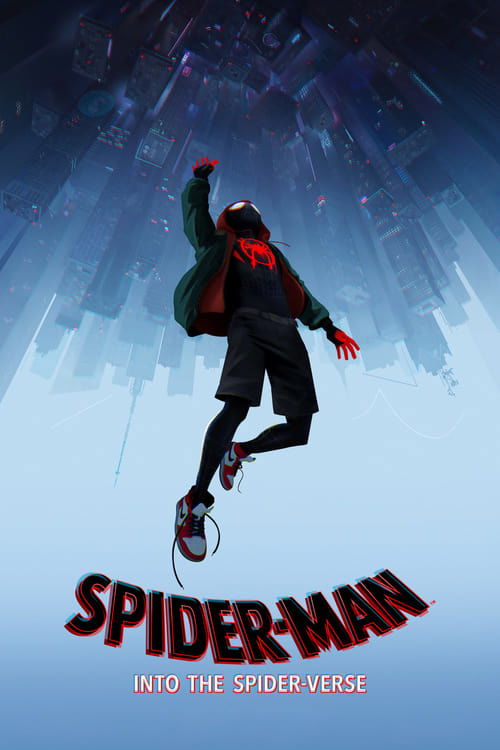
Spider-Man: Into the Spider-Verse (2018) is a superhero film adapted from Marvel Comics, directed by Bob Persichetti, Peter Ramsey, Rodney Rothman and starring Shameik Moore and Jake Johnson. The film is part of the Sony Spider-Verse and was released by Sony Pictures. Runtime: 1h 57m. Rated PG. Audience rating: 8.4/10.
What is Spider-Man: Into the Spider-Verse (2018) about?
Teen Miles Morales becomes the Spider-Man of his universe and must team up with five other Spider-People across the multiverse to stop a threat that imperils all dimensions.
Released in 2018, Spider-Man: Into the Spider-Verse was directed by Bob Persichetti, Peter Ramsey, Rodney Rothman and produced under the Sony Pictures banner. The film occupies a significant place within the Sony Spider-Verse — contributing to the ongoing narrative and mythology of that cinematic universe.
The film features lead performances from Shameik Moore, Jake Johnson, Hailee Steinfeld, among others, anchoring a story that adapts characters first brought to life in Marvel Comics. Its source material gives the film a foundation rooted in decades of published storytelling, which Rothman and the creative team interpret through a cinematic lens.
With an audience rating of 8.4, Spider-Man: Into the Spider-Verse is generally praised as a strong entry in the superhero genre — its strengths in storytelling, performance, and production design regularly cited by viewers.
What happens in Spider-Man: Into the Spider-Verse (2018)? — Full Plot
Brooklyn, present day. Earth-1610 — the Ultimate Marvel comics universe. Peter Parker (Chris Pine) is the resident Spider-Man of his Earth and has been for ten years. The opening montage is the most-stylized Spider-Man origin in cinema — sketched 2D panels of every Peter Parker beat the audience has seen across the previous decade of Spider-Man films, all collapsed into a single thirty-second narrated speed-run. Peter is in his late twenties. He has Mary Jane Watson as his wife. He has fully-public Spider-Man fame in his universe. He's the standard-bearer of his Earth's superhero life. The film's first sequence introduces him as a confident, blond, athletic Spider-Man — exactly the version the audience knows from the comics. Then the film cuts away from Peter, and Peter Parker dies on Earth-1610 within ten minutes.
Miles Morales. Brooklyn middle-school student Miles Morales (Shameik Moore), age fourteen, Afro-Latino, attending Visions Academy — an elite Manhattan boarding school he was assigned to via a state scholarship that his father Jefferson Davis (Brian Tyree Henry, doing voice work) insisted he attend. Miles is unhappy at Visions Academy. He's been raised in Brooklyn by his Black father Jeff (a Brooklyn NYPD officer) and Puerto Rican mother Rio Morales (Luna Lauren Velez). He doesn't fit at the elite academy. He misses Brooklyn. His uncle Aaron Davis (Mahershala Ali, who'd just won the Best Supporting Actor Oscar for Moonlight the year before), Jeff's estranged brother, lives in a Brooklyn high-rise apartment and lets Miles crash on weekends.
Aaron and Miles. Aaron picks Miles up from Visions Academy on a Friday afternoon and takes him to an abandoned NYC subway station — the old underused IRT Brooklyn tunnel below Sutter Avenue — to spray-paint graffiti together. Aaron has been Miles's secret cool-uncle for years. He's been encouraging Miles's artistic side. Miles paints a vivid streetwise mural. Aaron and Miles laugh. Then a small black-and-yellow radioactive spider — the Earth-42 spider that bit Miles's parallel-universe counterpart — drops onto Miles's hand and bites him. Miles doesn't notice for a few hours. He spends the night at Aaron's apartment.
Powers. Miles wakes up the next morning with abilities he doesn't understand. His hand stuck to his bedroom wall when he tried to push off it. He's grown a half-inch overnight. His school uniform doesn't fit. He's seeing static-electric energy at the corners of his eyes. He has been telepathically scanning everyone's emotional state. He has Spider-Man-style abilities — wall-crawling, super-reflexes, super-strength, and (uniquely) Venom Strike electrical-shock through his hands. He has also developed an ability his Peter Parker never had — temporary cloaking (he can turn invisible at will). He's terrified. He searches Google for "radioactive spider symptoms," finds an article about Peter Parker's career, and realizes he's the next Spider-Man.
Kingpin's collider. That night, Miles returns to the abandoned subway tunnel to find the spider that bit him. He doesn't find it. He does find — at the deepest level of the tunnel system — Kingpin Wilson Fisk's secret laboratory. Fisk (Liev Schreiber, in voice work) is Earth-1610's primary crime boss. He has been quietly building a massive Tesla-coil-style multi-dimensional collider beneath Brooklyn for years. The collider is meant to open a dimensional aperture to Earth-1610's parallel realities so that Fisk can retrieve his wife and son from an alternate universe where they didn't die in a car accident two years ago. The collider is illegal, unstable, and would likely tear apart Brooklyn (and possibly the entire Earth-1610 universe) if it fired.
Peter's death. Miles is in the tunnel watching the collider operate. Spider-Man — Earth-1610's Peter Parker — arrives at the lab to destroy the collider. Spider-Man, in his blue-and-red suit, recognizes Miles immediately as a fellow spider-bitten metahuman and adopts him as a junior sidekick. He hands Miles a USB drive containing the collider's shut-down code. Then Fisk arrives. Fisk and his enforcers — including the Green Goblin (an Ultimate-Marvel version, with massive monstrous proportions) and a fast-running technological villain called the Prowler — corner Spider-Man. The collider activates. Spider-Man and Green Goblin fight on the collider's exterior. The collider's first firing pulls dozens of versions of Spider-Man from across the multiverse into Earth-1610. Fisk crushes Spider-Man with a massive blow. Peter Parker dies on the lab floor with Miles watching from a hidden ventilation grate.
Miles goes home. Miles, terrified, escapes the collider lab with the USB shutdown drive. He returns to Aaron's apartment and confesses everything — that he's been bitten by a radioactive spider, that he just watched Peter Parker die, that he has the USB drive that could destroy Kingpin's collider. Aaron, who is hiding a secret of his own, says nothing about his Prowler identity. He drops Miles back at Visions Academy the next morning.
Peter B. Parker. The next day, Miles is at a Spider-Man memorial service in Times Square — the city is mourning the local Spider-Man's death. Miles, in his civilian clothes, walks past the memorial. Then a thirty-eight-year-old, balding, beer-bellied, divorced version of Peter Parker (Jake Johnson) — Earth-616's Spider-Man, pulled from his own reality into Earth-1610 by the collider's first firing — wanders into the memorial drunk and looking for a sandwich. This Peter B. Parker is the schlubby older Spider-Man we never see in mainstream comics. He's been Spider-Man for twenty-two years. He recently divorced Mary Jane. His back hurts. His knees crack when he web-swings. He's tired. He doesn't want to be a mentor. Miles, who can sense Spider-Man-DNA-resonance, recognizes him immediately. "Peter Parker. You're Peter Parker. Holy crap, I just watched you die." Peter B. Parker, dirty-haired and depressed, agrees to help Miles destroy the collider in exchange for getting Peter B. back to his home universe.
Training. Peter B. takes Miles to the abandoned subway lab to retrieve original-Peter's USB drive — they need its specific resonance signature to use the collider to send Peter B. home. The drive has been kept by Mary Jane Watson (Stan Lee cameo as a costume-shop owner). Peter B. trains Miles in the basics. The training montage is the film's most-charming sequence — Peter B. teaching Miles how to web-swing, how to use his Venom Strike, how to commit to leaping from skyscrapers. Miles is clumsy. He keeps falling. Peter B. is patient.
Other Spider-People arrive. Then the collider's second firing pulls additional spider-people into Earth-1610 — Gwen Stacy of Earth-65 (Hailee Steinfeld), the Spider-Gwen in white-and-pink costume; Peni Parker of Earth-14512 (Kimiko Glenn), a Japanese-anime-style fourteen-year-old in a giant mecha called SP//dr; Spider-Man Noir of Earth-90214 (Nicolas Cage), a 1930s-pulp-detective Spider-Man in monochrome black-and-white inked colors; and Spider-Ham of Earth-8311 (John Mulaney), a literal cartoon-pig version of Spider-Man called Peter Porker. All five spider-people meet in Aunt May's house and decide to coordinate.
The Prowler is Aaron. While Miles is recruiting his uncle Aaron for support, Aaron reveals his secret identity — he is the Prowler, a top-tier Kingpin enforcer who has been working for Wilson Fisk for ten years. Aaron has been Miles's uncle by day and Kingpin's hitman by night. He had been at Peter Parker's death. He had not known Miles was the new Spider-Man. He realizes the truth and refuses to harm his nephew. He defects from Kingpin's organization. Kingpin sends Tombstone to execute Aaron in an alley. Aaron dies in Miles's arms. The Prowler subplot — and Mahershala Ali's voice-performance — gives the film its most-emotional beat. Miles's foster-father-figure Aaron Davis dies as a redemption arc.
The leap of faith. Miles, devastated, can't seem to use his Spider-Man powers consistently. He keeps falling. He keeps getting his web-shooter angles wrong. He's been Spider-Man for two days and watched two Peter Parkers die in front of him. Peter B. Parker, in a quiet conversation in Miles's bedroom, tells him the secret all Spider-Men eventually learn: you don't choose when to leap. Your body knows when. "You'll know when you're ready." He hands Miles his own custom-painted black-and-red Spider-Man suit. Miles spray-paints his own version. He puts it on.
The skyscraper leap. Miles climbs to the top of a Manhattan skyscraper. He looks down. He leaps. He doesn't free-fall like before — this time, his body knows. He web-swings perfectly through the city. He twists in mid-air to fire a webline at a passing helicopter. He arcs across the Brooklyn Bridge in a swing that the film's animation team labors over for sixteen minutes of screen time. The Leap of Faith sequence is widely-cited as the most-influential animation moment in 2010s cinema. It's the moment Miles becomes Spider-Man.
Final battle. The collider's third firing — the major one — will both send Peter B., Spider-Gwen, Peni, Noir, and Spider-Ham back to their home universes AND destabilize Earth-1610 entirely. Kingpin plans to use it to pull his wife and son from a happier-alternate universe. Spider-Man, Peter B., Gwen, Peni, Noir, and Spider-Ham all infiltrate the collider lab. Miles uses his Venom Strike and his invisibility powers strategically. The fight is everyone vs. Kingpin's army — Tombstone, Doc Ock (a female version of Doc Ock in a lab coat, voiced by Kathryn Hahn), and finally Kingpin himself. Miles, alone, faces Kingpin in the collider's central chamber. He delivers a perfectly-aimed Venom Strike to Kingpin's face. Kingpin goes down. Miles inserts the USB drive into the collider's mainframe. The collider's power-cycle reverses. Peter B. Parker, Gwen, Peni, Noir, and Spider-Ham each get pulled back to their respective realities. The collider implodes. Earth-1610 is safe.
Goodbye. Miles is the only Spider-Man left in Earth-1610. He has fully accepted his identity. He swings across Brooklyn at sunset. His father Jeff — who has spent the entire film disapproving of vigilantes — finally has a quiet conversation with Miles on the front stoop. Jeff doesn't know Miles is Spider-Man, but he tells Miles he loves him no matter what. Miles, in his Spider-Man mask, hugs his dad. Cut to credits.
Coda. The film's after-credits sequence: Miguel O'Hara, the Spider-Man 2099 (Oscar Isaac, in voice work), in his red-and-blue 2099 costume, in a futuristic laboratory in Nueva York 2099. Miguel is wearing a wrist-mounted dimensional-jump device. He activates it. He travels back to a 1967 Earth where he meets the original 1967 animated Spider-Man cartoon version of Peter Parker. The two of them have a brief argument over which one of them is the real Spider-Man — the Sony comedic pinpoint to the iconic Spider-Man-points-at-Spider-Man meme. The post-credits scene closes with a giggle at the absurdity of the multiverse. Cut to credits.
Who stars in Spider-Man: Into the Spider-Verse (2018)?
Find Spider-Man: Into the Spider-Verse (2018) on Amazon
Watch Spider-Man: Into the Spider-Verse on Prime Video, browse the original Marvel Comics source material, and discover Blu-rays, soundtracks, and related merchandise on Amazon.
As an Amazon Associate, I earn from qualifying purchases. Link clicks do not affect editorial coverage — see our disclaimer.
What are some facts about Spider-Man: Into the Spider-Verse (2018)?
Spider-Man: Into the Spider-Verse released in 2018, placing it within the 2010s era of comic book cinema — a decade that saw superhero films become the dominant force at the global box office.
Directed by Bob Persichetti, Peter Ramsey, Rodney Rothman, the film was produced by Sony Pictures and adapts source material from Marvel Comics.
The principal cast features Shameik Moore and Jake Johnson, with key supporting roles played by Hailee Steinfeld, Mahershala Ali.
The film belongs to Sony Spider-Verse — Sony Pictures' Spider-Man adjacent film universe.
Spider-Man: Into the Spider-Verse carries an audience rating of 8.4 — a strong critical benchmark that few comic book films have achieved.
The Marvel Comics source material for Spider-Man: Into the Spider-Verse has been in continuous publication for decades, giving filmmakers a rich well of storylines, character arcs, and iconography to draw upon.
Modern superhero films like this one use a mix of practical effects and digital VFX, with entire sequences often shot against volume walls or LED stages pioneered by shows like The Mandalorian.
Spider-Man: Into the Spider-Verse is catalogued on Movies on Comics among our collection of 164 comic book films spanning 48 years of cinema — from Richard Donner's 1978 Superman to the present day.
Easter Eggs & Hidden Details in Spider-Man: Into the Spider-Verse (2018)
Phil Lord and Christopher Miller built the film around the idea that each Spider-Man character would visually exist in their own native art style. The result was six concurrent animation styles on screen — a technique no live-action Spider-Man film has been able to replicate.
Each Spider-Man character was rendered in their own native art style. Peter B. Parker uses classic Marvel realism; Spider-Gwen uses watercolor with anime-inflected linework; Spider-Man Noir uses 1930s black-and-white pulp comics; Peni Parker uses Japanese manga style; Spider-Ham uses Looney Tunes cel animation; Miles Morales uses graphic-novel halftone print dots. The studio invented new animation pipelines to make six styles coexist.
Stan Lee has a brief cameo as a comic-shop owner selling Miles a Spider-Man costume. 'It always fits — eventually.' It was Lee's final live-action Marvel cameo before his November 2018 death — released two months after he passed.
Into the Spider-Verse won the 2019 Academy Award for Best Animated Feature, defeating Pixar's Incredibles 2. It was the first Spider-Man film to win an Oscar in any category.
Miles Morales is animated at 12 frames per second (signaling his inexperience) while Spider-Gwen is at 24 fps (signaling her confidence). The technique was invented specifically for this film. It became widely cited as a key element of the film's storytelling.
Aaron Davis — Miles's uncle / Prowler — references Donald Glover's 2010s social-media campaign to play Spider-Man. The character was named specifically to honor Glover, who had publicly campaigned for the role years earlier. Glover eventually played a different Aaron Davis character in Spider-Man: Homecoming (2017).
Kathryn Hahn voices Olivia Octavius — Doc Octopus, here a female scientist. The character was the first female Doc Ock in any live-action or animated Spider-Man media. The redesign was a deliberate Lord & Miller creative choice.
The disheveled middle-aged Peter B. Parker's design — slight beard, sweatpants, divorced lifestyle — was a deliberate visual reference to the Peter Parker of the comics' 1990s 'Clone Saga' era. The reference was widely caught by hardcore comic fans.
Phil Lord and Christopher Miller — known for The Lego Movie (2014) and Cloudy with a Chance of Meatballs (2009) — produced and co-wrote the film. The visual approach was the result of their longstanding interest in subverting animation-genre conventions.
Miles's eventual leap from the highest building in his neighborhood — falling, then sticking to the wall mid-fall — became one of the most-referenced moments in modern animation. The scene's visual representation of confidence-as-falling-becoming-flying was widely cited.
Shameik Moore (Miles), Jake Johnson (Peter B), Hailee Steinfeld (Gwen), Nicolas Cage (Spider-Man Noir), Kimiko Glenn (Peni Parker), and John Mulaney (Spider-Ham) were each deliberately chosen for their character's tonal register. The voice casts have all returned for subsequent Spider-Verse films.


💬 Reader Comments