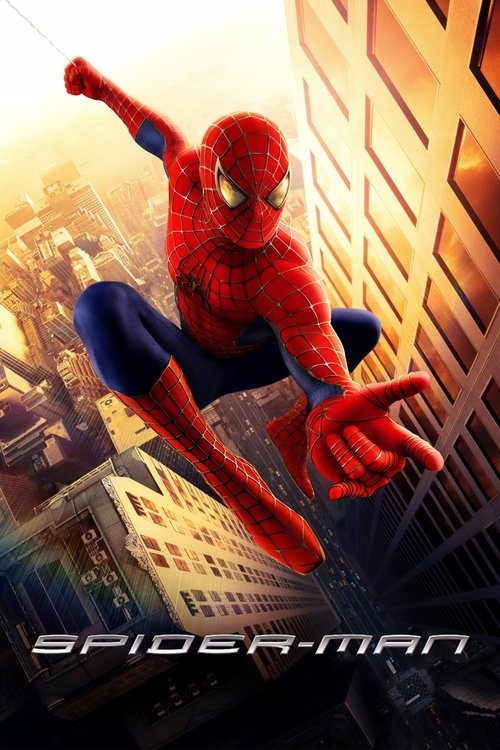
Spider-Man (2002) is a superhero film adapted from Marvel Comics, directed by Sam Raimi and starring Tobey Maguire and Kirsten Dunst. The film is part of the Sony Spider-Verse and was released by Sony Pictures. Runtime: 2h 1m. Rated PG-13. Audience rating: 7.4/10.
What is Spider-Man (2002) about?
Bitten by a genetically altered spider, nerdy high school student Peter Parker gains incredible powers and becomes Spider-Man, taking on his first great villain — the Green Goblin.
Released in 2002, Spider-Man was directed by Sam Raimi and produced under the Sony Pictures banner. The film occupies a significant place within the Sony Spider-Verse — contributing to the ongoing narrative and mythology of that cinematic universe.
The film features lead performances from Tobey Maguire, Kirsten Dunst, Willem Dafoe, among others, anchoring a story that adapts characters first brought to life in Marvel Comics. Its source material gives the film a foundation rooted in decades of published storytelling, which Raimi and the creative team interpret through a cinematic lens.
Its 7.4 rating reflects a film that divided audiences — appreciated for its ambition and spectacle by some, criticized for pacing and execution by others. Its place in the genre remains a frequent discussion point.
What happens in Spider-Man (2002)? — Full Plot
Queens, New York. Peter Parker — Tobey Maguire, brown hair flopping into his eyes, in a denim jacket and Converses, narrating in voice-over — sprints down a residential street trying to catch the school bus. He's a senior at Midtown High School. He lives with his Aunt May and Uncle Ben in a small two-story house in Forest Hills. The girl next door, Mary Jane Watson — Kirsten Dunst, red hair, half-shrugged sweater, the dream that every American teenager from 1962 to 2002 had at some point — waves at him from her own front porch and gets on the bus with him. They sit four rows apart. Peter draws her in his notebook on the way to school. His best friend Harry Osborn — James Franco, the rich kid, the son of Norman Osborn the CEO of OsCorp — is in the same class. Today the class is on a field trip to Columbia University's Department of Genetic Research.
Columbia's lab is a wall of glass terrariums housing genetically-engineered hybrid spiders. There are fifteen test specimens. The grad student lecturing the class can identify exactly fourteen of them. Peter is leaning into the glass, taking photographs for the school newspaper, when a spider — the missing fifteenth — drops down from the ceiling onto his hand and bites the back of his wrist between the knuckles. Peter doesn't notice for the next forty minutes. He gets home that evening, sees the swollen red welt, feels nauseous, and goes to bed. He spends the night sweating through his sheets in a fever dream while his body rewrites every cell of his DNA at the genetic level. He wakes up in the morning twenty pounds heavier, with perfect vision (he wears glasses no more), six-pack abs, and forearm strength that lets him crush his alarm clock into dust by shutting it off too hard.
Midtown High the next day. Peter walks into the cafeteria in a daze. Flash Thompson, the school bully, slams his shoulder into Peter's back to provoke a fight. Peter dodges him at the speed of a fly. Mary Jane Watson, in front of him in the lunch line, trips on the floor with her lunch tray. Without thinking, Peter catches the tray, her milk carton, her plate, her juice, and her cup of mac-and-cheese — all in mid-air, in one fluid motion, with his eyes closed. The whole cafeteria stops. He hands the tray back to her. "How'd you do that?" Peter doesn't know. He walks to his next class in a fog. By the third period, he's discovering his fingertips stick to walls when he wants them to. By gym class, he can climb the rope to the ceiling with one hand. By the end of school, in an alley fight with Flash he doesn't want, Peter dodges every punch in slow motion and accidentally launches Flash twenty feet across the hallway with one open-handed slap.
He runs out of school. He spends the afternoon climbing a brick wall, swinging through alleys on web-fluid that shoots from a fleshy spinneret-organ in each wrist (Raimi's organic web-shooters, unique to this trilogy — unlike the mechanical-shooters of the comics), and figuring out that the spider has rewired him into a human-arachnid hybrid. He needs money. He has a Polaroid camera. He has the body of a stuntman. He decides to enter an underground cage-fighting tournament in Brooklyn to win a $3,000 first-prize purse he can use to buy a beat-up car to impress Mary Jane.
Meanwhile across town. Norman Osborn — Willem Dafoe, in a $3,000 suit, demanding immediate results from OsCorp's research-and-development division — has been ordered by the U.S. Department of Defense to prove his experimental Goblin-serum can enhance a human subject's strength and stamina by 800 percent within six weeks or the military contract goes to OsCorp's competitor. Norman, desperate, locks himself in OsCorp's containment chamber and personally injects the green vaporiz formula. He convulses for thirty seconds and goes catatonic. The next morning he wakes up in his own private hospital room appearing fully recovered. His head scientist Dr. Stromm enters to check on him. Norman, in a rage trance, snaps Stromm's neck. He walks out of OsCorp wearing the OsCorp military prototype — a green-and-purple armored exoskeleton glider-suit that has been waiting in containment, fully outfitted with razor-edged glider blades, pumpkin grenades, and a fanged purple mask. The next morning a Defense Department review board is meeting at the Brooklyn waterfront to award the contract to OsCorp's rival. Norman, as the Green Goblin, flies onto the Brooklyn rooftop, kills the review board with pumpkin grenades, and disappears into the sky.
Peter, meanwhile, is in the cage-match locker room with $3,000 of prize money waiting to be paid to him by the promoter. The promoter stiffs him — pays $100 only and disappears with the cash. Peter walks out furious into the lobby. A burglar enters from the side, holds the promoter at gunpoint, robs the cash from the promoter's safe, and runs out past Peter — who could have stopped him with a single web. Peter lets the burglar pass because the promoter just screwed him. The promoter, on the floor with the empty safe, accusing Peter of complicity. Peter walks out indignantly. "I missed the part where that's my problem."
Outside on the sidewalk. Uncle Ben — Cliff Robertson, gentle, slow-spoken, the only father figure Peter has ever had — has been waiting in his old Oldsmobile to give Peter a ride home after the match. Peter walks toward the car. He passes the same burglar from the lobby running for a beat-up Chevrolet at the curb, opening the car door. As Peter approaches Uncle Ben's car, the burglar pulls a gun and demands the car keys from Ben. Ben refuses. The burglar shoots him. Ben falls onto the pavement. The burglar runs. Peter catches up to him moments later three blocks away in an abandoned warehouse. They fight. Peter pulls the burglar's mask off. He recognizes him as the same burglar from the lobby — the burglar Peter let walk past him minutes earlier. The burglar, panicking, runs backwards onto a windowsill. He misses his footing. He falls four stories to his death on the warehouse floor. Peter looks at the corpse. He looks at his own webbed wrist. He understands.
He cradles Uncle Ben in the alley for the few seconds the man has left. Ben — bleeding out — squeezes his nephew's hand. "Peter. There's something I haven't told you. With great power… comes great responsibility." Ben dies. Peter screams. He buries himself in the funeral that follows. He doesn't tell Aunt May who the killer was. He doesn't tell anyone what he is. He spends the next three months in his bedroom designing the Spider-Man costume — red mask, blue body, web pattern stenciled in red marker over the chest and arms, all hand-sewn by Peter on his mother's sewing machine. He starts patrolling Queens. He becomes a local urban legend.
He gets a job. Peter convinces J. Jonah Jameson, editor of the Daily Bugle newspaper, to hire him as a freelance photographer. The hook: Peter is the only person in Manhattan who can reliably get clear photographs of Spider-Man in action (because Peter is Spider-Man and is setting up the shots with a tripod-mounted camera in his backpack before the action starts). Jameson — JK Simmons, throat permanently in a yell, cigar always lit — initially hates Peter, but starts buying his Spider-Man photos at $50 each for the front page. Peter has rent money now. He moves out of Aunt May's house and into a Lower East Side walkup with Harry Osborn as a roommate. Harry is now dating Mary Jane Watson. Peter is now in love with Mary Jane Watson. Norman Osborn is now obsessed with Spider-Man as a threat.
The Green Goblin's escalation. Norman has been alternating between his Norman-self and his Goblin-self, sometimes blacking out as one and waking up as the other. He hijacks the Unity Day Festival in Times Square — a parade of OsCorp board members in a publicity float celebrating Norman's recovery — and bombs the parade reviewing stand from his glider. The Goblin's pumpkin grenades fry every OsCorp board member instantly. Spider-Man arrives mid-attack, catches a falling MJ from a balcony, fights the Goblin in midair through the canyon of Times Square. The Goblin escapes. The newspapers next morning blame Spider-Man for the attack. Aunt May is wounded in a separate Goblin home-invasion attack on Peter's apartment a week later. Peter's secret identity is on the verge of compromise.
Queensboro Bridge climax. The Goblin kidnaps Mary Jane from her waitressing job and chains a Roosevelt Island tram full of schoolchildren to the top of the bridge. He flies over the bridge holding MJ in one arm and the tram cable in the other. He gives Spider-Man a choice: save Mary Jane, OR save the tram of schoolchildren. He drops both at the same moment. Spider-Man dives. He catches MJ in one arm and the tram cable in his other hand at the last second, anchored to a bridge cable by his ankle-web. He holds them both up by hand for thirty seconds while the Goblin pelts him with pumpkin grenades. A passing tugboat pulls into the bridge below him to receive the tram, which Spider-Man can finally release. Spider-Man pulls MJ up to the bridge tower. Civilians on the bridge pelt the Goblin with bricks and trash. "You mess with one of us, you mess with ALL of us!"
Final battle. The Goblin tags Spider-Man with a grappling line and yanks him off the bridge into an abandoned warehouse in Long Island City for one last private fight. They smash through walls. They smash through floors. Peter is beaten to a pulp. The Goblin, mid-monologue, removes his own mask to reveal Norman Osborn's face, panting and weeping at the same time, his split personality fully visible in real time. He begs Peter for forgiveness. Then the Goblin-self takes over and remote-summons his razor-edged glider from across the room with a remote control. The glider rockets toward Peter from behind to impale him. Peter, with his spider-sense triggered, dodges at the last possible second. The glider drives into Norman Osborn's torso instead, impaling him through the chest. He dies in Peter's arms. "Don't tell Harry. Don't tell my son. About this. About me." Peter agrees.
Peter — bleeding, in his mask, exhausted — carries Norman Osborn's body back to the Osborn mansion in the rain. He lays the body in Norman's study. Harry walks into the study, sees Spider-Man with his father's body, and assumes Spider-Man is the murderer. The hatred that drives Spider-Man 2 (2004) and Spider-Man 3 (2007)'s entire Harry-as-New-Goblin arc is planted in this single moment.
Funeral. Norman is buried under cloudy skies. Harry Osborn, in a black suit, kneels at the grave promising vengeance against Spider-Man. Peter, in the same black suit, stands quietly behind. After the burial, Mary Jane Watson walks Peter to the gates of the cemetery and tells him she's in love with him. "All the time, it's you. It's always been you." She kisses him. Peter, who has spent the whole film loving her from a distance, looks at her and tells her he can't love her back. Anyone he loves becomes a target. He turns and walks out of the cemetery alone. The final voiceover plays: "Whatever life holds in store for me, I will never forget these words: with great power, comes great responsibility. This is my gift. My curse. Who am I? I'm Spider-Man." He swings off into Manhattan as the credits roll. Danny Elfman's theme blares. The 21st century comic book movie is officially born.
Who stars in Spider-Man (2002)?
Find Spider-Man (2002) on Amazon
Watch Spider-Man on Prime Video, browse the original Marvel Comics source material, and discover Blu-rays, soundtracks, and related merchandise on Amazon.
As an Amazon Associate, I earn from qualifying purchases. Link clicks do not affect editorial coverage — see our disclaimer.
What are some facts about Spider-Man (2002)?
Spider-Man released in 2002, placing it within the 2000s era of comic book cinema — a decade that marked the modern superhero cinema revolution.
Directed by Sam Raimi, the film was produced by Sony Pictures and adapts source material from Marvel Comics.
The principal cast features Tobey Maguire and Kirsten Dunst, with key supporting roles played by Willem Dafoe, James Franco.
The film belongs to Sony Spider-Verse — Sony Pictures' Spider-Man adjacent film universe.
Spider-Man carries an audience rating of 7.4 — putting it in the solid-to-excellent tier of the genre.
The Marvel Comics source material for Spider-Man has been in continuous publication for decades, giving filmmakers a rich well of storylines, character arcs, and iconography to draw upon.
Films from this era combined practical stunts with the rising CGI industry — many sequences would be impossible with either technology alone.
Spider-Man is catalogued on Movies on Comics among our collection of 164 comic book films spanning 48 years of cinema — from Richard Donner's 1978 Superman to the present day.
Easter Eggs & Hidden Details in Spider-Man (2002)
Sam Raimi's 2002 Spider-Man invented the modern superhero blockbuster. Without this film, no MCU. The deep cuts include Stan Lee's reaction, the cancelled mechanical web-shooters, and the alternate ending that became No Way Home setup.
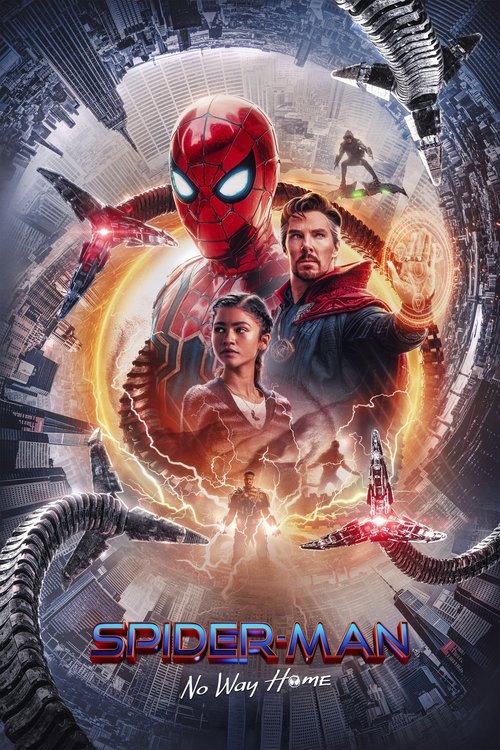
In the original Steve Ditko and Stan Lee comics, Peter Parker invents mechanical web-shooters. Sam Raimi changed this for the film, making Peter's webbing biological. The change was controversial with comic-book purists. No Way Home (2021) later acknowledged the change as an explicit multiversal-difference joke between Peters.
Uncle Ben's most-quoted line — 'With great power comes great responsibility' — comes from Stan Lee's actual narrator-voiceover at the end of Amazing Fantasy #15 (1962), the comic that introduced Spider-Man. Raimi's film made it cinematically iconic.
Tobey Maguire injured his back during the original film's production. The injury became chronic and was the primary reason Sam Raimi's planned Spider-Man 4 was eventually cancelled in 2010. Maguire's No Way Home (2021) back-pain joke directly references this history.
Jake Gyllenhaal was Sam Raimi's backup plan for Peter Parker after Maguire's back injury during pre-production. Gyllenhaal was on standby for two weeks before Maguire recovered. Seventeen years later, Gyllenhaal finally entered the Spider-Man franchise — as the villain Mysterio in Far From Home (2019).
J.K. Simmons's J. Jonah Jameson became one of the most-iconic supporting comic-book performances. Simmons later reprised the role in Spider-Man: Far From Home (2019) as a multiversal-canon character — the only actor to play the same comic-book character across two completely different cinematic universes.
Willem Dafoe's Goblin mask was a hand-sculpted prosthetic. Dafoe insisted on wearing it for his most-intense scenes rather than relying on CGI substitution. The mask design became one of the most-recognized comic-book villain visuals of the early 2000s.
Stan Lee cameos in the World Unity Festival sequence as a man saving a young girl from falling debris during the Green Goblin's attack. Lee yells 'Look out, miss!' and pushes her to safety. The cameo was filmed in a single take.
The wrestler Peter fights in the cage match — Bonesaw McGraw — was played by 'Macho Man' Randy Savage, a real WWE wrestler. Savage's casting was a Raimi creative choice; the wrestler had appeared in multiple horror films Raimi had worked on previously.
Cliff Robertson's Uncle Ben dies relatively quickly in the film but his death — and the lesson it teaches Peter — became the foundational emotional beat the entire franchise has worked from. Every Peter Parker in the multiverse traces back to Ben's death.
The film's original 2001 trailer prominently featured the Twin Towers as part of the Manhattan skyline. After 9/11, Sony quickly recut the trailer and digitally removed the towers. The official theatrical release also altered some Manhattan establishing shots.
💬 Reader Comments