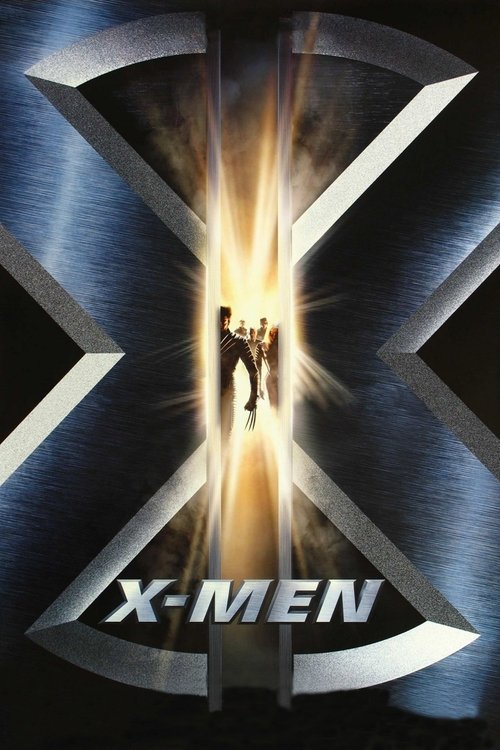
X-Men (2000) is a superhero film adapted from Marvel Comics, directed by Bryan Singer and starring Hugh Jackman and Patrick Stewart. The film is part of the X-Men Universe and was released by 20th Century Fox. Runtime: 1h 44m. Rated PG-13. Audience rating: 7.3/10.
What is X-Men (2000) about?
In a world where mutants exist, two groups clash: Professor Xavier's X-Men who seek peaceful coexistence, and Magneto's Brotherhood who fight for mutant supremacy.
Released in 2000, X-Men was directed by Bryan Singer and produced under the 20th Century Fox banner. The film occupies a significant place within the X-Men Universe — contributing to the ongoing narrative and mythology of that cinematic universe.
The film features lead performances from Hugh Jackman, Patrick Stewart, Ian McKellen, among others, anchoring a story that adapts characters first brought to life in Marvel Comics. Its source material gives the film a foundation rooted in decades of published storytelling, which Singer and the creative team interpret through a cinematic lens.
Its 7.3 rating reflects a film that divided audiences — appreciated for its ambition and spectacle by some, criticized for pacing and execution by others. Its place in the genre remains a frequent discussion point.
What happens in X-Men (2000)? — Full Plot
Auschwitz concentration camp, Poland, 1944. Rain on barbed wire. A thin Jewish boy of fifteen — Erik Lehnsherr, with hollow eyes and a yellow Star of David sewn to his coat — is being marched into the camp's selection-area gate, separated from his parents by SS guards. He reaches back through the chain-link gate trying to grab his mother's hand. The SS officer hauls him back. The boy's eyes go cold. The iron gate around him bends backward in a slow, anguished arc — the metal whining under stress that has no human source. Three guards rush him, beat him to the ground, and the gate snaps shut. The boy goes unconscious in the mud. The film's first scene is the moment Magneto's powers awaken in a Nazi death camp, and the audience knows everything they need to about why he believes what he believes for the next forty years.
Meridian, Mississippi, present day (2000). A teenage girl named Marie — Anna Paquin, brown hair with a white streak in front, freckled — is on her bed making out with her high-school boyfriend. He brushes her cheek with the back of his hand. She gasps. He goes into convulsions. He passes out on her bed and slips into a coma. The doctors at the local hospital have no idea what happened. Marie, on the phone with her parents, looks at her own hands in horror. She runs out of the house at midnight with a green army-surplus duffel bag, hitchhikes north, and adopts the alias "Rogue." She winds up six weeks later in Laughlin City, a logging-town bar in northern Alberta, Canada, freezing and out of money. She walks into the bar looking for a job and finds a cage match underway.
Inside the cage: Logan — Hugh Jackman, 6 feet 3, in his late thirties with mutton-chop sideburns — is fighting a 250-pound logger in a no-rules MMA exhibition for a $200 purse. Logan is the bouncer, the bartender, and the regular cage champion. Logger drops on him at full force; Logan absorbs three rib-cracking shots, then unleashes a single jaw-snapping uppercut and the logger goes down for the count. Logan walks away from the cage uninjured. The logger, in the locker room, hits Logan from behind with a Bowie knife. Logan barely flinches. Three foot-long claws of pure bone-and-metal slide out of the back of Logan's right hand. The logger sees them. He pisses himself and runs. Logan walks out into the parking lot. Marie has been watching from a stool in the corner. She hides in the back of Logan's Winnebago RV under a tarp.
Logan discovers her on the highway twenty miles later. He almost throws her out into the snow. She gives him the puppy-dog look. He sighs and keeps driving. A road sign passes. Then a black sedan with no headlights smashes them off the road. Sabretooth — Tyler Mane, seven-foot-tall, fur-faced, blond hair down to his waist — emerges from the wreckage and tries to kill Logan. They fight in the snow. Logan loses badly. Marie is about to be eaten. Then a tall Black woman with white hair — Storm, Halle Berry, in a tight black leather suit — descends from the sky on a column of weather and blasts Sabretooth with hail. A second mutant, Cyclops (James Marsden, in a red-visored sleek tactical visor), fires a force-beam from his eyes that knocks Sabretooth into the trees. Sabretooth flees. Storm and Cyclops introduce themselves as X-Men, members of Professor Charles Xavier's School for Gifted Youngsters in Westchester, New York. They invite Logan and Rogue to come back with them.
Westchester, New York. Xavier's School for Gifted Youngsters. A grand mansion converted to a mutant boarding school for a hundred students. Professor Charles Xavier — Patrick Stewart, in a wheelchair, bald, in a tweed jacket — runs the school as a sanctuary and a tactical-training center. The full X-Men team is here: Cyclops, Storm, Jean Gray (Famke Janssen, telekinetic and telepathic, currently dating Cyclops), and a basement of mutant tech including a Cerebro mind-amplification helmet that lets Xavier mentally locate any mutant anywhere in the world. Xavier has been tracking Logan for years — Logan was once a Canadian military experiment subject, his memory wiped, his skeleton injected with an unbreakable metal alloy called adamantium, his bone-claws coated in adamantium. Logan has no memory of his life before the experiment. He's been wandering for 17 years. Xavier offers to help him recover his memory.
Meanwhile, Magneto. Erik Lehnsherr — now Sir Ian McKellen, in his sixties, still very much alive and active — leads a rival mutant faction called the Brotherhood. Their philosophy: mutants are humanity's evolutionary successor, the natural enemy of Homo sapiens, and must dominate or destroy the human race before humans build death camps for mutants the way they built them for Magneto's people. His three lieutenants: Mystique (Rebecca Romijn, a shape-shifting blue-skinned mutant who can become anyone she's seen), Toad (Ray Park, the agile amphibian-mutant from Star Wars Episode One), and Sabretooth. Magneto has been a top-tier metal-manipulator since 1944 and his magnetic powers are immense — he can lift cars, bend bridges, throw I-beams the size of subway cars.
Senate hearings. Senator Robert Kelly (Bruce Davison) has been pushing the Mutant Registration Act through Congress for two years — a bill that would force every mutant in the United States to register with the federal government with biometric identification. Magneto views this as the first step toward concentration camps. Xavier views it as the wrong approach but ultimately preferable to violence. Jean Gray testifies before the Senate against the bill. "We are not the threat. We are the same as everyone else." Kelly mocks her. The vote is set for the following week.
Magneto kidnaps Senator Kelly at the train station. He brings Kelly to his island fortress on Genosha. Magneto activates a machine he has been building for years — a giant electromagnetic-pulse device that channels human DNA into mutant DNA using the operator's own life-energy as fuel. He uses the machine to force-mutate Senator Kelly. The senator emerges from the chamber visibly different — slick, gelatinous, his body transformed into an unstable liquid-flesh state. He's a mutant now, against his will, and he is dying because his body cannot maintain the mutation. Magneto's plan: capture every world leader at a UN summit currently happening on Ellis Island and forcibly mutate them all, creating a generation of human-to-mutant leaders who will protect mutant rights forever.
Cerebro. Xavier uses Cerebro to track down Kelly's transformed body and brings him to the mansion's medical bay. Jean Gray examines Kelly while he liquefies in real time. Kelly tells Xavier about Magneto's machine and his plan. Then Kelly dissolves into a pool of fluid on the hospital bed. The X-Men understand the stakes. Magneto needs a much more powerful mutant to charge his machine for the UN attack. He cannot use himself directly — the machine would kill him. He's going to use Rogue.
Mystique infiltrates the school. She disguises herself as Bobby Drake (Iceman, a teenage student at the school) and convinces Rogue that Xavier sees her as a liability. Rogue runs away from the school at midnight. She catches a Grand Central train heading north. Mystique-as-Bobby has tagged Rogue with a tracking device. Magneto and the Brotherhood ambush her at the train station, fight the X-Men who come to rescue her, and kidnap Rogue. They take her to Magneto's machine atop the Statue of Liberty (the new machine has been transferred to the Statue's torch as a more politically symbolic location near the UN summit).
The Battle of Liberty Island. The X-Men assault the Statue of Liberty in a single nighttime set piece. Storm calls a hurricane down on the harbor. Cyclops blasts a Brotherhood guard off the rooftop. Jean Gray telepathically scans the machine's operation. Logan engages Sabretooth in the Statue's crown — they fight through the iron sculpture's inner gangways with claws and fangs. Sabretooth is knocked off the Statue and falls into the harbor. Storm fights Toad. Mystique fights Wolverine — she tries to seduce-and-stab him by impersonating Storm but Logan stabs her with adamantium claws when she gets too close. Magneto chains Rogue to the machine and the device begins activating — drawing Rogue's life force to power the EMP that will mutate everyone at the UN summit. Rogue starts to die.
Logan, fighting through the machine's defenses, reaches the torch. Magneto magnetically slams Logan against the railing and pins him with adamantium-attracted force. Cyclops blasts the machine. Jean Gray telekinetically holds the machine's pulse cycle in mid-fire. Logan, pinned, reaches across the machine with his claws and slices Rogue free of her bondage. He then presses her hand against his face — willingly transferring his own healing factor and life force into her body through her skin-touch absorption. He goes unconscious on the torch. Rogue absorbs Logan's regenerative powers and his metabolism, becoming temporarily superhuman. The machine shorts out. Magneto is captured.
Aftermath. Magneto is imprisoned by the federal government in a clear plastic cell designed to nullify his magnetic abilities — a polycarbonate box with no metal anywhere inside. Xavier visits him in prison and they play chess through the cell wall using a magnetic-free wooden board. Two old friends and ideological opponents settled into the long fight to come. Xavier: "Don't get too comfortable. I'll always be here." Magneto: "Why do you persist, Charles? I am your worst enemy." Xavier: "You're my friend." The two men nod across the chessboard.
At the mansion, Logan recovers from his injuries. Rogue, also recovered, is now a permanent student at the school. Logan, looking for answers about his past, has been given a clue by Xavier — a coordinate to a remote Canadian Air Force base called Alkali Lake where Logan's adamantium-injection experiments were performed in 1979. Logan packs his bike and rides north alone at dawn. He flirts with Jean Gray on his way out the door. He nods at Cyclops. He leaves the mansion. Cut to black. The Patrick Stewart-narrated voiceover closes the film: "Mutation. It is the key to our evolution. It is how we have evolved from a single-celled organism into the dominant species on the planet. This process is slow, normally taking thousands and thousands of years. But every few hundred millennia, evolution leaps forward." The X-Men franchise begins.
Who stars in X-Men (2000)?
Find X-Men (2000) on Amazon
Watch X-Men on Prime Video, browse the original Marvel Comics source material, and discover Blu-rays, soundtracks, and related merchandise on Amazon.
As an Amazon Associate, I earn from qualifying purchases. Link clicks do not affect editorial coverage — see our disclaimer.
What are some facts about X-Men (2000)?
X-Men released in 2000, placing it within the 2000s era of comic book cinema — a decade that marked the modern superhero cinema revolution.
Directed by Bryan Singer, the film was produced by 20th Century Fox and adapts source material from Marvel Comics.
The principal cast features Hugh Jackman and Patrick Stewart, with key supporting roles played by Ian McKellen, Halle Berry, Famke Janssen.
The film belongs to X-Men Universe — 20th Century Fox's X-Men film franchise, now absorbed into the MCU multiverse.
X-Men carries an audience rating of 7.3 — putting it in the solid-to-excellent tier of the genre.
The Marvel Comics source material for X-Men has been in continuous publication for decades, giving filmmakers a rich well of storylines, character arcs, and iconography to draw upon.
Films from this era combined practical stunts with the rising CGI industry — many sequences would be impossible with either technology alone.
X-Men is catalogued on Movies on Comics among our collection of 164 comic book films spanning 48 years of cinema — from Richard Donner's 1978 Superman to the present day.
Easter Eggs & Hidden Details in X-Men (2000)
Bryan Singer's 2000 X-Men is the film that established the modern 21st-century superhero blockbuster era. The deep cuts include Hugh Jackman's last-minute Wolverine casting and the deliberate spandex rejection.
Hugh Jackman was cast as Wolverine just weeks before filming began. Russell Crowe was the original choice but turned down the role to film Gladiator (2000). Bryan Singer was forced to recast at short notice. Jackman, an unknown Australian stage actor, was suggested by Crowe himself. The casting set up Jackman's 17-year Wolverine tenure across eight films.
Bryan Singer's decision to dress the X-Men in matching black leather instead of the comic-book yellow-and-blue uniforms was a deliberate departure from source material. Singer wanted the X-Men to look like a serious paramilitary organization. The line 'You go out in that?' in X-Men Origins: Wolverine (2009) directly references this decision.
X-Men (2000) was released two years before Sam Raimi's Spider-Man (2002). Singer's serious tonal approach influenced every subsequent superhero film — including Batman Begins (2005) and Raimi's Spider-Man. The film effectively launched the 21st-century superhero blockbuster era.
Patrick Stewart played Charles Xavier across X-Men (2000), X2 (2003), The Last Stand (2006), Days of Future Past (2014), and Logan (2017). He returned to the role in Multiverse of Madness (2022) after 22 years.
The opening sequence — young Erik Lehnsherr in Auschwitz, 1944 — established Magneto's Holocaust-survivor backstory. The choice was deliberate; Singer wanted to ground the X-Men's persecution metaphor in historical trauma.
Anna Paquin's Marie / Rogue — a Mississippi teen — was the franchise's first explicit teen-coming-of-age character. The choice was deliberate; Singer wanted to establish the X-Men school as a haven for misfit youth.
Halle Berry's Storm — the African weather-controlling mutant — was the franchise's first major Black superhero in cinema. Berry returned in three subsequent X-Men films across 14 years.
Magneto's planned use of the Statue of Liberty to convert humans into mutants was a deliberate immigration metaphor. The Statue's prominence in the film was Singer's commentary on America's mythological relationship with immigration and assimilation.
James Marsden's Cyclops visor was a real practical effect — a custom-built ruby-quartz device that diffused light through the actor's eyes. The visor was widely cited as the film's most-effective practical visual effect.
X-Men (2000) grossed $296 million globally on a $75 million budget — strong commercial success that established the franchise. The film's success directly enabled the next nine X-Men theatrical sequels through the 2010s.
💬 Reader Comments