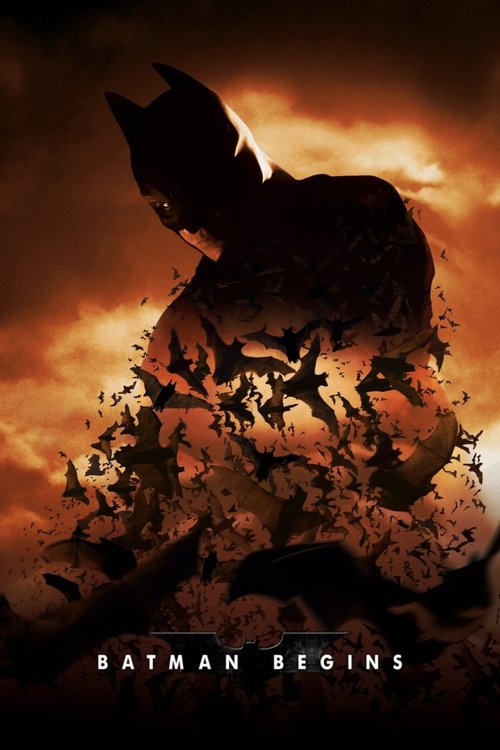
Batman Begins (2005) is a superhero film adapted from DC Comics, directed by Christopher Nolan and starring Christian Bale and Liam Neeson. The film is part of the DC Classic and was released by Warner Bros.. Runtime: 2h 20m. Rated PG-13. Audience rating: 8.2/10.
What is Batman Begins (2005) about?
After witnessing his parents' murder, Bruce Wayne travels the world seeking the means to fight injustice, returning to Gotham to become Batman — a symbol of hope against fear.
Released in 2005, Batman Begins was directed by Christopher Nolan and produced under the Warner Bros. banner. The film occupies a significant place within the DC Classic — contributing to the ongoing narrative and mythology of that cinematic universe.
The film features lead performances from Christian Bale, Liam Neeson, Michael Caine, among others, anchoring a story that adapts characters first brought to life in DC Comics. Its source material gives the film a foundation rooted in decades of published storytelling, which Nolan and the creative team interpret through a cinematic lens.
With an audience rating of 8.2, Batman Begins is generally praised as a strong entry in the superhero genre — its strengths in storytelling, performance, and production design regularly cited by viewers.
What happens in Batman Begins (2005)? — Full Plot
A snow-blanketed Bhutanese prison yard. Bruce Wayne — Christian Bale, beard, gaunt, in inmate-issue gray rags — fights six prisoners at once in a yard brawl over a small bowl of porridge. He's outnumbered. He wins. The guards drag him to solitary. We don't know his name yet. The voice-over narration explains that the man in the prison has been traveling the criminal underworlds of Asia for seven years, learning what makes criminals tick. He's been arrested for theft. He's twenty-eight years old. He's been waiting for someone specific to find him.
Flashback. Gotham City, twenty years earlier. Eight-year-old Bruce Wayne is playing in the garden of Wayne Manor with his childhood best friend Rachel Dawes. He falls through a covered-over wooden plank into an abandoned well shaft on the estate. He breaks his leg on the way down. Bats — a swarm of them — boil out of the cave at the bottom of the well and overwhelm him. His father Thomas Wayne rescues him on a rope and pulls him up. Bruce, traumatized, develops a permanent terror of bats that defines the rest of his life. Years later, eight-year-old Bruce and his parents leave an opera production of Mefistofele at the Monarch Theater. They take a shortcut through a back alley. A mugger named Joe Chill, a desperate methamphetamine-addled small-time criminal, demands Thomas Wayne's wallet at gunpoint. He shoots Thomas in the chest. Martha Wayne, in shock, screams for her son. Chill shoots her in the throat. Both Waynes die on the alley pavement next to their son. Bruce, holding his mother's pearl necklace, kneels in the alley until the police arrive. The pearls scatter on the wet asphalt.
Twelve years later. Joe Chill is paroled from prison having served his time. Bruce, now in his twenties at Princeton, drives back to Gotham to attend the parole hearing with a hidden pistol in his coat. He plans to murder Chill on the courthouse steps. Before Bruce can act, a hired mob assassin sent by Carmine Falcone — Gotham's reigning crime boss who wants Chill silent forever — kills Chill first. Bruce, sitting in his car with the unloaded pistol still in his hand, has just had his revenge taken from him by the criminal world. He drives directly from the courthouse to Falcone's bar, confronts the crime boss in his own back room, demands respect. Falcone tears him to pieces in a humiliation lecture. "You're nothing to people like me. You don't even know how good you've got it. I've got friends in every part of this city. We all do." He has Bruce thrown out into the harbor. Bruce, soaking wet, throws his expensive coat into a homeless man's dumpster fire and leaves Gotham that night with $40 in his pocket.
Seven years of wandering. Bruce travels through the criminal underworlds of Hong Kong, Mumbai, Lagos, Beijing, Bangkok, and Tangier — joining smuggling rings, drug operations, gun runners, learning what makes criminals tick from inside their world. He's arrested in Bhutan for stealing a Wayne Enterprises shipment as a deliberate provocation, hoping someone in the criminal underworld he's joined will notice him. In the Bhutan jail, a man named Henri Ducard — Liam Neeson, in a tactical greatcoat — visits him in solitary confinement. Ducard claims to represent a clandestine organization called the League of Shadows. He offers Bruce a singular education in martial arts, surveillance, psychological warfare, and (the League's specialty) the art of theatricality and deception. The League's purpose: to act as a counterweight to civilizations that grow corrupt past saving. Their leader is the immortal Ra's al Ghul. Bruce accepts the offer. Ducard pays his bail.
League of Shadows training. The Bhutan monastery — a hidden compound on a frozen mountain in the Himalayas — is where Bruce trains for two years. He fences with Ducard daily. He learns ninjutsu, psychology, smuggling, demolition. He overcomes his fear of bats by hallucinating through a hallucinogenic herb the League uses ritually. The man Bruce has been calling Henri Ducard the whole time is actually Ra's al Ghul himself — the immortal-implied founder of the League. The actual man Bruce thought was Ra's, sitting on a throne the whole time, is a decoy. Ra's, on Bruce's graduation night, tells him the League's next assignment: destroy Gotham City completely, because Gotham represents the modern world's most-decayed urban center and must be cleansed for civilization to continue. Bruce is to murder a captured local criminal — a man who killed his neighbor for an ox — as the final test before joining the League's hierarchy. Bruce refuses to kill the man. He throws the executioner's sword across the monastery hall. The League's masters move on him. Bruce ignites a barrel of incense oil he's been preparing in the room, the monastery catches fire, and in the chaos Bruce rescues the unconscious Ra's al Ghul (who he still thinks is just Ducard) from the burning compound and lays him in the snow before slipping away into the mountains. He carries Ra's al Ghul to safety. He leaves the League with the foundational training but none of the ideology.
Bruce returns to Gotham. The city has only gotten worse. Wayne Enterprises has been taken public; CEO William Earle is liquidating it for parts. Bruce's childhood friend Rachel Dawes is now an Assistant District Attorney trying to prosecute Carmine Falcone but failing because Falcone has half the judiciary on his payroll. The corrupt psychiatrist Dr. Jonathan Crane runs Arkham Asylum and has been certifying Falcone's enforcers as criminally insane to keep them out of Blackgate Prison. Crane — Cillian Murphy, soft-voiced, glasses, eyes like marbles — has been developing a hallucinogenic toxin he weaponizes by wearing a burlap-bag scarecrow mask to terrorize his victims. He calls himself the Scarecrow. He sells the toxin to Falcone's drug operation.
Bruce, back at Wayne Manor with Alfred Pennyworth — Michael Caine, the only family he has left — descends into the manor's basement. He finds the original Wayne family entry to the same bat-infested cave system he fell into as a child. The cave is enormous, full of bats roosting on the ceiling. Bruce stands there, in a dirt-floor sub-basement under his ancestral house, conquering his terror by sitting in the middle of the cave for three hours and letting the bats fly around him. The cave becomes his refuge. The bats become his motif.
Bruce visits Wayne Enterprises' Applied Sciences division — a forgotten Cold War-era basement weapons lab — where he meets Lucius Fox (Morgan Freeman), the demoted engineer who used to run the company's actual R&D before Earle politically marginalized him. Lucius has been sitting on a basement full of prototype military technology — a Kevlar-and-Nomex tactical bodysuit designed for the Pentagon and rejected for being too expensive, a grappling-line gun, a sound-disorientation device, and a six-wheeled bridge-jumping urban-warfare prototype vehicle called the Tumbler that Wayne Enterprises spent $300M on and never deployed. Bruce, posing as a hobby buyer, buys the entire basement at scrap-metal prices. He has Alfred order him 5,000 pieces of black bodyfabric. He has a Macau metallurgist forge him a Bat-shaped chest plate. He has a Singapore tailor design him a wing-shaped cape. In a three-week montage, he becomes Batman.
First night out. Batman emerges from the Gotham harbor wearing the matte-black armored body suit and a horned cowl. He intercepts a Falcone shipment of Scarecrow-toxin-laced narcotics arriving from Asia at the Gotham docks. He drops Falcone's entire smuggling crew — eighteen men — silently in three minutes. He hoists Falcone himself up by the ankles on a dock floodlight rope and leaves him hanging in the spotlight for the cops. Sergeant Jim Gordon — Gary Oldman, the only honest cop in Gotham's MCU, the Major Crimes Unit's last man standing — arrives at the dock to find Falcone, Falcone's crew, and a wall painted in spray-paint with a giant bat-shadow. Gordon's career has just gotten started.
Investigation. Batman tracks Falcone's poisoned-narcotics operation to the Narrows — Gotham's most-dilapidated borough where Arkham Asylum sits on Crane's domain. Crane has been arranging the toxin to be aerosolized into Gotham's drinking water through a giant Wayne Enterprises microwave-emitter prototype that he has stolen with the help of Ra's al Ghul's League of Shadows operatives who have followed Bruce home. The League has infiltrated Gotham. Crane, working for the League, was meant to be the toxin chemist; the microwave emitter is meant to vaporize the toxin from inside the city's water mains and trigger a citywide hallucinogenic fear-attack. Half of Gotham will tear itself apart in mass-psychotic episodes. The other half will succumb to the toxin. The League will then move in and finish what fear left standing.
Crane dose Bruce with the toxin in a confrontation at Arkham. Bruce hallucinates terror for the next twelve hours. Alfred recovers him from the Narrows and Lucius Fox synthesizes an antidote in his Wayne Enterprises lab. Bruce wakes up at Wayne Manor the next afternoon. Then on his thirtieth birthday party that night at the rebuilt Wayne Manor, Ra's al Ghul walks through the front doors with a half-dozen League warriors and tells the gathered Gotham elites that the League has returned. He confronts Bruce. "I told you. I am Ra's al Ghul." He sets fire to Wayne Manor. The structure burns. Bruce escapes through the cave. Alfred follows. They emerge in the underbasement bat cave, miles from the burning manor, in tactical gear, ready to fight.
The microwave emitter is loaded onto a Wayne Enterprises monorail train heading toward Wayne Tower at Union Station. Ra's al Ghul plans to vaporize the entire central Gotham water supply at peak hour and trigger the citywide panic. Batman, in the Tumbler — the prototype urban-combat vehicle from Lucius's basement, now painted matte black — chases the train through the Gotham streets. The Tumbler chase is the film's centerpiece set piece: Batman driving an urban tank on monorail tracks while the elevated train passes overhead, leaping between rooftops, smashing through a parking garage at fifty miles per hour, all to the most propulsive Hans Zimmer score moment in the trilogy. Gordon, on the police side, drives a stolen Tumbler-tank in pursuit. The Tumbler chases the train into the city center.
Batman boards the train at the Wayne Tower station and confronts Ra's al Ghul on the train's roof for the final fight. The fight is cleanly choreographed — Ra's's experienced ninjutsu against Bruce's improvised crime-fighting tactics. Bruce, pinned at one point, has to make a decision he's spent the entire film preparing for: he can either kill Ra's or save the train. Both at once. He chooses neither and both. He smashes the train's hydraulic system, stops the monorail above the Wayne Tower water-vaporization site, and exits through the side hatch leaving Ra's al Ghul trapped inside. "I won't kill you. But I don't have to save you." The train, derailed and on fire, crashes into Wayne Tower's water-pumping basement. Ra's al Ghul dies in the explosion. The toxin in the central reservoir burns off. Gotham is saved.
Aftermath. Rachel Dawes finds Bruce on the rebuilt-Wayne-Manor steps the morning after. She tells him she loves him as her childhood friend — but the man wearing the cowl is the real Bruce now, and that man can't have a normal life with her. She'll wait. He doesn't ask her to. Lucius Fox is promoted to Wayne Enterprises CEO; he handles the corporate side now. Alfred is rebuilding the manor. Sergeant Gordon is promoted to Lieutenant after the Wayne Tower incident and given a permanent place in the Gotham PD. He invites Batman onto the GCPD roof one night and shows him a brand-new device the department has installed — a giant spotlight with a Batman silhouette stenciled onto the front. The Bat-signal goes live. Batman has institutional recognition.
Gordon — looking down at Gotham from the rooftop — pulls a small evidence bag out of his coat. "I owe you the conversation. There's a guy. New criminal in the city. Calls himself the Joker." He flashes a small evidence card. It's a single playing card. The Joker. From the deck of cards. Hand-drawn smile and harlequin face. Cards left at three escalating crime scenes over the past month. Gordon: "He started with armed robbery. Bank job last week. He's working his way up. You'd better be ready." Batman: "I'll look into it." He swan-dives off the GCPD rooftop into the Gotham night, his cape catching the wind. Cut to credits.
Who stars in Batman Begins (2005)?
Find Batman Begins (2005) on Amazon
Watch Batman Begins on Prime Video, browse the original DC Comics source material, and discover Blu-rays, soundtracks, and related merchandise on Amazon.
As an Amazon Associate, I earn from qualifying purchases. Link clicks do not affect editorial coverage — see our disclaimer.
What are some facts about Batman Begins (2005)?
Batman Begins released in 2005, placing it within the 2000s era of comic book cinema — a decade that marked the modern superhero cinema revolution.
Directed by Christopher Nolan, the film was produced by Warner Bros. and adapts source material from DC Comics.
The principal cast features Christian Bale and Liam Neeson, with key supporting roles played by Michael Caine, Katie Holmes, Gary Oldman.
The film belongs to DC Classic — the classic DC film era — predating the connected-universe model.
Batman Begins carries an audience rating of 8.2 — a strong critical benchmark that few comic book films have achieved.
The DC Comics source material for Batman Begins has been in continuous publication for decades, giving filmmakers a rich well of storylines, character arcs, and iconography to draw upon.
Films from this era combined practical stunts with the rising CGI industry — many sequences would be impossible with either technology alone.
Batman Begins is catalogued on Movies on Comics among our collection of 164 comic book films spanning 48 years of cinema — from Richard Donner's 1978 Superman to the present day.
Easter Eggs & Hidden Details in Batman Begins (2005)
Christopher Nolan rebuilt Batman from the franchise rot of Batman & Robin (1997). The deep cuts include Cillian Murphy's failed Batman audition, the secret Ra's al Ghul reveal, and the modern-day relevance of the film's structural realism.
Cillian Murphy was a top finalist for the role of Bruce Wayne / Batman. Nolan chose Christian Bale. He was so impressed with Murphy's audition that he cast him as Dr. Jonathan Crane / Scarecrow instead — making the character a major franchise villain across all three Nolan films.
Liam Neeson was cast as Henri Ducard early in production. Nolan and screenwriter David Goyer kept the Ra's al Ghul reveal locked down through filming — many supporting cast didn't know the twist. The decoy Ra's (played by Ken Watanabe) was deliberately cast for audience misdirection.
The Tumbler — Nolan's military-grade armored vehicle — was a deliberate departure from the franchise's prior Batmobile designs. The vehicle was built around a real Humvee chassis with V8 engine. Multiple practical units were built for stunt redundancy.
Christian Bale gained approximately 30 pounds of muscle for Bruce Wayne. He had previously lost 63 pounds for The Machinist (2004) — a dramatic weight cycle that was widely cited as one of cinema's most-impressive single-year physical transformations.
Bruce's mountain-temple training sequences were filmed in Iceland, not Tibet. The location was chosen for the dramatic glacial cinematography and the practical inaccessibility of actual Tibetan monasteries during filming. The 'Tibetan' setting was implied through staging and dialogue.
Hans Zimmer and James Newton Howard composed the score, introducing the two-tone 'Batman' theme that would carry through The Dark Knight (2008) and The Dark Knight Rises (2012). The theme is built around just two notes alternating.
Gary Oldman's Lieutenant James Gordon became the franchise's first-ever multi-film Gordon arc. Previous Batman films had cast Gordon as a supporting role; Nolan made him Batman's true partner. Oldman's Gordon appeared across all three Nolan films.
Wayne Manor scenes were filmed at Mentmore Towers in Buckinghamshire, England. The location was chosen for its Victorian architecture matching the franchise's gothic aesthetic. The same property was used across all three Nolan films.
The film closes with Gordon handing Batman a card with the Joker's calling card on it. 'I've got a feeling. Things are escalating.' The setup directly led to The Dark Knight (2008)'s development.
Batman Begins was the first major Batman film since Batman & Robin (1997), a 16-year gap considered unusually long for a major comic-book franchise reboot. The gap was specifically because of the 1997 film's commercial and critical failure.
💬 Reader Comments