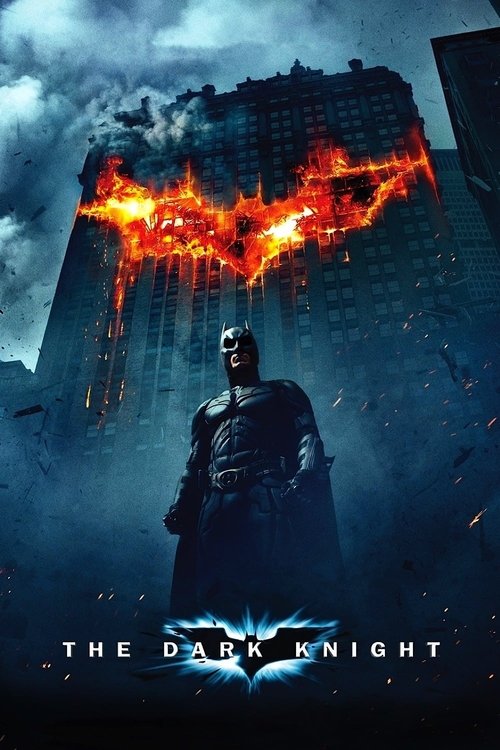
The Dark Knight (2008) is a superhero film adapted from DC Comics, directed by Christopher Nolan and starring Christian Bale and Heath Ledger. The film is part of the DC Classic and was released by Warner Bros.. Runtime: 2h 32m. Rated PG-13. Audience rating: 9.0/10.
What is The Dark Knight (2008) about?
With the Joker sowing chaos throughout Gotham, Batman and Commissioner Gordon must accept a corrupting alliance with District Attorney Harvey Dent to dismantle organized crime — at tremendous personal cost.
Released in 2008, The Dark Knight was directed by Christopher Nolan and produced under the Warner Bros. banner. The film occupies a significant place within the DC Classic — contributing to the ongoing narrative and mythology of that cinematic universe.
The film features lead performances from Christian Bale, Heath Ledger, Aaron Eckhart, among others, anchoring a story that adapts characters first brought to life in DC Comics. Its source material gives the film a foundation rooted in decades of published storytelling, which Nolan and the creative team interpret through a cinematic lens.
A critical and cultural benchmark within the genre, The Dark Knight is widely regarded as one of the finest comic book films of its era. Its 9.0 audience rating places it among the all-time classics of the medium.
What happens in The Dark Knight (2008)? — Full Plot
Opening sequence. Six masked men in pale clown faces hit the Gotham National Bank in broad daylight — IMAX wide-angle, no music, just the hum of the city outside the windows. The crew is split into roles by job: explosives, alarm, vault. The first thing they do once inside is shoot each other. Every man in the building has been promised the previous man's share — wait for the alarm, kill the alarm guy, take his cut. The bank manager — Hangmen-era William Fichtner — pulls a shotgun out from under his desk and unloads on three of them before they put him down. By the time the last clown standing is hauling the cash sack out the front door, he's a single man — the Joker, in white grease paint, smearing the rest of his face into a smile-shaped scar with his thumb as he walks out into the morning. Cash in a yellow school bus. School bus pulls into a line of school buses. Joker drives off. He never names himself. The audience hasn't even seen the title card yet.
Gotham, several months into Batman's career. Bruce Wayne, exhausted under the cowl, is working with Lt. Jim Gordon and a new DA named Harvey Dent on a long-game prosecution of every made man in Gotham — a single RICO case that could decapitate the mob in a single afternoon if the books can be subpoenaed. The books are with Lau, the mob's Hong Kong accountant, who flees to Asia the second Dent files. Bruce flies to Hong Kong and extracts Lau out of a high-rise the SWATs can't legally touch — sonar mask on his cowl, parachute exit through a window, Skyhook plane pickup straight out of a 1970s CIA op. He delivers Lau to Gotham PD in a packing crate. Dent files 549 indictments. Every mob boss in the city is in handcuffs by Friday afternoon.
Mob meeting in the basement of a Chinese restaurant. The Russian, the Italian, the Chechen, Gambol — every surviving boss in Gotham — sit around a table arguing about what to do next, because their assets are frozen and Lau is in custody and a guy named Batman is climbing through their windows at night. A purple-coated white-faced man steps out of a hidden corner he's been listening from. He puts a small wooden block on the table — a pencil, standing straight up. "I'm going to make this pencil disappear." He grabs a Gambol enforcer's head and slams it face-first onto the table. The pencil is gone. The man is dead. The Joker offers to kill Batman for half their money. Gambol scoffs. The Joker calmly says he's a man of his word and walks out.
Bruce Wayne, in his civilian life, is hosting a fundraiser at the Wayne penthouse for Harvey Dent — the public effort to make Dent the city's hero so Batman can hang up the cowl and Bruce can finally marry Rachel Dawes, who's now dating Dent. Mid-toast, the Joker and three henchmen smash open the penthouse elevators. "Where… is… HARVEY… DENT?" He goes guest to guest with a knife pressed to faces. He finds Rachel. He explains the scars on his face — "my daddy was a drinker, and a fiend" — only it's a different story this time than the one he told in the bar two scenes ago. He drops Rachel out a window. Batman flies in from the next building and catches her on a fire-escape. By the time he's back, the Joker has gone.
Serial killings begin. The Joker hangs an off-duty cop in a Batman costume from City Hall. A coroner is murdered on TV. Commissioner Loeb dies sipping poisoned whiskey at his desk. A judge is killed by car bomb. Every name is on a list the Joker has been sending to the Gotham Times. The pattern: anyone with authority in this city, falling fast. At Loeb's funeral procession, the Joker's men dress as a Honor Guard rifle squad and open fire on the mayor's reviewing stand from across the street. Jim Gordon shoves the mayor down and takes the bullet. He's reported dead.
Bruce, undone by the killings, decides to unmask. He's writing the press statement when Rachel begs him not to. Then Harvey Dent walks to the podium and tells the room he is Batman. He's lying. He's bait. He surrenders to GCPD custody and the transport convoy moves through Gotham at night with Dent in an armored truck, his real identity dressed-up so that the Joker takes the bait. The Joker takes the bait. He attacks the convoy with a Mack semi rigged with a grenade launcher and an army of clown-faced gunmen in three SUVs. Batman, in the Tumbler, intercepts the assault under the elevated highway and the entire chase becomes the centerpiece set piece of the film — a chess match in moving metal. The Joker fires a bazooka at the Tumbler. Batman takes the hit on the front armor, rolls the Tumbler into a self-destruct, and the back-half ejects out the wreckage as the Batpod — a two-wheeled fold-out motorcycle with cannons in the fork. He drives it under the Mack, hooks a tow-cable to the back axle, and uses the cable to flip the entire semi end-over-end into the road. The truck lands on its roof in a forty-foot vertical pancake. The Joker, walking through traffic with an M-16, finally meets Batman face to face in the street. "Hit me. Hit me. I want you to hit me." Batman swerves to avoid him. The Batpod lays itself out. Then Gordon — alive — emerges from the wreckage of a police cruiser, walks up to the Joker, and puts a gun to his temple. "Hands behind your head. You're under arrest."
Police station interrogation. Gordon turns up the lights. Batman walks into the cell. The Joker, restrained at a table with a flat-light fluorescent over his head, grins. "You. Complete. Me." Batman beats him with both fists. The Joker laughs through every punch. "You have nothing! Nothing to threaten me with! Nothing to do with all your strength!" Then, calmly, he tells Batman that he's rigged Harvey Dent and Rachel Dawes in two separate buildings, each with a five-minute fuse, and Batman only has time to save one. He gives Batman both addresses. Batman tears the building down chasing Rachel's. He arrives. He blows the door off the kidnap warehouse and finds Harvey Dent on the floor next to a barrel of leaking gasoline. The Joker switched the addresses. The other building, the one Gordon's SWAT got to, contained Rachel. She doesn't make it. Harvey, on the floor, screams Rachel's name into a radio as the warehouse explodes around him and the gas catches and half his face burns down to bone.
The Joker walks out of the interrogation room because he has rigged a man in the holding cell with a bomb in his stomach. He activates it via cell phone. The cell block collapses. Lau and the mob's frozen-asset accounts go with him as he commandeers a patty wagon and escapes. In a hospital ward an hour later, Joker — in a nurse's uniform, with white face paint smeared through the makeup — strolls into Harvey Dent's burn room. Half of Dent's face is gauzed; the other half is gone, eyeball exposed, jaw and teeth visible through cooked muscle. The Joker hands Harvey his lucky two-headed silver dollar, one side scarred to match Harvey's face. "Chaos isn't fair. You ever flipped this in a court? Try it. You'll see what I mean." Joker presses Harvey's hand on a trigger and walks out of the hospital. Behind him, the entire wing explodes. The Joker walks down the sidewalk in a nurse dress in front of fire and detonations, almost gets away unscathed by his own bomb because a single charge doesn't go off — he hits the remote again, the charge goes off, he keeps walking. Two-Face is born in that bed.
The Joker is now functionally the king of Gotham. He goes to a yacht where the mob has stashed the money he was hired to recover, lights it on a pile, says "all you care about is money — this town deserves a better class of criminal — and I'm going to give it to them," and burns the entire pile of cash. He tells the Chechen "you and your friends are dead" and walks out. He's been clear from the start: he doesn't want money, doesn't want power, doesn't want the city — he wants to show Batman that any man, anywhere, is one bad day away from being him. He turns the city against itself. Two ferries — one for civilians, one for transported prisoners — are evacuating Gotham at dusk under his orders. Both are rigged with explosives. Each ferry has the detonator for the other. Whoever pushes the button first lives. The clock is counting down. The civilian ferry holds a vote and votes to blow up the prison ferry. The civilians, when the moment comes, can't bring themselves to do it. The lead prisoner on the convict ferry — Tiny Lister, in a beat that should not work and absolutely does — takes the trigger out of the captain's hand and throws it out the window. "You don't want to die with this on your conscience." Both ferries float in the dark and don't blow up.
Batman, meanwhile, has located the Joker in the half-built Prewitt skyscraper across the harbor by using a city-wide sonar system Lucius Fox built off every cell phone in Gotham — the moral compromise of the film, the technology Lucius resigns over the moment they use it. The Joker has SWAT-uniformed his hostages and dressed his henchmen in hospital scrubs so the FBI sniper teams will pick the wrong targets. Batman has eight minutes. He clears the floor, identifies who's who, hangs the SWAT team off the side of the building so the snipers can't fire, and finds the Joker on the top floor with three rottweilers and a sawn-off shotgun. They fight. Joker pins Batman over the edge of the building. Batman pushes him over instead. Batman catches him with a grapple cable at the last second and leaves him dangling upside down from the unfinished skyscraper laughing his head off. "You truly are incorruptible, aren't you? You won't kill me out of some misplaced sense of self-righteousness — and I won't kill you because you're just too much fun. I think you and I are destined to do this forever." GCPD takes him into custody.
Meanwhile, Harvey Dent — now Two-Face — is going through Gordon's list of every cop and judge involved in Rachel's death. He flips the coin. The unscarred side: spare. The scarred side: kill. He's already killed two cops, Wuertz and Maroni, when he kidnaps Gordon's wife and two kids and brings them to the same burned-out warehouse where Rachel died. Gordon walks in. So does Batman. They negotiate. Two-Face shoots Batman in the gut and flips the coin for Gordon. Scarred. Then he flips it for Gordon's son. The coin is still spinning. Batman tackles Two-Face off the second-floor scaffolding and they fall together. Two-Face hits the ground neck-first. Gordon catches his son. Batman is on the floor next to Dent's body, alive but wounded.
He looks at Dent's corpse. He looks at Gordon. He understands instantly that if Gotham finds out Dent — its white knight, the public face of the mob takedown, the symbol of legitimate hope — became a serial-killing terrorist who shot his way through the police department, every prosecution from Dent's office unwinds, the mob walks free, and the Joker wins by default. He chooses to take the blame himself. "You either die a hero or live long enough to see yourself become the villain." Batman takes responsibility for Dent's murders. Gordon, in tears, alerts every officer in the city that the cop killer is Batman. Bruce drives away on the Batpod with sirens screaming after him into the night. Gordon, smashing the Bat-signal on the GCPD roof so it can't be lit again, gives the closing voiceover his son asks for. "Because he's the hero Gotham deserves, but not the one it needs right now. So we'll hunt him. Because he can take it. Because he's not our hero. He's a silent guardian. A watchful protector. A Dark Knight."
Who stars in The Dark Knight (2008)?
Find The Dark Knight (2008) on Amazon
Watch The Dark Knight on Prime Video, browse the original DC Comics source material, and discover Blu-rays, soundtracks, and related merchandise on Amazon.
As an Amazon Associate, I earn from qualifying purchases. Link clicks do not affect editorial coverage — see our disclaimer.
What are some facts about The Dark Knight (2008)?
The Dark Knight released in 2008, placing it within the 2000s era of comic book cinema — a decade that marked the modern superhero cinema revolution.
Directed by Christopher Nolan, the film was produced by Warner Bros. and adapts source material from DC Comics.
The principal cast features Christian Bale and Heath Ledger, with key supporting roles played by Aaron Eckhart, Maggie Gyllenhaal, Gary Oldman.
The film belongs to DC Classic — the classic DC film era — predating the connected-universe model.
The Dark Knight carries an audience rating of 9.0 — a strong critical benchmark that few comic book films have achieved.
The DC Comics source material for The Dark Knight has been in continuous publication for decades, giving filmmakers a rich well of storylines, character arcs, and iconography to draw upon.
Modern superhero films like this one use a mix of practical effects and digital VFX, with entire sequences often shot against volume walls or LED stages pioneered by shows like The Mandalorian.
The Dark Knight is catalogued on Movies on Comics among our collection of 164 comic book films spanning 48 years of cinema — from Richard Donner's 1978 Superman to the present day.
Easter Eggs & Hidden Details in The Dark Knight (2008)
Christopher Nolan filmed The Dark Knight as a crime epic that happened to feature Batman. Almost every major sequence was practical, IMAX-shot, and built around Heath Ledger's months-long performance preparation.
The Dark Knight was the first major Hollywood feature filmed using IMAX cameras for principal photography. Approximately 28 minutes of the film — about 15-20% of the runtime — was shot natively in IMAX. The bank heist prologue was filmed entirely in IMAX to immediately announce the film's expanded scope over Batman Begins (2005).
Ledger spent approximately one month alone in a hotel room studying Joker comics and developing the character. He created what he called his 'Joker diary' over four months — collecting images, photos, and references he thought would resonate.
Ledger built the Joker's distinctive high-low pitch combination by studying classical ventriloquist performances — confirmed in his production interviews.
Ledger described his preparation: 'It's the most fun I've had with a character and probably will ever have... It was an exhausting process. At the end of the day, I couldn't move. I couldn't talk.'
The semi-truck flip during the Joker convoy chase is a real, practical stunt using a real 18-wheeler. Nolan used CGI only for cleanup — the actual physics of the flip are unaltered.
The Joker's slow walk away from the exploding Gotham General Hospital was not in the original script. Nolan added the sequence during production. The building was a real abandoned structure in Chicago scheduled for demolition.
The film draws heavily from Jeph Loeb and Tim Sale's Batman: The Long Halloween (1996-97) — the comic exploring the relationship between Batman, Harvey Dent, and Jim Gordon.
Moore's Batman: The Killing Joke (1988) is cited as a conceptual reference for the Joker's characterization but did not influence the main narrative — the two scar stories the Joker tells are deliberately ambiguous, not from any single source.
Nolan particularly wanted the bank heist opening filmed entirely in IMAX to immediately convey the difference in scope between The Dark Knight and Batman Begins (2005). Production filmed at the Old Chicago Main Post Office over five days.
The film has relatively few visual effects compared to equivalent films of its era. Nolan's production philosophy was to use computer-generated imaging only where practical effects would not work — making The Dark Knight one of the most practical-heavy blockbusters of its decade.
The Joker tells two completely different origin stories about his scars during the film. Nolan and the Ledger estate have confirmed neither is canonically true — both are presented as manipulation tools, a deliberate departure from the comics where backstories are unreliable but documented.
The downtown Chicago truck-chase sequence took approximately three weeks of principal photography. Nolan added set-pieces during production, including a SWAT van crashing through a concrete barricade — one of multiple in-production additions.
Harvey Dent's lucky coin is a double-headed silver dollar — the same coin he uses to make 'fair' decisions throughout the film. When his face is scarred, the coin is shown scarred on one side to match — a 1:1 visual link between his ruined face and his ruined sense of justice.
Bale's gravelly Batman voice became progressively more raspy across Batman Begins, The Dark Knight, and The Dark Knight Rises (2012). It was developed during production rather than predetermined.
Ledger died on January 22, 2008 — six months before the film's theatrical release. His Best Supporting Actor Oscar win remains the only Academy Award won for a comic-book performance until Joaquin Phoenix's Joker (2019) Best Actor win.

💬 Reader Comments