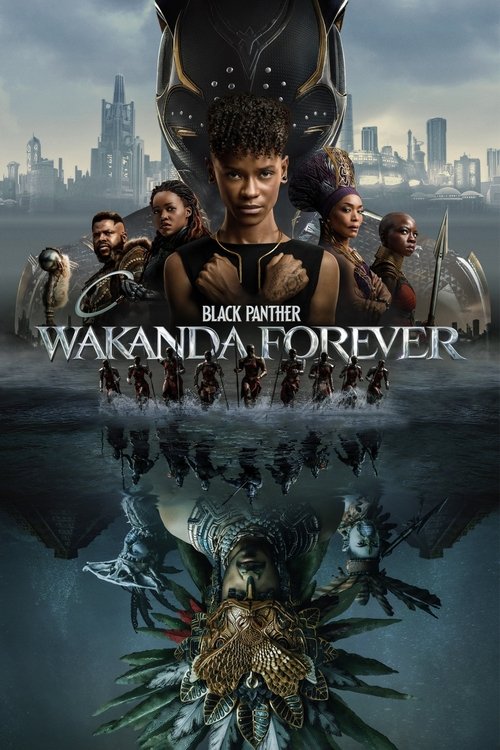
Black Panther: Wakanda Forever (2022) is a superhero film adapted from Marvel Comics, directed by Ryan Coogler and starring Letitia Wright and Angela Bassett. The film is part of the MCU and was released by Marvel Studios. Runtime: 2h 41m. Rated PG-13. Audience rating: 7.3/10.
What is Black Panther: Wakanda Forever (2022) about?
The people of Wakanda fight to protect their home from intervening world powers following King T'Challa's death, and Queen Ramonda faces a powerful new threat from the underwater nation of Talokan.
Released in 2022, Black Panther: Wakanda Forever was directed by Ryan Coogler and produced under the Marvel Studios banner. The film occupies a significant place within the MCU — contributing to the ongoing narrative and mythology of that cinematic universe.
The film features lead performances from Letitia Wright, Angela Bassett, Tenoch Huerta, among others, anchoring a story that adapts characters first brought to life in Marvel Comics. Its source material gives the film a foundation rooted in decades of published storytelling, which Coogler and the creative team interpret through a cinematic lens.
Its 7.3 rating reflects a film that divided audiences — appreciated for its ambition and spectacle by some, criticized for pacing and execution by others. Its place in the genre remains a frequent discussion point.
What happens in Black Panther: Wakanda Forever (2022)? — Full Plot
Wakanda. The royal palace's medical wing. Princess Shuri (Letitia Wright) is at the center of her brother King T'Challa's hospital room, hunched over a synthesized version of the heart-shaped herb. T'Challa is dying. He's been ill for months — Wakanda's foreign minister Okoye and Queen Mother Ramonda (Angela Bassett) are at his bedside. Shuri has been working on a synthetic version of the herb (the original was destroyed by Killmonger in Black Panther (2018)) but the new version isn't ready. T'Challa flatlines. The film opens on his death. Shuri runs to the lab to make one more attempt at the herb. By the time she returns to the room, T'Challa is gone. Wakanda goes into mourning. The funeral procession plays out across the entire opening: a public ceremony with Wakandan tribal mourners drumming, T'Challa's coffin draped in royal purple, Ramonda walking behind it. Then in a single quiet shot, Marvel's title card appears — the Marvel Studios logo for the first time without an introductory fanfare, just the company name silently transitioning into the film's title. A real-world tribute to Chadwick Boseman. The film holds that beat. The audience in 2022 wept.
One year later. Queen Mother Ramonda has been ruling Wakanda since T'Challa's death. She addresses the United Nations General Assembly in Geneva — the same body T'Challa addressed at the end of Black Panther. She has come to publicly refuse the international community's demands that Wakanda share its vibranium reserves. The CIA, the EU, the Russian government, and three Pacific Rim states have all been quietly searching for alternative sources. Ramonda warns them: "The Wakanda you remember is no more. We are a global power." She walks out of the chamber with her honor guard. The same week, the CIA's MIT-affiliated research division detects an underwater vibranium deposit on the Atlantic Ocean floor — the first such deposit outside Wakanda's borders. They send a team to extract samples. The extraction crew is attacked by blue-skinned, water-breathing warriors led by a man flying out of the ocean wearing a feathered serpent crown.
Namor. The aquatic warriors are Talokanil — citizens of the underwater civilization of Talokan, hidden in the Atlantic for five hundred years. Their king is Namor (Tenoch Huerta), a pale-blue-skinned, winged-ankled, eight-foot-tall warrior who can fly through air and breathe water equally well. Namor and his soldiers wipe out the CIA extraction team. He then surfaces in Wakanda's lower river basin and walks unaccompanied into the royal palace's throne room — bypassing all of Wakanda's air-defense, surface-defense, and tribal-defense systems with ease. He introduces himself to Queen Ramonda and Princess Shuri as the King of Talokan. He delivers a single message: the CIA has hired an MIT student named Riri Williams (Dominique Thorne) to build a vibranium-detection device that has now mapped two underwater vibranium deposits — one near Wakanda and one near Talokan. Talokan was discovered by Riri's machine. Riri must be killed within seven days. Wakanda will help eliminate her, or Wakanda will be the next civilization Talokan invades.
Riri Williams. Shuri and Okoye fly to MIT to find Riri Williams — a Black female engineering student, mid-twenties, who Tony Stark-style has been quietly building advanced exoskeleton technology in her dorm room (a younger, scrappier version of Iron Man minus the corporate funding). Riri is the same character about to become the lead of Ironheart (2025) Disney+ series — she's the next-generation Tony Stark, both Black and female. Shuri and Okoye arrive at MIT undercover. They explain the situation to Riri. Riri agrees to come with them. But the FBI — alerted that Wakandan agents are operating on American soil — arrives at her apartment simultaneously. So do Namor's Talokanil assassins. The three forces collide in a Boston traffic chase. Shuri, Okoye, and Riri are pursued through downtown Boston by both FBI sedans and aquatic-suited Talokanil mercenaries. The chase ends with Shuri and Riri captured by Talokan's warriors.
Talokan revealed. Namor takes Shuri and Riri to Talokan — a vast Mesoamerican-inspired underwater civilization beneath the Atlantic Ocean. Pyramids, temples, gold-decorated walls, blue-glowing reef structures, citizens by the thousands swimming through the city. Talokan has eight million inhabitants. They have been hidden for five hundred years. The civilization's architecture echoes ancient Maya — pre-Columbian stone-pyramid temples, glyphs, jade ornamentation. Talokan citizens are blue-skinned (a side-effect of the herb that transformed their ancestors), have webbed hands, breathe water, and have evolved beyond surface humanity. They are not subaquatic mutants — they're descendants of refugees.
Namor's origin. Namor takes Shuri on a personal tour of Talokan and tells her his origin. In 1571, a small Yucatec-Maya tribe living near the Caribbean coast was being decimated by smallpox brought by Spanish colonizers. The tribe's shaman discovered a heart-shaped Talokan-flower growing on a coastal cliff that, when consumed, transformed the consumer's body into a water-breathing, gilled humanoid. The shaman and tribe chose to take the herb and dive into the ocean rather than be killed by colonizers. They became Talokanil. The first child born among the underwater Talokanil was Namor — Tenoch Huerta — who was born already walking, with the strength of fifty grown men and the ability to fly. His mother, the tribe's elder, named him K'uk'ulkan (Yucatec for "feathered serpent god") because of his ankles' avian-feather genetic mutation. He has been ruling Talokan for four hundred and fifty-three years.
Namor's proposition. Namor offers Shuri an alliance. Talokan and Wakanda are both descended from indigenous peoples who survived colonial extermination through hidden technological-cultural sovereignty. They have a shared enemy in the surface world's industrial powers. Namor proposes that together they preemptively destroy the surface world's industrial centers — drowning major coastal cities (Lisbon, Mumbai, New York, Buenos Aires) — to ensure neither Wakanda nor Talokan is ever discovered or attacked again. Shuri refuses. She tells Namor that genocide is not who Wakanda is.
Ramonda's death. Namor invades Wakanda. The Talokanil army emerges from the Wakandan river basin and the coastal Lagunas using newly-converted Talokanil scouts who have been infiltrated for months. Talokanil warriors flood the royal palace's lower floors. Ramonda, leading the defense, evacuates Riri Williams to a hidden underwater bunker. Namor catches Ramonda at the riverside and personally drowns her in a moment of cold brutality — pushing her head under the water until she stops moving. Ramonda's body floats face-down in the river. The shock is total. Wakanda has lost two members of the royal family in one year — its king and now its queen mother — within twelve months. Wakanda is leaderless except for Princess Shuri.
Shuri becomes Black Panther. Shuri, mourning, returns to her lab. She finally has all the components she needs — Namor's species of heart-shaped herb (which Shuri has secretly extracted from Namor during their Talokan visit), combined with T'Challa's preserved blood. She synthesizes a functional heart-shaped herb. She takes it. She enters the Ancestral Plane. She expects to see her brother T'Challa or her father T'Chaka. Instead, she sees Erik Killmonger (Michael B. Jordan, reprising his Black Panther 2018 role) — the cousin T'Challa killed in the first film, returned from the Ancestral Plane to test Shuri's worthiness. Killmonger challenges her: "What are you going to do, princess?" Shuri chooses her path. She becomes the new Black Panther. She gets a new purple-and-vibranium suit. She trains. She prepares for war.
The naval battle. Wakanda mobilizes against Talokan. Okoye is given a new Midnight Angels armor — a vibranium combat suit. Riri Williams designs and builds her own Iron Man-style exoskeleton armor in three days using Shuri's vibranium-3D-printing technology. M'Baku of the Jabari leads a Mountain Tribe assault force. Wakanda's airborne kimoyo fleet engages Talokan's underwater naval force off the African coast. The Battle of the Atlantic Ocean is the film's centerpiece set piece — Wakandan flying patrol craft vs Talokanil whale-cavalry mounts, Riri Williams in her Iron Heart armor vs Talokanil warrior squads, Okoye's Midnight Angels battalion vs Namor's K'uk'ulkan elite guard. The fight tears across thirty kilometers of open ocean and three hours of in-story time.
Shuri vs Namor. Shuri, in her Black Panther suit, engages Namor directly. They fight on the upper deck of a damaged Talokanil dreadnought ship. Their fight choreography is the film's emotional climax — Shuri, hot-blooded and grief-stricken, has every reason to kill Namor; Namor, defending his civilization, has every reason to kill her. They fight to a stalemate. Then, mid-combat, Shuri receives a quiet vision of her mother Ramonda whispering to her: "Show him who we are." Shuri, with Namor at her mercy on the deck, declines to kill him. She offers him an armistice instead: Wakanda will publicly acknowledge Talokan's existence and protect their location from the surface world; Talokan in exchange will stop targeting surface civilizations and respect Wakandan sovereignty. Namor, surprised by the diplomatic gesture, accepts. The war ends with the two sovereigns holding hands in armor on the dreadnought's deck.
Aftermath. Wakanda and Talokan ceremonially exchange ambassadors. Riri Williams is offered protection in Wakanda permanently but chooses to return to her MIT dorm to continue building her exoskeleton — she's the next phase of the MCU's Ironheart project. Okoye is reinstated as the Dora Milaje's general. Shuri is officially Wakanda's regent until Wakanda chooses its next monarch. M'Baku declines the role. Wakanda enters a quiet period of mourning and rebuilding. Shuri travels to Nakia's secret residence in Haiti — Nakia had been living in Haiti for five years since the Snap, running an underground school for Wakandan diaspora children.
Haiti coda. Shuri sits on a Haitian beach at sunset wearing her royal funeral white. She removes the white robe (the Wakandan mourning attire she has been wearing for a full year) and burns it at the shoreline. She finally lets herself grieve T'Challa, Ramonda, and the entire year of loss. As the white funeral robe burns into ash on the sand, Nakia walks down the beach toward her with a small Wakandan boy in tow.
Mid-credits. The boy is approximately five years old, dark-skinned, with the same posture and quiet bearing as T'Challa. Nakia introduces him to Shuri. "This is Toussaint." The boy looks at her. "My mother named me Toussaint, after a Haitian liberator. But my Wakandan name is." Nakia interrupts him. She explains: T'Challa and Nakia had a son together before T'Challa's illness. He has been raised in Haiti in secret to protect him from Wakandan political pressure. He is now T'Challa Udaku II, the actual heir to the Wakandan throne. The boy nods at Shuri. "My aunt. The Black Panther." Shuri kneels and hugs her nephew for the first time. The film closes with the secret existence of T'Challa's son revealed — a continuation of T'Challa's actual genetic line that will become a major Phase 5/6 MCU plot driver in the planned Black Panther 3 film. End movie.
Who stars in Black Panther: Wakanda Forever (2022)?
Find Black Panther: Wakanda Forever (2022) on Amazon
Watch Black Panther: Wakanda Forever on Prime Video, browse the original Marvel Comics source material, and discover Blu-rays, soundtracks, and related merchandise on Amazon.
As an Amazon Associate, I earn from qualifying purchases. Link clicks do not affect editorial coverage — see our disclaimer.
What are some facts about Black Panther: Wakanda Forever (2022)?
Black Panther: Wakanda Forever released in 2022, placing it within the 2020s era of comic book cinema — a decade that saw superhero films become the dominant force at the global box office.
Directed by Ryan Coogler, the film was produced by Marvel Studios and adapts source material from Marvel Comics.
The principal cast features Letitia Wright and Angela Bassett, with key supporting roles played by Tenoch Huerta, Lupita Nyong'o, Danai Gurira.
The film belongs to MCU — the Marvel Cinematic Universe — the highest-grossing film franchise of all time.
Black Panther: Wakanda Forever carries an audience rating of 7.3 — putting it in the solid-to-excellent tier of the genre.
The Marvel Comics source material for Black Panther: Wakanda Forever has been in continuous publication for decades, giving filmmakers a rich well of storylines, character arcs, and iconography to draw upon.
Modern superhero films like this one use a mix of practical effects and digital VFX, with entire sequences often shot against volume walls or LED stages pioneered by shows like The Mandalorian.
Black Panther: Wakanda Forever is catalogued on Movies on Comics among our collection of 164 comic book films spanning 48 years of cinema — from Richard Donner's 1978 Superman to the present day.
Easter Eggs & Hidden Details in Black Panther: Wakanda Forever (2022)
A posthumous tribute to Chadwick Boseman. The deep cuts include Ryan Coogler's refusal to recast T'Challa and Tenoch Huerta's Namor introduction.
Chadwick Boseman died August 28, 2020 — months after wrapping Endgame (2019) reshoots. Coogler was given the option to recast T'Challa with digital de-aging, hire a new actor, or write T'Challa out entirely. Coogler chose the latter — making the film about grief rather than the character's continuation.
Tenoch Huerta's Namor — the underwater Talokan civilization leader — was the franchise's first major Latino antagonist. The character was redesigned from his comic-book origins as Atlantean royalty to be Mayan-descended.
Dominique Thorne's Riri Williams — Ironheart, a young MIT student — was introduced in this film. The character was introduced to set up the Ironheart Disney+ series. Williams becomes a Wakandan ally; her Iron Man-style armor is partially Wakandan-vibranium-enhanced.
The mid-credits scene reveals T'Challa's son Toussaint — raised in secret by Nakia. The reveal is the film's most-emotional sequence: T'Challa has a son who will eventually become the next Black Panther.
Letitia Wright's Shuri inherited the Black Panther title — taking up the heart-shaped-herb ritual that her brother had performed. The decision was widely cited as the franchise's most-significant character mantle-passing.
Angela Bassett's Queen Ramonda — the queen of Wakanda — is killed in the Talokan attack, drowning in the throne room. The scene was widely cited as the film's emotional peak. Bassett earned an Oscar nomination for Best Supporting Actress.
Shuri's eventual UN address — formally announcing Wakanda's continued international engagement — was widely cited as the franchise's largest political-rhetoric moment.
The film features extensive Mayan-language dialogue. The cast trained with Mayan-language consultants for months. The decision was a deliberate Coogler creative commitment to cultural authenticity.
Talokan was visually designed to be distinct from Aquaman's Atlantis. The cities feature Mayan-pyramid architecture rather than Greek-temple aesthetics.
The U.S. CIA's attempts to extract vibranium from the seafloor creates the film's central conflict. The premise establishes vibranium as a cosmic resource with multiple competing claims.
💬 Reader Comments