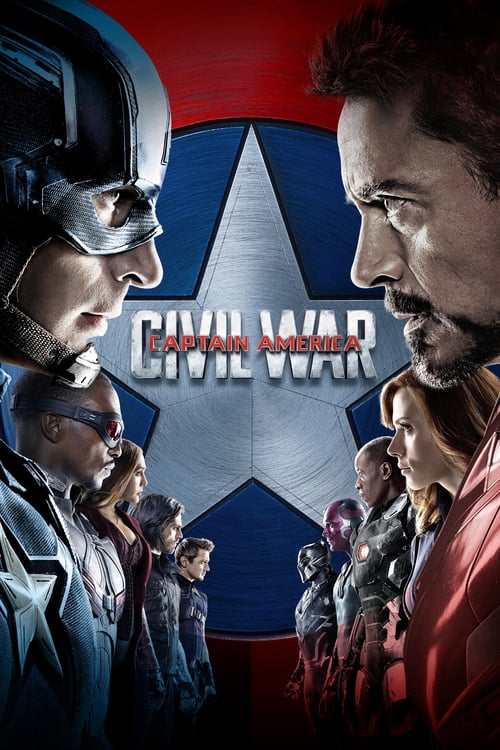
Captain America: Civil War (2016) is a superhero film adapted from Marvel Comics, directed by Anthony & Joe Russo and starring Chris Evans and Robert Downey Jr.. The film is part of the MCU and was released by Marvel Studios. Runtime: 2h 27m. Rated PG-13. Audience rating: 7.8/10.
What is Captain America: Civil War (2016) about?
Political interference in the Avengers' activities causes a rift between Captain America and Iron Man — splitting Earth's mightiest heroes into opposing sides in a dangerous war.
Released in 2016, Captain America: Civil War was directed by Anthony & Joe Russo and produced under the Marvel Studios banner. The film occupies a significant place within the MCU — contributing to the ongoing narrative and mythology of that cinematic universe.
The film features lead performances from Chris Evans, Robert Downey Jr., Scarlett Johansson, among others, anchoring a story that adapts characters first brought to life in Marvel Comics. Its source material gives the film a foundation rooted in decades of published storytelling, which Russo and the creative team interpret through a cinematic lens.
With an audience rating of 7.8, Captain America: Civil War is generally praised as a strong entry in the superhero genre — its strengths in storytelling, performance, and production design regularly cited by viewers.
What happens in Captain America: Civil War (2016)? — Full Plot
Siberia, December 1991. A black sedan moves down an empty mountain road. The driver is Howard Stark — yes, that Howard Stark — and Maria Stark is in the passenger seat. Howard is carrying five vials of recreated super-soldier serum in a briefcase in the trunk. A motorcycle drops out of the trees. The rider is in goggles and a black mask and a Soviet leather jacket and his left arm is metal. He runs the sedan off the road. He walks up to Howard, recognizes him, and beats him to death with the metal arm. He shoots Maria. He retrieves the briefcase, plants the wreck to look like an accident, and rides into the night. The film opens by showing you the murder Tony Stark spends the next twenty-five years not knowing about.
Cut to Lagos, Nigeria. A year after Age of Ultron (2015). Crossbones — Brock Rumlow, the STRIKE commander Cap left burning in the Triskelion — is back, scarred but still breathing, and he's stealing a biological weapon out of the IFID Institute. Steve leads a four-person op: himself, Natasha, Sam, Wanda. They run it tight, they recover the weapon, they corner Rumlow in a marketplace. Rumlow tells Steve that Bucky remembered him. Then he pulls his dead-man's switch. Wanda catches the explosion with telekinesis on instinct — saves Steve's life — but she can't hold it and she has to push it somewhere, so she lobs it up and away. Up and away turns out to be into the eleventh floor of an office building full of Wakandan humanitarian aid workers. Eleven dead, including a young woman named Aisha. The world watches it on cable news for a week.
Back at the Avengers compound, Secretary of State Thaddeus Ross — the same general who hunted Bruce Banner in The Incredible Hulk (2008), now in a tailored suit instead of fatigues — drops a 117-country document called the Sokovia Accords onto the conference table. The Avengers will be folded into a UN panel. Missions only when authorized. Sign the Accords by the end of the week or retire. Tony — wrecked by guilt over Ultron and just torched in the lobby that morning by the mother of a kid who died in Sokovia — signs. Steve doesn't. Vision sides with Tony on the math. Rhodey backs Tony out of loyalty. Wanda is too shaken from Lagos to argue. Natasha, of all people, sides with Tony — "if we have one hand on the wheel, we can still steer" — though she'll change her mind by reel four. Sam stands with Steve. The team is split before anybody throws a punch.
London. Peggy Carter has died at 95. Steve is a pallbearer. He hears Sharon Carter — Peggy's niece, the cute nurse from The Winter Soldier (2014) — give the eulogy and quote a line of Peggy's about planting your feet and saying No, you move. It's the thesis statement of the entire movie. Natasha shows up at the church and tries one more time to bring Steve in. He won't sign. Then they get a news alert: the Vienna UN building, where the Accords are being signed, has just been hit by a bomb. King T'Chaka of Wakanda is dead. Eleven more bodies. The security footage shows the bomber, and the bomber is the Winter Soldier.
Bucharest. Steve traces Bucky to a fifth-floor walkup above a market. He's been hiding in Eastern Europe for two years working construction jobs and reading the journal he kept of every man Cap is here to bring him in before the Joint Counter-Terrorism Center's strike team kills him on sight. They have about ninety seconds. Bucky reads them right and tries to bolt. The strike team breaches. So does T'Challa — in a sealed black bodysuit with vibranium claws, a panther helmet that retracts on cue, and reflexes that match Bucky's. The four-way chase tears down a stairwell, through an apartment block, into a tunnel, and onto a highway through bumper-to-bumper traffic at sixty miles an hour. Bucky on a motorcycle. Cap on foot through cars. Sam from above with the wings. T'Challa on the roof of a moving van leaping between vehicles like an actual panther. Rhodey closes the box from the air. Everyone gets arrested.
Berlin. Joint Counter-Terrorism Center. Bucky is locked in a glass-walled vault that runs on its own power. Tony arrives to broker peace — get Steve to sign, save the band. Then a man impersonating a UN-appointed shrink slips into the vault holding a small red leather notebook with a black star embossed on the cover. This is Helmut Zemo. He doesn't have powers. He doesn't want money. He's a former Sokovian black-ops colonel whose wife, son, and father died under a falling Sokovian city in the Ultron event. He opens the book. He reads ten words aloud in Russian. "Желание. Ржавый. Семнадцать. Рассвет. Печь. Девять. Доброкачественный. Возвращение домой. Один. Грузовой вагон." Longing. Rusted. Seventeen. Daybreak. Furnace. Nine. Benign. Homecoming. One. Freight car. Bucky's eyes glaze. He's the Winter Soldier again. He breaks the vault. He destroys half the building on the way out. Zemo walks out the other door wearing the shrink's badge.
Steve and Sam pull a brainwashed Bucky out of the building before he can kill anyone. They knock him out and stash him in an abandoned industrial warehouse. When he comes back, he's Bucky again, raw and confused. He tells them what Zemo wanted: there are five more Winter Soldiers — the rest of the program, prototypes from 1991, frozen in cryo tubes inside a HYDRA base in Siberia. Zemo wants the codes to wake them up and command them. Five enhanced super-soldiers under the control of a man who has nothing left to lose. Steve can't take that to the UN; they'll shoot Bucky on the way in. He'll need a team. Off the books.
Tony assembles his side first. Natasha. Rhodey. Vision. T'Challa, in suit form now, riding along to put hands on Bucky himself. He needs a sixth and goes hunting in Queens, New York, where a high-school kid named Peter Parker has been catching cars on YouTube. Tony's introduction scene with Peter is six minutes of pure character — Aunt May, the walnut date loaves, the homemade suit in a footlocker under the bed, the line about "when you can do the things that I can but you don't, and then the bad things happen, they happen because of you." Tony hands him a Stark-engineered Spider-Man suit and tells him there's a plane leaving in six hours. Peter doesn't even know what the fight is about.
Steve assembles his side too. Sam, Bucky, Wanda — broken out of house arrest at the compound by Steve himself in a vent-shaft sequence that's half Mission Impossible, half college-dorm rescue. Clint Barton, retired since Ultron, comes out of his Iowa farmhouse for Wanda. Sam recommends a guy he met in San Francisco who shrinks down — Scott Lang flies in on Sam's word and meets Cap on a German tarmac and visibly loses his mind. "Captain America. I know you. You're great." Six versus six. The Leipzig-Halle Airport opens its evacuated tarmac to them at sunset and the Russos give you the single best superhero fight ever filmed: every pairing, every power set, every line, every gag earned. Spider-Man taking Cap's shield. Ant-Man on a Hawkeye arrow. Vision drawing a line in the concrete with a beam from his forehead. Black Panther vs. Bucky around a forklift. Wanda burying Tony under cars. "I could do this all day." "I know, I know. That's why I quit." And then Scott Lang says "I've been working on something" and goes Giant-Man — three stories tall, ripping the wing off a Boeing 747 — and the audience screams in a way Marvel films rarely earn anymore.
The fight has consequences. Vision aims a beam at Sam, Sam dodges, the beam hits the back of Rhodey's War Machine reactor instead, and Rhodey falls eight thousand feet to a tarmac his suit cannot autopilot him out of. Tony catches him too late. Rhodey's spine is shattered. He'll walk again only in braces of Tony's making. While Tony is on his knees over his oldest friend, Natasha — who's been on Tony's side this whole movie — turns and stuns T'Challa so Steve and Bucky can reach the quinjet. "Of course you let me down," Tony tells her over comms. She's done. So is everyone. Sam, Wanda, Clint, Scott — captured at the airport — go straight to a deep-sea floating supermax called the Raft. T'Challa takes off the suit and follows in his own jet.
Tony reads the report on Bucky's pursuer in Berlin and realizes the shrink was Zemo. He goes to the Raft, gets the truth out of Sam, and flies after Steve to Siberia alone — no team, no Accords briefing, no backup. Inside the HYDRA bunker the three of them — Tony, Cap, Bucky — find the cryo tubes. The other five Winter Soldiers. Every one of them dead. Headshot at point-blank range. Zemo never wanted to lead an army. Zemo wanted Tony, Cap, and Bucky in this room together. He's on a balcony in a Plexiglas booth and he hits play on a video file from a CCTV camera mounted on a Siberian tree in December 1991. Tony watches the Winter Soldier kill his mother. Tony watches the Winter Soldier kill his father. Tony turns to the Winter Soldier in the room with him and says, very quietly, "Did you know?" Steve says "I didn't know it was him." Tony says "Don't bullshit me, Rogers. Did you know?" Steve says "yes."
What follows is not a fight. It's a grief tantrum from the richest man in the world inside a $300 million suit. Tony goes at Bucky. Cap pulls Tony off. Tony goes at both. The three of them tear through the concrete bunker for ten straight minutes — no quips, no scoring, just metal and bone and breathing. Tony fires a missile that blows Bucky's metal arm clean off at the shoulder. Bucky goes down. Cap pins Tony, raises the shield, and brings it down — but not on the head. On the arc reactor. He hammers it until it shorts out. Tony lays on the bunker floor, suit dead, eyes wet, watching Cap haul Bucky up under his shoulder. "That shield doesn't belong to you. My father made that shield." Cap drops it. The shield clangs on the concrete and rocks back and forth. Howard Stark's shield, dropped at Tony Stark's feet by Captain America, in front of the man who killed his parents. The frame holds on it for a long beat.
T'Challa, who's been tailing Zemo this whole time and has heard every word from a vent above the bunker, climbs up to the balcony and stops Zemo from putting a bullet in his own mouth. He turns the colonel over to the German authorities and tells him his hatred consumed him. Wakanda absorbs Bucky — T'Challa offers him sanctuary in a country no one will follow him into. Tony, walking again with a brace under his pants, builds Rhodey a set of leg exos. The Raft sits in the Atlantic with Wanda, Clint, Sam, and Scott in separate cells. Steve breaks them out, off-screen, in the final montage — a quinjet flies into the Raft's open dock. Steve sends Tony a flip phone in a hand-addressed package along with a letter that ends "I'll be there." Mid-credits: Bucky goes back into cryo in a vibranium-lined ice chamber under the Wakandan royal palace until they can pull Zemo's words out of his head. Post-credits: a kid in Queens in his bedroom hits a button on a Stark-issued web-shooter and a red-and-black Spider-Man logo lights up on the wall.
Who stars in Captain America: Civil War (2016)?
Find Captain America: Civil War (2016) on Amazon
Watch Captain America: Civil War on Prime Video, browse the original Marvel Comics source material, and discover Blu-rays, soundtracks, and related merchandise on Amazon.
As an Amazon Associate, I earn from qualifying purchases. Link clicks do not affect editorial coverage — see our disclaimer.
What are some facts about Captain America: Civil War (2016)?
Captain America: Civil War released in 2016, placing it within the 2010s era of comic book cinema — a decade that saw superhero films become the dominant force at the global box office.
Directed by Anthony & Joe Russo, the film was produced by Marvel Studios and adapts source material from Marvel Comics.
The principal cast features Chris Evans and Robert Downey Jr., with key supporting roles played by Scarlett Johansson, Chadwick Boseman, Tom Holland.
The film belongs to MCU — the Marvel Cinematic Universe — the highest-grossing film franchise of all time.
Captain America: Civil War carries an audience rating of 7.8 — putting it in the solid-to-excellent tier of the genre.
The Marvel Comics source material for Captain America: Civil War has been in continuous publication for decades, giving filmmakers a rich well of storylines, character arcs, and iconography to draw upon.
Modern superhero films like this one use a mix of practical effects and digital VFX, with entire sequences often shot against volume walls or LED stages pioneered by shows like The Mandalorian.
Captain America: Civil War is catalogued on Movies on Comics among our collection of 164 comic book films spanning 48 years of cinema — from Richard Donner's 1978 Superman to the present day.
Easter Eggs & Hidden Details in Captain America: Civil War (2016)
Civil War isn't actually about superhero registration. It's about two men who used to be best friends pretending the politics matter while one of them figures out the other's been hiding something for a decade. The 1991 tape is the film's real climax.
Tony's recruitment visit to Peter Parker's Queens apartment was filmed before Tom Holland was even formally announced publicly. Marvel deliberately kept the casting quiet through production. Holland's first MCU scene was filmed under heavy NDA.
Rhodey's mid-air fall and subsequent paralysis from Vision's stray blast was not shown in any pre-release trailer or TV spot. Marvel kept the moment as a deliberate emotional ambush for opening-weekend audiences.
Marvel deliberately positioned Civil War as the third Captain America film — not an Avengers crossover. The Russos and screenwriters Markus and McFeely structured the film around Steve's personal arc with Bucky, with the Tony conflict serving as thematic counterweight. This is why the emotional climax is Steve and Bucky against Tony — not the Leipzig airport battle.
Scott Lang's Giant-Man transformation during the airport battle was the film's most-expensive single VFX sequence. The sequence required custom motion-capture rigging and over 6 months of post-production work.
T'Challa's Black Panther suit was canonically established as woven vibranium mesh — making it bulletproof and capable of absorbing kinetic energy. The mesh design directly anchored Black Panther (2018)'s vibranium-civilization premise.
Helmut Zemo doesn't have superpowers and doesn't seek world domination. His entire plan is personal vengeance for his family killed in Sokovia's collapse. Daniel Brühl's portrayal as a meticulous engineer rather than a comic-book mastermind reframed MCU villains for the rest of Phase 3.
The flashback to Bucky's 1991 Stark assassination was Marvel's first explicit on-screen depiction of a Winter Soldier mission. The sequence was filmed in a single day; Sebastian Stan and Eric Burgan (playing young Howard Stark) trained for months on the choreography.
Vision and Wanda's quiet kitchen scene — Vision making her a paprika omelet — set up the romantic relationship that became central to WandaVision (2021). The Russos have confirmed the relationship was planted with the intention of future series development.
Steve's letter to Tony — and the included flip phone — closes the film. The phone is the device Tony uses in Infinity War (2018)'s opening to receive Bruce Banner's emergency call. The phone's arrival is the franchise's smallest-scale emotional bridge to the largest-scale stakes.
Tony's gift of the high-tech Spider-Man suit to Peter Parker established Tony as the surrogate father figure that defines Peter's arc through Homecoming (2017), Far From Home (2019), and No Way Home (2021).
💬 Reader Comments