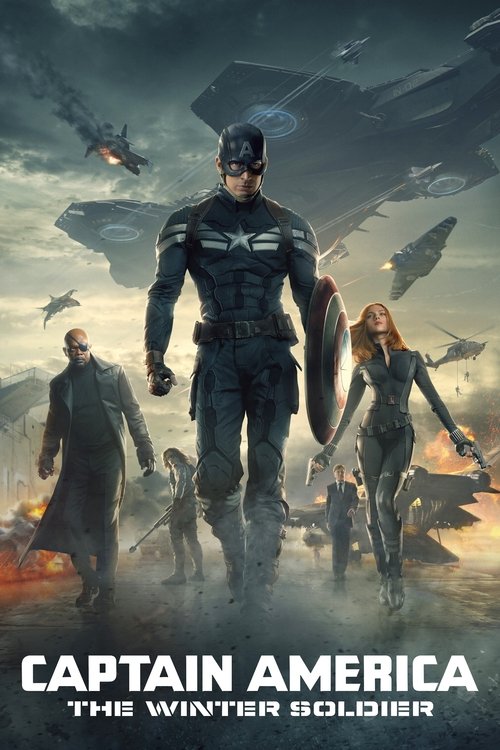
Captain America: The Winter Soldier (2014) is a superhero film adapted from Marvel Comics, directed by Anthony & Joe Russo and starring Chris Evans and Scarlett Johansson. The film is part of the MCU and was released by Marvel Studios. Runtime: 2h 16m. Rated PG-13. Audience rating: 7.7/10.
What is Captain America: The Winter Soldier (2014) about?
Steve Rogers navigates the complex politics of modern espionage as S.H.I.E.L.D. is infiltrated from within, and a ghostly assassin from his past — the Winter Soldier — is revealed.
Released in 2014, Captain America: The Winter Soldier was directed by Anthony & Joe Russo and produced under the Marvel Studios banner. The film occupies a significant place within the MCU — contributing to the ongoing narrative and mythology of that cinematic universe.
The film features lead performances from Chris Evans, Scarlett Johansson, Anthony Mackie, among others, anchoring a story that adapts characters first brought to life in Marvel Comics. Its source material gives the film a foundation rooted in decades of published storytelling, which Russo and the creative team interpret through a cinematic lens.
With an audience rating of 7.7, Captain America: The Winter Soldier is generally praised as a strong entry in the superhero genre — its strengths in storytelling, performance, and production design regularly cited by viewers.
What happens in Captain America: The Winter Soldier (2014)? — Full Plot
Two years after the Battle of New York and Steve Rogers is still trying to figure out what year his life is supposed to be in. He runs the National Mall before sunrise — laps so fast he keeps lapping the same guy, a Black Air Force veteran named Sam Wilson. "On your left," Steve says, every loop. Sam is dying. They get to talking. Sam runs a counseling group at the VA for soldiers who came home and couldn't bring all of themselves back with them, and Steve recognizes him immediately as one of his own — a man who understands what it's like to walk through a world that doesn't fit anymore. Natasha rolls up in a black sports car. Mission. Pirates have hijacked a SHIELD vessel called the Lemurian Star in the Indian Ocean. Time to suit up.
The op is led by Brock Rumlow's STRIKE team, and Cap goes in first — silent drop from a quinjet, hitting the water and climbing the hull while pirates patrol the deck. He moves like the soldier the trailers always promised but the previous films rarely delivered: blade-quiet, brutal, no quips. He takes down a dozen mercenaries in the open before they realize anyone is on board. Up on the bridge, Georges Batroc — the leaper, the savate champion, the only man in the building besides Steve who fights like he was raised by martial arts — engages him hand to hand. They trade kicks across the bridge. Cap wins, but barely, and only after Batroc lands one across his jaw that knocks the helmet off. The hostages get free. Then Steve walks back into the deck and finds Natasha at a terminal, plugging something into a hard drive that has nothing to do with the rescue. She's downloading SHIELD's classified data on Fury's direct orders. Mission inside the mission. Steve is furious.
Back at the Triskelion — SHIELD's three-pronged headquarters on the Potomac — Steve walks into Nick Fury's office and demands the truth. Fury takes him down to a secure elevator that descends into a vault Steve didn't know existed. The doors open onto Project Insight: three next-generation helicarriers linked to a satellite network, designed to identify threats from orbit and neutralize them from above before they ever pull a trigger. Pre-crime, basically. Minority Report with repulsor cannons. Fury sells it as the future of security. Steve hears the pitch and his face goes cold. "This isn't freedom. This is fear." He walks out of the vault and out of the building. Fury is left holding the briefing and wondering if he's just lost his best soldier — or if his best soldier just gave him the only honest read he was going to get all week.
But something in the Insight data is bothering Fury too. He pulls the encrypted files Natasha extracted from the Star and finds he can't decrypt them — his own clearance level isn't high enough on his own agency's files. That's a problem. He calls in a delay on the Insight launch. Driving back into DC, he gets ambushed at a stoplight. DC Metro cop cars box him in, but they're not cops — they're armored gunmen with grenade launchers and assault rifles, and they unload on the SUV from every side. His armored car holds, just. He punches through them with the front bumper and weaves out of the kill box, and for a moment it looks like he'll make the hospital. Then a man with a metal arm steps into the middle of the road, plants a magnetic charge under the chassis, and flips the SUV like a Hot Wheels car. The Winter Soldier walks down the street with a grenade launcher on his shoulder, looking for the body. Fury escapes into the alleys through a hole he cut with a wrist laser. He's bleeding out as he goes.
He makes it to Steve's apartment. Kate, the cute nurse next door — who turns out to be Agent 13, SHIELD plant — is in the hallway. Steve walks in and finds Fury slumped against his living room wall, gun in hand. "Ears everywhere," Fury mouths, scribbling on a notepad. SHIELD COMPROMISED. He presses a flash drive into Steve's hand. Then a single high-caliber round punches through the wall from across the street and into Fury's chest. Steve dives for the window and sees a shadow vaulting between rooftops. He chases. He throws the shield from a hundred yards out and the Winter Soldier catches it with his metal arm in mid-leap — catches Captain America's shield like it's a frisbee — and tosses it back. Steve stops. So does the audience. Who the hell is this guy.
Fury flatlines on the operating table. Or so the chart says. Pierce — Alexander Pierce, SHIELD's senior leadership, Fury's mentor and superior on the World Security Council — calls Steve into his office and asks why Fury was at his apartment. Steve lies by omission. Pierce flags him as a fugitive the moment he steps out the door, and a STRIKE team led by Rumlow corners him in the elevator on the way down. Floor by floor, more agents board. Steve clocks every weapon, every breath, every wedding ring missing where it should be. The elevator gets to him before he gets to the lobby. He drops the entire car — punches, slams, shield-smashes — and walks out through a top-floor window. Smashes through the glass roof and rolls onto the ground forty feet down. The shield takes the impact. He limps off the campus on stolen legs.
Natasha finds him at the mall, because of course she does. She has the flash drive he ghosted with from Fury — she pickpocketed it back out of his coat. They run the drive on a public computer at an Apple Store, posing as a couple browsing Hawaii vacations while the file traces itself to a remote location. Camp Lehigh, New Jersey. The army base where Steve became Captain America in 1942. They drive up the coast in a stolen pickup. The base is abandoned, fenced off, weeds taller than they are. Steve finds a building with the door alignment slightly wrong — a building that wasn't there in 1942. They go in. A bank of 1970s mainframes hums behind dust sheets, and when Natasha plugs in the drive a green-cursor terminal asks them to confirm initiation. A face flickers onto the screen. Arnim Zola. Red Skull's chief scientist from The First Avenger (2011), the one who supposedly died of natural causes in 1972 — now a digitized consciousness ranting from inside SHIELD's bones.
Zola brags too long and a missile hits the bunker — Pierce called in the strike the second they tripped the terminal. Steve throws a manhole-cover grate over Natasha and dives on top of her as the roof collapses. They survive under the rubble. They come up dirty and hunted and out of allies. Steve has one card left: the Air Force veteran who likes to run. Sam Wilson opens the door, sees them, doesn't ask questions, and hands them his shower. Then he hands Steve a manila folder labeled EXO-7 FALCON — the experimental wingsuit Sam piloted in Iraq before his wingman Riley got shot out of the sky. "I do what he did," Sam says, "just slower." Steve looks at him. "You ready to do it faster?" Three of them now. They're going to get Sitwell.
Jasper Sitwell — the SHIELD agent we last saw in The Avengers (2012) and the Marvel One-Shot — is on a hotel rooftop in DC schmoozing senators. Sam knocks his bodyguards out, Steve takes the suit jacket, and they fly him to the roof's edge and threaten to throw him off the top. Natasha kicks him over the side. Sam catches him with the wings — terrifying, hilarious, perfect — and they have their conversation on the roof. Sitwell breaks. Project Insight's algorithm was written by Zola: it uses social media, banking records, voting records, GPS data, school transcripts — anything in the digital exhaust of a modern life — to identify anyone who might one day stand in HYDRA's way. Bruce Banner, Tony Stark, journalists, doctors, teachers, kids. Twenty million names on the kill list. The helicarriers are scheduled to launch in nineteen hours and the satellites will execute the whole list inside the first nine minutes.
They head back into the city. Stalled in traffic on the bridge. Something heavy lands on the roof of the car — the Winter Soldier yanks Sitwell out the door and throws him into oncoming traffic without slowing down. Then he opens fire through the roof of the SUV. What follows is one of the most rewatchable street fights of the entire MCU: Cap-Romanoff-Falcon vs the Winter Soldier and a STRIKE squad with grenade launchers, the SUV flipping in slow-motion down the freeway with Steve riding it like a sled, gunfire arcing in every direction. The Soldier shoots Natasha through the shoulder. Cap charges him with the shield. They trade blows at full sprint and the Soldier's mask gets knocked off and Steve sees his face for the first time. James Buchanan Barnes. Best friend since Brooklyn. Dead since 1945. Standing on a Washington overpass with a metal arm and a Soviet sidearm and no idea who the man in front of him is. "Bucky?" "Who the hell is Bucky?"
STRIKE takes the team in alive. Maria Hill — Fury's right hand — breaks them out of the transport van and drives them to a dam in rural Virginia where the man himself is sitting up in a hospital bed, breathing fine. Fury faked his death with a tetrodotoxin that drops the heart rate to one beat per minute. He's been off-grid coordinating from underground. Pierce, he tells them, is the head of HYDRA inside SHIELD. The Insight launch can still be stopped — but only if they replace the targeting blades on all three helicarriers with overrides Hill rigged, and then dump every byte of SHIELD/HYDRA data they have onto the open internet. Burning the agency down to kill the parasite. Steve agrees on the second condition without flinching. "They're not gonna stop," he says. "You either gotta put 'em down or take them out at the knees."
Launch day. Steve walks into the Triskelion's PA system in full uniform — first time in the cowl this whole movie, no helmet hiding the face — and gives the entire campus a speech. Every loyal SHIELD agent listens. Every HYDRA agent hears it too. The whole agency goes into civil war in real time, gunfire in the hallways, agents shooting other agents at desks they've shared for years. Up on the launch deck, Falcon takes off and inserts a blade into helicarrier one. Steve takes helicarrier two, fighting through STRIKE soldiers including Rumlow, who he leaves crushed under collapsing scaffolding. Helicarrier three is where Bucky is waiting. Cap inserts the last blade. The Winter Soldier shoots him in the gut, the leg, the shoulder. They fight inside the engine bay while the carrier banks toward the city. Steve doesn't fight back hard. "You know me." "No I don't!" "Your name is James Buchanan Barnes." Bucky pummels him. "You've known me your whole life." Bucky pummels him. Steve drops the shield off the side of the carrier. "I'm not gonna fight you," he says, "You're my friend." Bucky tackles him through the glass floor. "You're my mission." The carrier explodes around them.
Down in Pierce's office, Natasha walks in wearing the face of a councilwoman she Black-Widow'd a half hour earlier and forces Pierce at gunpoint to authorize the SHIELD data dump. Every file. Every secret. Every name on every kill list. The entire seventy-year archive sprays out onto WikiLeaks in real time. Pierce tries to kill her. Fury — alive, back in his coat, in the doorway — shoots him first. "Hail HYDRA," Pierce mumbles, and dies. The three helicarriers slam into the Triskelion building and into each other and into the Potomac. Steve falls out of the sky into the river, unconscious, sinking. A metal hand reaches into the water and pulls him out. Bucky drags him onto the bank and walks away without looking back. Steve wakes up in a hospital bed with Sam Wilson reading a magazine and Marvin Gaye playing on a clock radio. "On your left," Sam says.
Aftermath. Natasha testifies in front of a Senate panel that wants to throw all of them in jail and dares them to try. SHIELD is dissolved. Fury fakes his way to Eastern Europe to hunt the remaining HYDRA cells. Steve and Sam read the leaked Winter Soldier file — every assassination, every freeze, every wipe — and Steve closes the folder. "You're going after him," Sam says. "You don't have to come with me." "I know. When do we start?" Mid-credits: a HYDRA stronghold in a Sokovian forest. Baron Wolfgang von Strucker briefs his lieutenants about "the age of miracles" and shows them Loki's scepter on a workbench. In two adjacent cells: a young man pacing at superhuman speed and a young woman moving small objects with her hands. Pietro and Wanda Maximoff. The MCU just put two more on the board. Post-credits: Bucky stands in front of the Smithsonian Captain America exhibit, staring at his own black-and-white photograph on the wall above the words SERGEANT JAMES BUCHANAN BARNES — KILLED IN ACTION. He doesn't blink. Something old and human is starting to wake up in there.
Who stars in Captain America: The Winter Soldier (2014)?
Find Captain America: The Winter Soldier (2014) on Amazon
Watch Captain America: The Winter Soldier on Prime Video, browse the original Marvel Comics source material, and discover Blu-rays, soundtracks, and related merchandise on Amazon.
As an Amazon Associate, I earn from qualifying purchases. Link clicks do not affect editorial coverage — see our disclaimer.
What are some facts about Captain America: The Winter Soldier (2014)?
Captain America: The Winter Soldier released in 2014, placing it within the 2010s era of comic book cinema — a decade that saw superhero films become the dominant force at the global box office.
Directed by Anthony & Joe Russo, the film was produced by Marvel Studios and adapts source material from Marvel Comics.
The principal cast features Chris Evans and Scarlett Johansson, with key supporting roles played by Anthony Mackie, Robert Redford, Sebastian Stan.
The film belongs to MCU — the Marvel Cinematic Universe — the highest-grossing film franchise of all time.
Captain America: The Winter Soldier carries an audience rating of 7.7 — putting it in the solid-to-excellent tier of the genre.
The Marvel Comics source material for Captain America: The Winter Soldier has been in continuous publication for decades, giving filmmakers a rich well of storylines, character arcs, and iconography to draw upon.
Modern superhero films like this one use a mix of practical effects and digital VFX, with entire sequences often shot against volume walls or LED stages pioneered by shows like The Mandalorian.
Captain America: The Winter Soldier is catalogued on Movies on Comics among our collection of 164 comic book films spanning 48 years of cinema — from Richard Donner's 1978 Superman to the present day.
Easter Eggs & Hidden Details in Captain America: The Winter Soldier (2014)
The Russo Brothers' political-thriller framing reframed the MCU as something darker, more morally compromised, and more cinematic than anything Marvel had done before. The film hides 70s political-thriller references in every major scene.
The Russos cast Robert Redford as Alexander Pierce specifically as a nod to his lead role in Three Days of the Condor (1975) — the 70s thriller about a CIA analyst exposing a conspiracy inside his own agency. Redford has said in interviews he signed on because the script reminded him of his own 70s filmography.
Toby Jones reprised his role as Arnim Zola from Captain America: The First Avenger (2011) — but as a digitized consciousness running on a vast underground computer. This made Zola the first MCU character to return from apparent death, establishing the franchise's resurrection-pattern.
Sam Wilson's casual jogging-line 'On your left' that opens the film returns as Sam's first words to Steve during the portal sequence in Avengers: Endgame (2019) when the entire MCU pours through. The Russos have confirmed the callback was planted from day one.
Cap fighting his way out of an elevator full of HYDRA-loyal SHIELD agents was choreographed in a single continuous shot. The sequence was widely cited as the best MCU action sequence at the time of release. It was directly recreated in Endgame (2019) as a callback.
The mid-credits sequence introduces Pietro and Wanda Maximoff in a Strucker-controlled Eastern European facility — their first MCU appearance, setting up Avengers: Age of Ultron (2015).
Frank Grillo plays Brock Rumlow as a SHIELD STRIKE team operative who is secretly HYDRA. The character becomes Crossbones — a future Captain America villain — in Civil War (2016). The setup is deliberate; Grillo's contract included options for multiple future appearances.
The SHIELD headquarters Triskelion was deliberately designed to evoke Cold War-era brutalist Washington DC government buildings — the FBI building, the J. Edgar Hoover Building, the Pentagon. Production designer Peter Wenham cited these specifically in interviews.
When the Winter Soldier sees Steve's face during the bridge fight, the mask slips. Bucky says: 'Who the hell is Bucky?' The line plays out across Civil War (2016) and Infinity War (2018) as Bucky's gradual restoration.
Stan Lee appears as the elderly security guard at the Smithsonian Captain America exhibit. He yells at someone for leaving with a stolen costume display — and the audience knows it's Cap retrieving his own original suit.
Anthony and Joe Russo had previously directed only TV comedy — Community (2009-2014) and Arrested Development. Marvel Studios hired them for Winter Soldier specifically because of their political-thriller pitch. Their previous comedic background was widely considered a creative risk; the film's commercial and critical success cemented their MCU position through Endgame (2019).
💬 Reader Comments