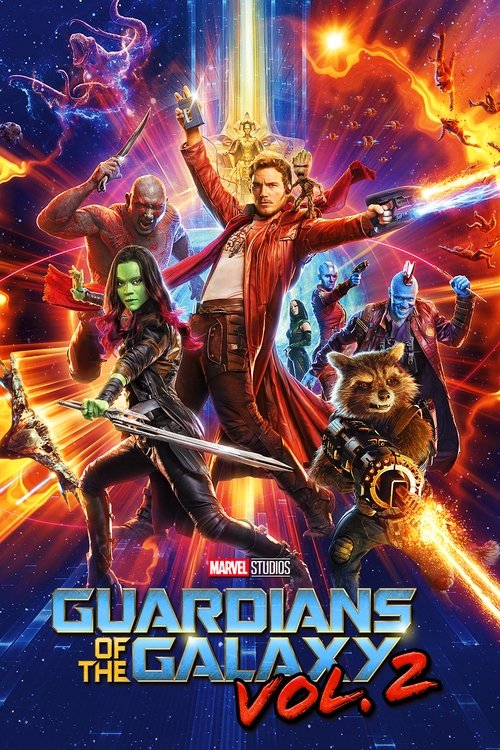
Guardians of the Galaxy Vol. 2 (2017) is a superhero film adapted from Marvel Comics, directed by James Gunn and starring Chris Pratt and Zoe Saldana. The film is part of the MCU and was released by Marvel Studios. Runtime: 2h 16m. Rated PG-13. Audience rating: 7.6/10.
What is Guardians of the Galaxy Vol. 2 (2017) about?
The Guardians struggle to keep their newfound family together while unraveling the mystery of Peter Quill's true parentage — with the fate of the universe at stake.
Released in 2017, Guardians of the Galaxy Vol. 2 was directed by James Gunn and produced under the Marvel Studios banner. The film occupies a significant place within the MCU — contributing to the ongoing narrative and mythology of that cinematic universe.
The film features lead performances from Chris Pratt, Zoe Saldana, Dave Bautista, among others, anchoring a story that adapts characters first brought to life in Marvel Comics. Its source material gives the film a foundation rooted in decades of published storytelling, which Gunn and the creative team interpret through a cinematic lens.
With an audience rating of 7.6, Guardians of the Galaxy Vol. 2 is generally praised as a strong entry in the superhero genre — its strengths in storytelling, performance, and production design regularly cited by viewers.
What happens in Guardians of the Galaxy Vol. 2 (2017)? — Full Plot
Missouri, 1980. A red 1979 Chevy convertible drives down a country highway in golden sundown. Behind the wheel is Meredith Quill — a young woman in her twenties, the same one who dies of cancer in 1988 in the prologue of Guardians of the Galaxy (2014). In the passenger seat is a tall, conventionally-handsome man with brown hair — Ego (Kurt Russell, dynamically de-aged for the prologue). Meredith and Ego are in love. They drive to a roadside meadow. He plants a small alien seedling in the grass and tells Meredith it will grow over time. He tells her he has to leave her — he's not from Earth, he's from somewhere far away, and his presence on Earth is finite. He kisses her. He vanishes in a flash of golden light. Meredith plants her hand on her stomach. She's pregnant with Peter Quill. The film's title card hits.
Present day, deep space. The Guardians of the Galaxy — Peter Quill / Star-Lord (Chris Pratt), Gamora (Zoe Saldana), Drax (Dave Bautista), Rocket Raccoon (Bradley Cooper voicing), and Baby Groot (Vin Diesel voicing) — are on a paid bodyguard contract for a gold-skinned humanoid species called the Sovereign. The Sovereign — a society of genetically-engineered superior humanoids led by High Priestess Ayesha (Elizabeth Debicki, gold-painted, magisterial) — are paying the Guardians with custody of Gamora's adopted sister Nebula (Karen Gillan) in exchange for protecting a vault of high-density Anulax energy batteries from a planet-sized inter-dimensional creature called the Abilisk. The opening scene is the iconic Baby Groot dancing sequence — Groot dancing to ELO's "Mr. Blue Sky" in slow motion across the empty stone arena while the rest of the Guardians are in mid-battle behind him, just barely in focus. The Guardians win. The Abilisk is defeated.
Then Rocket steals a single Anulax battery on his way out of the Sovereign vault. He's an unrepentant kleptomaniac. The Sovereign discover the theft within minutes, declare blood-debt against the Guardians, and launch a fleet of small remote-piloted star-drones to hunt them across the galaxy. The Milano is overwhelmed by Sovereign drones in deep space. The ship crashes through three solar systems trying to evade them. Then a single tall, golden-armored Celestial saucer arrives and one-handedly destroys the entire Sovereign drone fleet by erasing them from existence with a flick of energy.
Ego. The saucer is piloted by Ego (Kurt Russell, in full Celestial-cosmic-being mode) — Peter Quill's biological father, who has been searching the galaxy for his half-Celestial son for thirty years. Ego arrives at the wrecked Milano with his empath companion Mantis (Pom Klementieff, an antennaed empath who reads emotions by touch). Ego introduces himself as Peter's father, claims he's a Celestial — a primordial, near-immortal cosmic being — and offers to take Peter, Gamora, and Drax to his home planet to explain everything. Rocket, Baby Groot, and the captured Nebula stay behind at the Milano crash site to make repairs. Peter, Gamora, Drax, and Mantis fly off with Ego.
Ego's home planet. They arrive at a strange luminescent world that looks like a paradise — a glowing-pastel landscape of crystalline architecture, glowing rivers, sentient flora. Ego explains that the planet itself is his body — he's a Celestial, a being so cosmically powerful that he can manifest his consciousness across an entire planet-sized body of organic matter. The humanoid form Peter has been talking to is just a projected avatar of his actual planet-self. Ego has spent millions of years finding his way to physical creation in this corner of the galaxy. He's a god. He's also Peter's actual biological father. Mantis serves as Ego's caretaker. She's been with him since she was a child orphan. Ego found her on a planet that he had quietly colonized.
The Sovereign retaliation. Meanwhile, the Sovereign have hired the Ravagers — Yondu Udonta's old Ravager faction, the same pirate-mercenary group that raised Peter as a boy — to recapture the Guardians for the unpaid Anulax debt. Yondu (Michael Rooker) finds Rocket and Baby Groot at the Milano crash site on a forest planet and captures them. Then Yondu's first mate Taserface (Chris Sullivan) leads a mutiny — the Ravager crew has been resentful of Yondu's leniency toward Peter for decades — and seizes the ship from Yondu's command. Yondu and Rocket are imprisoned in the brig with Baby Groot. Taserface plans to execute them and renegotiate with Ayesha for double the bounty. Yondu, Rocket, and Baby Groot break out — Yondu still has his Ravager Yaka arrow, the telekinetic whistle-controlled flying spear that follows his commands. He whistles. The arrow rockets out of his pocket. The arrow kills 80 percent of the mutiny crew in the next 90 seconds — flying through cabin walls, popping skulls, decapitating Ravager guards. The Yondu-Rocket-Groot rescue scene is the most-violent Marvel comedy in the studio's history, scored to ELO's "Mr. Blue Sky." Yondu, Rocket, and Baby Groot retake the ship.
Nebula and Gamora reconciliation. On the planet where the Milano crashed, Nebula — chained to a piece of wreckage — has hours of conversation with her sister Gamora. The two adopted Thanos-daughter sisters have been at each other's throats for years, but in their shared captivity, Nebula breaks down. She reveals that every battle she ever lost to Gamora as a child was followed by Thanos forcing Nebula to undergo more cybernetic body upgrades — her right arm, her left eye, her chest plate, her right leg — all surgical replacements for what Thanos considered defective body parts that lost to Gamora. Nebula has spent her entire life being mutilated for losing to her sister. She has never wanted to win battles to please Thanos. She just wanted to live without losing more of her body. Gamora — who had assumed her sister always wanted to be Thanos's favorite — cries. They start to repair their relationship.
Ego's plan revealed. Back on Ego's home planet, Mantis reveals to Peter, Gamora, and Drax in a quiet kitchen-table conversation that Ego is not what he claims to be. Ego has scattered hundreds of Celestial seeds across thousands of planets in the galaxy. Each seed was meant to germinate into a new Celestial child — Ego planned to use them to expand his consciousness across the entire universe, terraforming every planet in the galaxy into part of his own body. Peter is Ego's hybrid half-human, half-Celestial firstborn. Ego needs Peter's Celestial DNA to be alive and connected to his planet to trigger the seeds' simultaneous activation. Ego has murdered every other female human partner he's ever sired children with — and Peter is the only surviving descendent because Yondu's Ravagers had picked Peter up off Earth before Ego could collect him. Ego planted Meredith's cancerous tumor in her brain because she was distracting Ego from his plan. Ego killed Peter's mother. Peter, hearing the truth, shoots Ego in the face with both Quad Blasters. The planet rumbles. Ego's plan ignites.
The Guardians reunite. Yondu, Rocket, and Baby Groot arrive at Ego's planet just as the Celestial-seed activation begins. The seeds across thousands of planets are simultaneously beginning to germinate — they look like glowing alien tumors emerging from forest floors, ocean beds, mountain ranges across hundreds of worlds. Ego's plan is in motion. The Guardians regroup. Drax holds back Mantis. Gamora and Nebula descend into Ego's planet core through a tunnel system. Peter, Yondu, and Rocket attack Ego's avatar form in the upper atmosphere. The fight is a massive psychedelic light-show of cosmic powers — Ego firing planet-energy blasts at Peter, Peter using his own Celestial-light powers for the first time (golden energy projecting from his hands), Yondu's Yaka arrow flying around the planet's atmosphere wreaking havoc on Ego's biological matter.
Yondu's sacrifice. As Gamora and Nebula reach the planet core and Rocket sets a magnetic detonator that will collapse Ego's central neural matter, the planet begins exploding from within. The Guardians have minutes to escape. Yondu uses his Aero-Rig jet pack to fly Peter into space — Peter has been disabled by Ego's final attack. They're at the edge of the planet's atmosphere when Yondu realizes there's only one Aero-Rig and only one space-helmet between the two of them. Yondu gives Peter his last space-helmet, fires the Aero-Rig's last propellant to throw Peter free of Ego's planet at escape velocity, and then drifts into the vacuum of space without breathing equipment. He's smiling. He looks at Peter. "He may be your father, boy. But he ain't your daddy." Yondu freezes in the vacuum of space and dies in the void. Peter, in the Aero-Rig, catches Yondu's frozen body. He cradles it. He sobs.
Ego dies. The detonator triggers. Ego's planet's central neural matter — which Ego the avatar had been controlled from — collapses into a black-hole-density singularity that swallows the entire planet from inside out. Ego the avatar disintegrates as the planet implodes. Mantis, who has been emotionally manipulating Drax with empathic care throughout the film and has betrayed her abusive caretaker Ego, joins the Guardians officially. The Milano lifts off the planet just as the implosion-event triggers. The team escapes into space.
Yondu's funeral. The Ravagers — Yondu's original blue-skinned Centaurian crew, now scattered across various pirate vessels — receive a transmission from the surviving Guardians explaining Yondu's sacrifice. Yondu was technically banned from the Ravager Code (the federation of pirate vessels) decades ago for child-trafficking — he had picked Peter up off Earth for a paying Ego-collection client and decided to keep him instead of delivering him, which broke the Ravager treaty. Stakar Ogord (Sylvester Stallone), the Ravager Federation captain who had banished Yondu, hears the news of Yondu's sacrifice for his adopted son. Stakar grants Yondu a full Ravager funeral. Yondu's body is launched into deep space in a Viking-style pyre, accompanied by Cat Stevens's "Father and Son" playing over the funeral. The Ravager fleet — fifty pirate vessels in formation — lights their own colored funeral plasma over Yondu's drifting pyre. The most-affecting funeral scene in modern superhero cinema. Peter, Drax, Gamora, Rocket, and Mantis all weep at the funeral.
Aftermath. Mantis is now officially a Guardian. Baby Groot has been re-planted by Rocket and is growing into Teenage Groot — a sullen, sarcastic, video-game-playing teenager version of Groot who refuses to clean his bedroom. Peter Quill has accepted that Yondu was his actual father — not the Celestial biological one. The Milano lifts off into space at sunset. The Guardians are seven now, not six. The team is the most family-like Marvel franchise team in Phase 3.
Mid-credits. The first stinger scene shows Stakar Ogord on his own Ravager vessel reuniting with the OG Ravager Federation — Sylvester Stallone (Stakar), Ving Rhames (Charlie-27), Michelle Yeoh (Aleta Ogord), Michael Rosenbaum (Martinex), and Miley Cyrus (Mainframe, in voice cameo). The OG Guardians of the Galaxy comic-book team is together again on screen for the first time. The post-credits scene shows Ayesha of the Sovereign in her command chamber, weeping at her loss against the Guardians. She presses a button. "I made him perfect. Strong. Intelligent. Capable. I shall call him. Adam." A gold-plated cocoon opens in her workshop revealing a humanoid figure inside. Adam Warlock — a major comics character — is teased for the first time in the MCU. He would not actually appear on screen until Guardians of the Galaxy Vol. 3 (2023).
Who stars in Guardians of the Galaxy Vol. 2 (2017)?
Find Guardians of the Galaxy Vol. 2 (2017) on Amazon
Watch Guardians of the Galaxy Vol. 2 on Prime Video, browse the original Marvel Comics source material, and discover Blu-rays, soundtracks, and related merchandise on Amazon.
As an Amazon Associate, I earn from qualifying purchases. Link clicks do not affect editorial coverage — see our disclaimer.
What are some facts about Guardians of the Galaxy Vol. 2 (2017)?
Guardians of the Galaxy Vol. 2 released in 2017, placing it within the 2010s era of comic book cinema — a decade that saw superhero films become the dominant force at the global box office.
Directed by James Gunn, the film was produced by Marvel Studios and adapts source material from Marvel Comics.
The principal cast features Chris Pratt and Zoe Saldana, with key supporting roles played by Dave Bautista, Michael Rooker, Kurt Russell.
The film belongs to MCU — the Marvel Cinematic Universe — the highest-grossing film franchise of all time.
Guardians of the Galaxy Vol. 2 carries an audience rating of 7.6 — putting it in the solid-to-excellent tier of the genre.
The Marvel Comics source material for Guardians of the Galaxy Vol. 2 has been in continuous publication for decades, giving filmmakers a rich well of storylines, character arcs, and iconography to draw upon.
Modern superhero films like this one use a mix of practical effects and digital VFX, with entire sequences often shot against volume walls or LED stages pioneered by shows like The Mandalorian.
Guardians of the Galaxy Vol. 2 is catalogued on Movies on Comics among our collection of 164 comic book films spanning 48 years of cinema — from Richard Donner's 1978 Superman to the present day.
Easter Eggs & Hidden Details in Guardians of the Galaxy Vol. 2 (2017)
James Gunn's sequel went deeper rather than wider. The deep cuts include Yondu's funeral as the franchise's most-quoted death scene and the Kurt Russell casting that was reverse-engineered from his real personality.
James Gunn cast Kurt Russell as Ego after writing the character as a fan-fictional version of the actor's real personality — easy-going cosmic charm, mild megalomania, classic-rock-era charisma. Russell's son Wyatt Russell played a younger Ego in flashback scenes. Gunn confirmed in commentary that the entire Ego concept was reverse-engineered from his pitch to Kurt Russell.
The film closes with Yondu's funeral — the Ravagers' flying coffin ceremony lit by hundreds of small ships. Peter delivers a eulogy that recognizes Yondu, not Ego, as his real father. The line 'He may have been your father, boy. But he wasn't your daddy' became one of the most-quoted MCU emotional moments.
Yondu's mid-flight quote — 'I'm Mary Poppins, y'all' — became one of the most-quoted MCU lines of 2017. Michael Rooker improvised the moment on set. The line plays off Peter Quill's pop-culture obsession and reframes Yondu's lifelong father-figure role.
Pom Klementieff was cast as Mantis after James Gunn's table-read process. Gunn has said in interviews he wrote the character around Klementieff's specific awkward charm. The empath-character's interactions with Drax — particularly the 'happiness/lust' empathic-reading scene — became the film's emotional highlight.
Sylvester Stallone cameos as Stakar Ogord — the original Ravager who exiled Yondu. The casting was a deliberate Gunn creative choice; Stallone had been a long-rumored Marvel cameo. He returns briefly in Vol. 3 (2023).
The film closes with an extended end-credits sequence featuring dancing characters across the Guardians universe. The sequence was widely cited as the franchise's most-celebrated end-credits dance — extending the original Baby-Groot dance from Vol. 1 (2014).
The reveal that Peter Quill is Ego's biological son — and that Ego is a Celestial planning to assimilate the universe — was the franchise's largest cosmic-scale reveal at the time of release. The reveal directly informed the cosmic-stakes premise of Infinity War (2018).
Awesome Mix Vol. 2 — the film's soundtrack — hit the Billboard top 10. The album wasn't quite as commercially successful as the original Vol. 1 (2014) soundtrack (which hit #1), but established the franchise's continuing musical commitment.
Howard the Duck — the franchise's recurring Easter egg character — appears briefly during a Ravager funeral attended by Stakar Ogord. The cameo was Gunn's continuing tribute to the much-mocked Howard the Duck (1986) film.
James Gunn had been previously known for R-rated indie films like Slither (2006). Marvel deliberately kept the Guardians Vol. 2 PG-13. Gunn has said in interviews that he was deliberately self-restraining his R-rated tendencies; the choices led to his eventual The Suicide Squad (2021) R-rated work.

💬 Reader Comments