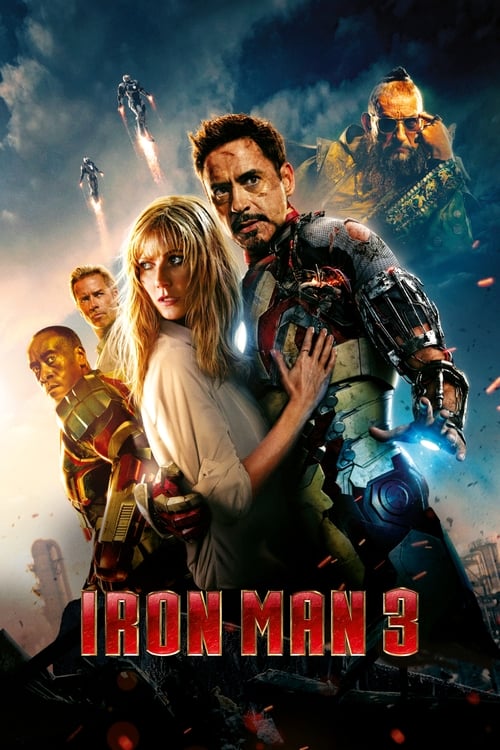
Iron Man 3 (2013) is a superhero film adapted from Marvel Comics, directed by Shane Black and starring Robert Downey Jr. and Gwyneth Paltrow. The film is part of the MCU and was released by Marvel Studios. Runtime: 2h 10m. Rated PG-13. Audience rating: 7.1/10.
What is Iron Man 3 (2013) about?
After a series of bombings by a terrorist calling himself the Mandarin, Tony Stark — suffering from PTSD — is pushed to his limits without his suit and must uncover the truth.
Released in 2013, Iron Man 3 was directed by Shane Black and produced under the Marvel Studios banner. The film occupies a significant place within the MCU — contributing to the ongoing narrative and mythology of that cinematic universe.
The film features lead performances from Robert Downey Jr., Gwyneth Paltrow, Don Cheadle, among others, anchoring a story that adapts characters first brought to life in Marvel Comics. Its source material gives the film a foundation rooted in decades of published storytelling, which Black and the creative team interpret through a cinematic lens.
Its 7.1 rating reflects a film that divided audiences — appreciated for its ambition and spectacle by some, criticized for pacing and execution by others. Its place in the genre remains a frequent discussion point.
What happens in Iron Man 3 (2013)? — Full Plot
Tony Stark's voice narrates over a quiet shot of the dark Pacific. "A famous man once said, we create our own demons. Who said that? What does that even mean?" The film cuts to Bern, Switzerland, December 31, 1999. Tony Stark, twenty-eight years old, in a tuxedo, drunk at a science conference. He's coming off a year of Stark Industries' biggest contracts and three magazine covers, and a guy named Aldrich Killian — gangly, balding early, walking with a cane, holding a binder labeled A.I.M. ADVANCED IDEA MECHANICS — approaches Tony in the hallway with a business pitch. Tony tells Killian to meet him on the roof in five minutes and never goes up there. Killian waits on the windy roof through the entire New Year's countdown. Tony, meanwhile, is in a hotel suite with a beautiful biologist named Maya Hansen who's working on a regenerative compound she calls Extremis — a virus that lets cells regrow lost limbs at the cost of, occasionally, exploding. Tony improvises a fix on Maya's blueprint at four AM and walks out at sunrise leaving her his number, which he later doesn't pick up. Killian, on the roof, freezes. He goes home. He gets cancer. He decides Tony Stark will pay.
Fourteen years later, post-Battle of New York. Tony has not slept for ninety-six hours. He's in his Malibu workshop building Iron Man armors — the Mark 33, Mark 34, Mark 35 are all stacked along the wall. He's at Mark 42, a prosthetic-control suit that flies in pieces and assembles itself around him. Pepper Potts comes home to find him crawling under a workbench in a half-disassembled chest plate. He has PTSD from the wormhole. Anyone says "New York" and his heart rate triples. He has panic attacks looking at Iron Man action figures in a store. He is awake at four in the morning every night welding plate metal because the alternative is closing his eyes and dreaming about the wormhole. The first twenty minutes of the film is the most psychologically honest portrait of a superhero in the entire MCU: a billionaire alcoholic genius drowning in trauma and replacing his marriage with engineering work.
Meanwhile, on every American cable news channel, a bearded man in elaborate robes appears on hijacked broadcasts and claims responsibility for a string of bombings. He calls himself the Mandarin. He invokes Sun Tzu, the Boxer Rebellion, the American imperial impulse, the Marlboro Man, and bedtime stories. He's been blowing up American military installations and shopping malls in a rolling campaign and the President's intelligence services can't find his signal source. Six soldiers dead at a base in Pakistan. Two civilians at a Tennessee strip mall. Twelve at a Chinese Theater in LA. Then the eight-bomb-per-week tempo starts accelerating.
At the Chinese Theater attack, Happy Hogan — Tony's old chauffeur, now Pepper's head of security at Stark Industries — was investigating Killian's odd visits to a Stark Industries executive. He sees something. He follows the man into the alley. He's caught in the heat blast of an Extremis-induced explosion. He survives in a coma. Tony, watching news footage of Happy in the burn ward, snaps. He walks out of his Malibu mansion onto his front porch with a swarm of news cameras already camped at the gate. He reads the Mandarin's mailing address off his own phone live on camera. "My address is 10880 Malibu Point, 90265. I'll be there. I'm not afraid of you. I'm not hiding." He drops the phone in the bushes.
Helicopters arrive that night. Three armed gunships from the Mandarin's cell open fire on the cliff-side mansion from above. Pepper is in the bedroom upstairs. Tony catches the first inbound missile in the open doorway. The Mark 42 — which has been responsive to him through wireless prosthetic implants embedded under his skin — assembles around Pepper instead, because Tony forced it on her first to protect her. Maya Hansen — the same biologist from 1999, now Killian's project lead at A.I.M. — is in the house too, having arrived to warn Tony about Killian an hour earlier. The mansion is torn apart by missile strikes and slides off its cliff into the ocean in a single ten-minute sequence. Pepper, in the Mark 42, jumps off the collapsing terrace and escapes inland. Tony, in nothing but a coat and pants, ends up trapped in the underwater wreckage of his own workshop. The Mark 42, on the inland side of the cliff, returns for him on JARVIS's autopilot and fishes him out from the bay.
The Mark 42 boots into emergency mode with twenty percent battery. JARVIS, on JARVIS's last working server, autopilots Tony to a precomputed safe destination he doesn't quite remember setting — the small Tennessee town of Rose Hill, the site of one of the Mandarin's earliest "bombings" months earlier. The Mark 42 lands in the snow in a barn outside town and runs out of power. Tony, in his sock feet, walks across a frozen field to the nearest building — a single-wide trailer with the lights on. A ten-year-old kid named Harley Keener is inside doing his Christmas math homework. Harley sees the world-famous Iron Man crawl into his garage in a half-broken suit and immediately offers him a tuna sandwich. Tony spends the next three days in Rose Hill investigating the Tennessee "bombing" with Harley as his apprentice, paying for the repairs out of his pocket and bantering with the kid like a deadpan adult friend, not a kid sidekick.
What Tony learns in Rose Hill: there was no Mandarin bomb. There were no bomb fragments. The blast crater was caused by an Extremis subject — a former soldier with PTSD recruited into A.I.M.'s human trials — combusting from the inside out when the regenerative virus failed to stabilize in his cells. The Mandarin's bombings are A.I.M. covering up its own failed test subjects' combustion deaths. Tony tracks the Extremis trial subject's widow to a local bar. She's an Extremis success — she demonstrates regenerated tissue, raised body temperatures, and the ability to glow red-hot at will. She's a sleeper agent. She and another Extremis soldier attack Tony in the bar. He kills both with improvised weapons from the local Home Depot. He calls Rhodey. Rhodey isn't picking up.
Rhodey's been hijacked too. The War Machine armor — recently repainted red-white-blue and renamed Iron Patriot by Killian's PR machine to better serve the post-9/11 War on Terror — has been digitally compromised by A.I.M.'s engineers. Rhodey-as-Iron-Patriot has been flying missions in Pakistan tracking the Mandarin's signal under what he believes is Pentagon authority. The Pentagon is the Vice President of the United States, Rodriguez, who has been Killian's mole since Killian fixed his disabled daughter with Extremis. Iron Patriot is being aimed at Air Force One.
Tony tracks the Mandarin's signal — through Pepper, who's been remotely cell-phone-tracing Killian's network from the Mark 42's spare uplink — to a beach mansion in Miami. He breaks in through the wall with a homemade taser-cannon and a Home Depot bag of repulsor parts. He clears six guards. He finds the Mandarin's bedroom. He bursts in. The Mandarin is in bed with two women, watching cricket on a flatscreen, drinking a beer, in his underwear, in a stained robe. He's a drunk fifty-year-old British stage actor named Trevor Slattery from Croydon who got hired by A.I.M. through a sketchy producer who promised him steady work after the failed Shakespearean tour. He has no real terrorist organization. He has no real ideology. He has memorized the speeches Killian wrote for him and reads them on camera in exchange for a steady supply of drugs and prostitutes. He giggles. "There's gonna be some consequences, mate. I do believe." Tony stares. The Mandarin is a fictional character A.I.M. invented to give the United States a perpetual war.
Killian, the real villain, runs the operation from a private compound where he holds Pepper Potts hostage and has had her dosed with Extremis. His grand plan: he and Vice President Rodriguez frame the Mandarin for an attack on President Ellis aboard Air Force One; Rodriguez succeeds to the presidency; Rodriguez signs A.I.M.'s contracts for a permanent military Extremis program. Killian controls both the supply (the terrorists) and the demand (the antiterror) for the next forty years of the American war machine. It's the cleanest war-profiteering scheme any MCU villain has ever proposed and the script doesn't make it sound silly.
Tony intercepts Air Force One in midair over Pennsylvania. Iron Patriot has dropped President Ellis through an exit hatch on a parachute under Killian's remote control. Tony catches Ellis in the freezing slipstream and drops him to safety. Then he watches in horror as Iron Patriot's wing strike destroys the cabin pressurization and thirteen civilian passengers — staff, advisors, secretaries — are sucked out the breach in the fuselage at thirty thousand feet. Tony, the Mark 42 in tatters now, dives after them. He commands JARVIS through his prosthetic implants to deploy what he calls the Barrel of Monkeys protocol: he scoops the falling civilians in a chain, hand-to-hand-to-hand, until they're all linked by their wrists in a long swinging garland of bodies. He lowers the whole garland into a Florida bay at low altitude. Every passenger lives. He delivers them to a Coast Guard cruiser. He immediately falls into the ocean, exhausted, the Mark 42 running on fumes.
Killian's final move is at an impounded oil tanker called the Norco docked outside Miami. Pepper is there, suspended over a vat of fire, while a dozen Extremis-modified soldiers including Savin (Killian's lieutenant) and Aldrich himself prepare to launch the final operation. Tony, on the dock with no armor, calls JARVIS. "Activate the House Party Protocol." Up at the Malibu wreckage, a hidden underground bunker opens and forty-two functioning Iron Man suits — every prototype, every retired model, every spare, all wirelessly linked — fire out of the cavity and launch toward Miami at Mach 3. They arrive in sixty seconds. They fly over the dockyard in formation. Tony, on the dock, summons individual suits to attach to him in pieces — left arm, right arm, helmet, leg armor — and switches suits in mid-fight as one breaks. The remaining suits fight Extremis soldiers around him in a forty-piece battle royale. "You really want one of these?" Tony tells Killian. "You can't have it. I don't owe you anything." Pepper falls off the catwalk through the flames as Killian taunts him.
After the dock fight, Tony — armor destroyed, mansion underwater, two suits left out of forty-two — declares his anxiety over. He activates the Clean Slate Protocol: every remaining Iron Man suit in the world, including the one on his body and the dozens stored in his backup hangars, launches into the sky and detonates over the Miami coastline in a spectacular nighttime fireworks display. The cliffside-mansion debris in the Pacific gets vaporized by the same protocol. He's choosing to walk away. He has Pepper. He has Rhodey alive. The Mark 42 reactor on his chest, the only one not destroyed, gets surgically removed three months later in a thoracic operation he should have had years ago. He drops the original spike of shrapnel that had been embedded in his ribs since Iron Man (2008) into the Pacific. Pepper watches the surgery on a hospital monitor. He's done with the chest reactor. He's done with the suits. He's not done with being Iron Man.
The frame story closes out. Tony has been narrating the entire film as a confessional to Bruce Banner in an upscale Manhattan apartment. He looks across the room. Bruce is sound asleep in a chair, mouth slightly open. "You're a terrible therapist." Bruce snorts awake. "I'm not — that kind of doctor. I'm an Avenger. You know that." "Yeah." Tony walks across the room and shakes him alive. Trevor Slattery, in jail, is becoming a celebrity inmate. Vice President Rodriguez is impeached. President Ellis personally awards Tony Stark a presidential medal for the rescue. Cut to a shot of the Pacific Ocean. Tony's final voice-over: "Are you allowed to cry in the Vatican? You can take away my house, all my tricks and toys. One thing you can't take away — I am Iron Man." Cut to black. The film ends as the most personal, traumatized, post-superhero film Marvel has ever made and the audience doesn't know yet that Age of Ultron (2015) is about to make him build forty more suits anyway.
Who stars in Iron Man 3 (2013)?
Find Iron Man 3 (2013) on Amazon
Watch Iron Man 3 on Prime Video, browse the original Marvel Comics source material, and discover Blu-rays, soundtracks, and related merchandise on Amazon.
As an Amazon Associate, I earn from qualifying purchases. Link clicks do not affect editorial coverage — see our disclaimer.
What are some facts about Iron Man 3 (2013)?
Iron Man 3 released in 2013, placing it within the 2010s era of comic book cinema — a decade that saw superhero films become the dominant force at the global box office.
Directed by Shane Black, the film was produced by Marvel Studios and adapts source material from Marvel Comics.
The principal cast features Robert Downey Jr. and Gwyneth Paltrow, with key supporting roles played by Don Cheadle, Guy Pearce, Ben Kingsley.
The film belongs to MCU — the Marvel Cinematic Universe — the highest-grossing film franchise of all time.
Iron Man 3 carries an audience rating of 7.1 — putting it in the solid-to-excellent tier of the genre.
The Marvel Comics source material for Iron Man 3 has been in continuous publication for decades, giving filmmakers a rich well of storylines, character arcs, and iconography to draw upon.
Modern superhero films like this one use a mix of practical effects and digital VFX, with entire sequences often shot against volume walls or LED stages pioneered by shows like The Mandalorian.
Iron Man 3 is catalogued on Movies on Comics among our collection of 164 comic book films spanning 48 years of cinema — from Richard Donner's 1978 Superman to the present day.
Easter Eggs & Hidden Details in Iron Man 3 (2013)
Shane Black's character-driven film let Tony Stark spend most of the runtime out of the armor. The deep cuts include Black's RDJ improv method and the Mandarin twist that infuriated comic-book fans.
Shane Black — known for Lethal Weapon and Kiss Kiss Bang Bang — directed and co-wrote Iron Man 3. Black and Robert Downey Jr. heavily improvised dialogue on set, rewriting large portions of Drew Pearce's script. The conversations with Harley Keener, the entire Tennessee subplot, and Tony's PTSD acknowledgment were largely Black/RDJ creations.
When Tony breaks into the Mandarin's compound, he discovers Ben Kingsley's character is actually Trevor Slattery — a British actor hired to play a public-facing villain. The real villain is Killian. The reveal was meant as a comedic subversion of expectations, but split the MCU fandom badly. Marvel later canonized the 'real' Mandarin in Shang-Chi (2021).
Tony's command 'House Party Protocol' triggers his Iron Legion deployment from his Malibu garage. The phrase became a recurring MCU joke. The Iron Legion concept inspired the drone-army premise in Age of Ultron (2015) and Civil War (2016).
The film's portrayal of Tony's post-Battle-of-New-York PTSD became the franchise's defining post-Avengers character development. Tony's panic attacks at the mention of New York were widely cited as some of the most-emotionally-mature acting in any MCU film.
Ben Kingsley's portrayal of the Trevor Slattery 'Mandarin' was widely cited as one of the funniest performances in any MCU film. Slattery returned in the Marvel One-Shot short film 'All Hail the King' (2014) and Shang-Chi (2021).
Ty Simpkins's Harley Keener — the 10-year-old who helps Tony in Tennessee — was widely cited as one of the franchise's most-effective character pairings. The character later silently returns in Avengers: Endgame (2019) attending Tony's funeral.
Pepper, dosed with Extremis by Killian, briefly becomes superhuman during the climactic fight. The choice to give Pepper temporary superpowers was widely cited as one of the franchise's most-progressive choices at the time. The powers are eventually neutralized.
At the film's climax, Tony has surgical surgery to remove the shrapnel from his chest. The arc reactor — established as life-sustaining in Iron Man (2008) — is removed. Tony throws it into the ocean as a symbolic farewell to the suit.
Rhodey's War Machine armor was repainted as the Iron Patriot — a more-American-flag-themed redesign — for political marketing reasons. The decision was a deliberate satire of post-9/11 American iconography.
The film opens with AC/DC's 'Back in Black' — continuing the franchise's AC/DC commitment from Iron Man (2008) and Iron Man 2 (2010). The choice was Shane Black's deliberate decision.

💬 Reader Comments