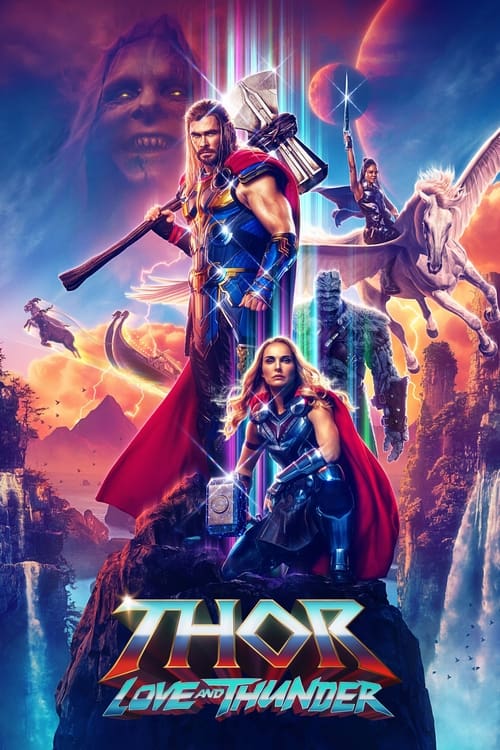
Thor: Love and Thunder (2022) is a superhero film adapted from Marvel Comics, directed by Taika Waititi and starring Chris Hemsworth and Natalie Portman. The film is part of the MCU and was released by Marvel Studios. Runtime: 1h 58m. Rated PG-13. Audience rating: 6.2/10.
What is Thor: Love and Thunder (2022) about?
Thor embarks on a soul-searching journey to find inner peace but his retirement is interrupted by Gorr the God Butcher, a galactic killer who seeks the extinction of the gods.
Released in 2022, Thor: Love and Thunder was directed by Taika Waititi and produced under the Marvel Studios banner. The film occupies a significant place within the MCU — contributing to the ongoing narrative and mythology of that cinematic universe.
The film features lead performances from Chris Hemsworth, Natalie Portman, Christian Bale, among others, anchoring a story that adapts characters first brought to life in Marvel Comics. Its source material gives the film a foundation rooted in decades of published storytelling, which Waititi and the creative team interpret through a cinematic lens.
The film's 6.2 audience rating indicates a mixed response. Even so, it holds interest as part of the broader MCU catalogue and for how it fits into the lineage of Marvel Comics-based cinema.
What happens in Thor: Love and Thunder (2022)? — Full Plot
A desert planet at the edge of the universe. Gorr (Christian Bale, gaunt, bald, in tattered robes) and his young daughter are dying of thirst. Gorr has been a devout believer in his god Rapu, the planet's deity, for years. He has been praying for his daughter's life and for an oasis. Neither has come. His daughter dies of dehydration in his arms. Gorr buries her with his bare hands at sunset. He drinks the last of his water and then walks into the desert to die. He stumbles onto an oasis at the planet's hidden center where Rapu the god — Jonny Brugh, in golden robes and a feathered crown — is hosting a feast with a half-dozen lesser gods, ignoring his dying worshippers. Gorr falls at Rapu's feet, weeping. Rapu mocks him. "Suffering is your purpose. Your function. Your faith is fed by my misery." Then a sentient black sword speaks to Gorr from a pool of black ink at his feet. The Necrosword — a god-killing weapon forged by a long-dead cosmic deity — recognizes Gorr's grief and offers him purpose. Gorr picks up the Necrosword. He cuts off Rapu's head in one motion. He turns to the lesser gods. He becomes the God Butcher. The Necrosword's curse begins to consume his body in real time — his skin pales to chalk, his eyes turn pitch black, his hair falls out. He commits himself to murdering every god in the universe. Title card.
Cut to space. Thor (Chris Hemsworth, in fighting shape, with long hair and a beard) has been traveling with the Guardians of the Galaxy since the events of Endgame (2019). He's been a quiet member of their team for three years. He's been doing god-fight contract work — defending oppressed civilizations on backwater planets — between Guardians missions. The opening montage shows Thor in his Asgardian armor punching out cosmic mercenaries on a half-dozen alien planets. Korg (Taika Waititi's own voice) narrates the entire montage in his soft Kiwi accent as if telling a bedtime story to children. Korg is now Thor's traveling companion — they've been together since Ragnarok (2017). The Guardians of the Galaxy briefly appear as guest stars (Star-Lord, Rocket, Groot, Mantis, Drax, Nebula) and bicker with Thor on whether he should leave the team. He stays for a few days. Then Sif (Jaimie Alexander, returning from Thor (2011)) sends Thor a distress message: Gorr the God Butcher has just slaughtered three Asgardian children on the planet Indigarr. Sif is wounded in the fight. Thor must return to New Asgard.
New Asgard. The fishing village from Ragnarok's epilogue, three years post-Snap. King Valkyrie (Tessa Thompson, in royal armor) has been governing the Asgardian refugee community as their elected leader. The village has expanded — there are now amusement-park-style tourist attractions throughout the village. The Asgardian children play in the streets. Valkyrie has been a competent administrator but bored by the lack of warriorhood the role offers her. She has been quietly drinking. Thor and Korg arrive at the village. They're greeted by Valkyrie at the dock.
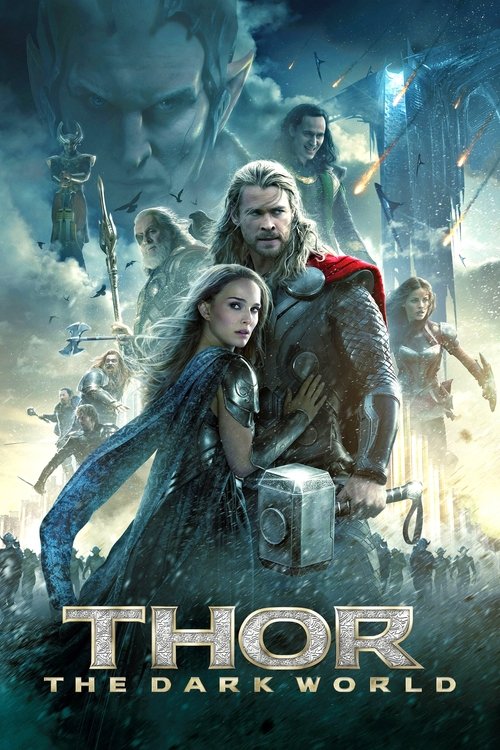
Jane Foster as the Mighty Thor. Then a thunderclap echoes across the village square. Mjolnir — Thor's old hammer, destroyed by Hela in Ragnarok seven years ago — has reassembled itself from its shattered fragments and is hovering above a stone pillar in the village's central plaza. Holding the hammer is a tall, blonde woman in full Asgardian battle armor — Jane Foster (Natalie Portman, who hadn't appeared in the MCU since 2013's Thor: The Dark World (2013)). Jane has stage IV breast cancer that has spread throughout her body. She has months to live. She had been searching for any way to extend her life and had heard the legend of Mjolnir's restorative healing powers. She traveled to New Asgard secretly, asked Mjolnir to heal her, and the hammer — recognizing her as worthy because Thor had once whispered an enchantment over it in Dark World hoping the hammer would always protect Jane — bonded to her body and made her the Mighty Thor. Jane is now wearing Thor-tier Asgardian armor and wielding Mjolnir with full strength.
Gorr arrives in New Asgard. Mid-greeting, Gorr the God Butcher arrives at New Asgard. He's been tracking Thor's location for months. He's not interested in fighting the Asgardian people — he wants only Thor's god-killing weapon Stormbreaker, which contains a cosmic-key signal that can lead him to Eternity, a cosmic primordial entity at the center of the universe who can grant any single wish to any one being. Gorr's plan: use Stormbreaker to find Eternity and wish all gods in the universe out of existence simultaneously. He kidnaps every Asgardian child from the village — about fifty children — and locks them in a cage of Necrosword-shadow energy in a hidden Shadow Realm dimension as bait.
Toothgnasher and Toothgrinder. To pursue Gorr, Thor and Valkyrie need cosmic-scale transportation. Thor calls in his royal Asgardian goats Toothgnasher and Toothgrinder (a comics deep-cut — Thor in the Marvel comics has driven a chariot pulled by celestial goats since 1962). The two goats are the size of small elephants and have been hidden in a New Asgard barn. Thor harnesses them to a Viking longship and uses Stormbreaker as a Bifrost signal to teleport the longship-and-goats across the galaxy. Thor, Valkyrie, Jane (as Mighty Thor), and Korg ride the goat-pulled Viking longship through deep space toward Omnipotence City. The goats scream a high-pitched battle cry the entire trip. The scene is widely-mocked online as the MCU's most-tonally-confused set piece.
Omnipotence City. The team arrives at a glittering Roman-architecture-style space platform — a gathering place for every active god in the universe. Zeus (Russell Crowe, in golden toga and laurel wreath, with a thick Greek accent and ostentatious mannerisms) is the celebrity-king of Omnipotence City. He's surrounded by court flatterers. Thor pleads with Zeus to assemble the assembled gods into a coordinated defense against Gorr. Zeus refuses — he doesn't believe Gorr can defeat all the gods in time, and the gods have been hiding from Gorr's threats for months in any case. He has Thor's team imprisoned. Thor escapes by stealing Zeus's lightning bolt — the artifact of pure cosmic thunder — and using it to fight his way out. He severs Zeus's lightning-bolt arm. He kills Zeus (or appears to — Zeus survives, see the post-credits). Thor, with Zeus's bolt now in his possession, has dramatically upgraded his cosmic power.
Shadow Realm rescue. The team enters the Shadow Realm — a Necrosword-shadow dimension where Gorr has been hiding the kidnapped Asgardian children. The Shadow Realm is shot in pure black-and-white film — the only color is the children's bright Asgardian clothes and the heroes' costumes against the monochrome backdrop. The team fights through dozens of Necrosword-shadow monsters Gorr has summoned. Jane, mid-fight, weakens — every time she summons Mjolnir, the hammer drains her remaining cancer-fighting cells. Her body is fully chemoed and the cancer is spreading. She has hours to live. She refuses to stop fighting.
Children rescued. The team frees the Asgardian children. Heimdall the Asgardian watchman (a brief cameo-appearance — Idris Elba reprising the role posthumously through Stormbreaker channeling) appears in vision to give the children courage. Each child is given a small Asgardian weapon — daggers, axes, swords — and joins the fight against the shadow-monsters. The shadow-children's-army moment is widely cited as Waititi's most-touching directorial choice. The fifty Asgardian children, in their elementary-school clothes, march behind the heroes wielding tiny swords. The fight wins. The children are freed and returned to New Asgard.
Gorr's escape with Stormbreaker. Gorr, watching the shadow-realm battle, has been waiting. As the team is celebrating the children's rescue, Gorr steals Stormbreaker from Thor's unconscious body. He has now achieved his goal: he has a god-killer weapon that can navigate to Eternity. He warps directly to Eternity's deep-cosmic location to make his wish.
Eternity. Thor and Jane chase Gorr through the cosmic tunnel that opens when Stormbreaker is used as a Bifrost. They emerge at Eternity — a vast, sentient, cosmic-entity at the center of the universe. Eternity is an enormous bipedal humanoid form composed of stars and galaxies, half-translucent against the cosmic background. Eternity will grant any one being's single wish. Gorr is about to wish all gods out of existence. Thor and Jane attack him. Jane, with the last of her strength, channels Mjolnir's lightning into Gorr's Necrosword arm. She kicks the Necrosword out of his hand. She collapses, exhausted. Gorr, weaponless now, has only seconds before Eternity revokes his wish-petition. He looks at Jane Foster — exhausted, dying, having just sacrificed herself to save the gods she doesn't even believe in. He looks at Thor. He decides his wish.
Gorr's choice. Gorr does not wish for all gods to die. He uses his single wish to bring his daughter Love back from the dead. He places his hand on Jane's shoulder as he wishes — Eternity, recognizing the wish, materializes a six-year-old girl in pure golden light. Love (India Rose Hemsworth, played by Chris Hemsworth's actual daughter) is alive. She is bewildered. She walks to Gorr, who is dying from the Necrosword's curse, and hugs him. Gorr asks Thor to take care of his daughter. He dies in his daughter's arms. Eternity vanishes. The cosmic tunnel closes.
Jane's death. Jane Foster has minutes left. Her cancer has fully consumed her. Thor kneels beside her on the floor of the empty cosmic chamber. They had loved each other for years before her cancer diagnosis pulled her away. She admits she wishes they had more time. Thor admits the same. They kiss for the first time in nearly a decade. She dies in his arms. He flies her body back to New Asgard via Bifrost. He places her body in a state Asgardian funeral on a Viking longship. The longship is set on fire and floats out into the New Asgard harbor at sunset. Mjolnir's pieces lie quiet on the village floor — she had used the hammer's power to revive Gorr's daughter at the last moment.
Adoption. Thor adopts Love, Gorr's now-orphaned daughter. The two of them — Thor as a single father, Love as a six-year-old daughter — return to Earth. The film closes with a training-montage epilogue: Thor in full Asgardian armor, holding Stormbreaker, teaches young Love how to call down lightning and swing a hammer. They become Love and Thunder — a father-daughter superhero duo. Thor has finally found a family. He has finally retired from the Avengers. Cut to credits.
Mid-credits. Omnipotence City. Russell Crowe's Zeus is bandaged on his throne, recovering from Thor's lightning-bolt attack. He has been brooding for weeks. He summons his son to the throne room — a tall, muscular, golden-haired warrior — Hercules (Brett Goldstein in his MCU debut). Zeus charges Hercules with the assassination of Thor as revenge for the lightning theft. Cut to credits. Hercules has not yet appeared in any subsequent Marvel film as of late 2026.
Post-credits. Jane Foster, now dead, arrives at the gates of Valhalla — the Asgardian afterlife realm reserved for warriors who die in battle. Heimdall meets her at the gates. "Welcome, Jane Foster. Welcome to Valhalla." The film closes on her smiling face as she walks into Valhalla in golden light. Cut to credits.
Who stars in Thor: Love and Thunder (2022)?
Find Thor: Love and Thunder (2022) on Amazon
Watch Thor: Love and Thunder on Prime Video, browse the original Marvel Comics source material, and discover Blu-rays, soundtracks, and related merchandise on Amazon.
As an Amazon Associate, I earn from qualifying purchases. Link clicks do not affect editorial coverage — see our disclaimer.
What are some facts about Thor: Love and Thunder (2022)?
Thor: Love and Thunder released in 2022, placing it within the 2020s era of comic book cinema — a decade that saw superhero films become the dominant force at the global box office.
Directed by Taika Waititi, the film was produced by Marvel Studios and adapts source material from Marvel Comics.
The principal cast features Chris Hemsworth and Natalie Portman, with key supporting roles played by Christian Bale, Tessa Thompson.
The film belongs to MCU — the Marvel Cinematic Universe — the highest-grossing film franchise of all time.
Thor: Love and Thunder carries an audience rating of 6.2 — a middling reception but one that hasn't prevented its cultural footprint.
The Marvel Comics source material for Thor: Love and Thunder has been in continuous publication for decades, giving filmmakers a rich well of storylines, character arcs, and iconography to draw upon.
Modern superhero films like this one use a mix of practical effects and digital VFX, with entire sequences often shot against volume walls or LED stages pioneered by shows like The Mandalorian.
Thor: Love and Thunder is catalogued on Movies on Comics among our collection of 164 comic book films spanning 48 years of cinema — from Richard Donner's 1978 Superman to the present day.
Easter Eggs & Hidden Details in Thor: Love and Thunder (2022)
Taika Waititi's tonal sequel to Ragnarok divided audiences. The deep cuts include Christian Bale's 30-pound weight loss for Gorr and Natalie Portman's franchise comeback.
Christian Bale — known for extreme physical transformations — lost approximately 30 pounds for the role of Gorr the God Butcher. Bale spent four months on a dramatic weight-loss protocol. The character's gaunt, skeletal appearance was a deliberate visual choice to contrast with his pre-loss farmer self in the prologue.
Natalie Portman last appeared as Jane Foster in Thor: The Dark World (2013). She reportedly returned for Love and Thunder specifically because the role was reframed — Jane Foster becomes the Mighty Thor, wielding Mjolnir. The decision drew from the 2014 comic-book run by Jason Aaron.
Russell Crowe's Zeus — depicted as a cowardly hedonist — was widely cited as the film's most-divisive choice. The deliberately-comedic portrayal contrasted with the franchise's traditional cosmic-deity reverence. Crowe later reprised the role in What If...? Disney+ series.
The film's deliberate alternation between Bale's serious Gorr arc and Waititi's continuing comic register was widely cited as the year's most-divisive tonal choice. Critics responded with mixed reviews. The film's commercial success ($760M globally) was below Ragnarok (2017).
Tessa Thompson's Valkyrie became Marvel's first openly LGBTQ+ MCU hero through the character's confirmed sexuality. Thompson has continued in the role across multiple MCU appearances.
Jane Foster — having been weakening from her cancer — dies in Thor's arms after delivering the killing blow against Gorr. The death was widely cited as one of the franchise's most-significant character losses of Phase 4.
Gorr's wish — granted by the universe at the moment of his death — brings his daughter back to life. The wish-reversal becomes the film's emotional resolution. Thor takes the daughter as his adopted child.
The Guardians of the Galaxy team — last seen in Endgame (2019) — briefly accompany Thor in the film's opening. The continuity acknowledges the team's role in supporting Thor's post-Endgame depression.
Korg — Waititi's recurring rock-warrior character — has his stone body fully shattered during the film's third act. The character is reduced to just his head, which is later restored. Korg's deliberate fragility became the franchise's most-comedic running gag.
The film retroactively establishes that Asgard has always been part of a broader pantheon of cosmic gods — including Zeus, Bao the God of Dumplings, and others. The retcon was widely cited as a deliberate Waititi creative expansion.
💬 Reader Comments