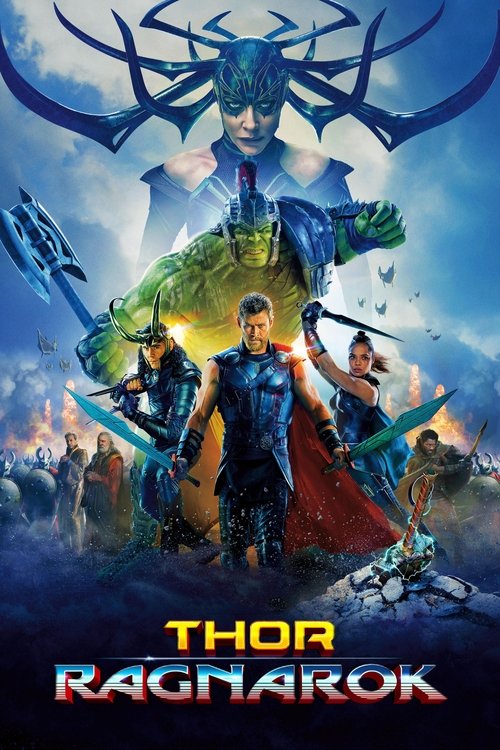
Thor: Ragnarok (2017) is a superhero film adapted from Marvel Comics, directed by Taika Waititi and starring Chris Hemsworth and Tom Hiddleston. The film is part of the MCU and was released by Marvel Studios. Runtime: 2h 10m. Rated PG-13. Audience rating: 7.9/10.
What is Thor: Ragnarok (2017) about?
Thor is imprisoned on the other side of the universe and must race against time to return to Asgard to stop Ragnarök — the destruction of his home — from the hands of his powerful sister Hela.
Released in 2017, Thor: Ragnarok was directed by Taika Waititi and produced under the Marvel Studios banner. The film occupies a significant place within the MCU — contributing to the ongoing narrative and mythology of that cinematic universe.
The film features lead performances from Chris Hemsworth, Tom Hiddleston, Cate Blanchett, among others, anchoring a story that adapts characters first brought to life in Marvel Comics. Its source material gives the film a foundation rooted in decades of published storytelling, which Waititi and the creative team interpret through a cinematic lens.
With an audience rating of 7.9, Thor: Ragnarok is generally praised as a strong entry in the superhero genre — its strengths in storytelling, performance, and production design regularly cited by viewers.
What happens in Thor: Ragnarok (2017)? — Full Plot
Thor, mid-monologue, hangs upside down in a cage swinging from a chain in a fire-realm called Muspelheim. He's been chained for hours. His captor is a giant horned fire demon called Surtur — Clancy Brown's voice, prophet of the end times, with a crown of burning iron on his head. Surtur explains that he will fulfill the Asgardian prophecy of Ragnarok — the destruction of Asgard — by uniting his crown with the Eternal Flame in Odin's vault. Thor, hanging upside down, narrating the entire sequence to himself, finds the timing of the chain's swing just right, frees Mjolnir from the floor, and dispatches Surtur in a kinetic four-minute Led Zeppelin needle-drop ("Immigrant Song") that resets the tone of the franchise in its first ninety seconds. Thor lops off Surtur's head, takes the crown back home in a sling, and locks it in the vault under Odin's throne room. Crisis averted. Or so he thinks.
Asgard. Thor walks into the throne room and finds his father Odin lounging on the throne watching a stage play. The play is a melodrama about Loki — the noble, sacrificial Loki who died at the end of Thor: The Dark World (2013), played here by Matt Damon in a Loki helmet doing terrible Shakespearean exposition with Sam Neill as Odin and Luke Hemsworth (Chris's actual brother) playing Thor. Thor watches the play for thirty seconds. He turns to the throne. "You are dismissed, Loki." The illusion drops. Odin shimmers into Loki — in disguise this entire two-year period since Dark World, having stashed the real Odin somewhere on Earth and ruled Asgard in his image. Thor drags him by the collar through a Bifrost portal.
New York, present day. Thor and Loki, in disguise as humans, arrive at the address Loki has left Odin at — a converted nursing home in Manhattan. The address is vacant. The building has been razed and replaced by a Starbucks. Doctor Strange, Sorcerer Supreme, appears in the Starbucks because he has been tracking the brothers' Bifrost arrival for days. He portals them to Odin's actual location: Norway, on a windy seaside cliff overlooking the North Sea. Odin — old, frail, smaller than they remember, in a peasant's overcoat — is sitting on a rock watching the waves. He has known Loki for two years. He has been at peace. He has been waiting to die. He smiles at Thor. He smiles at Loki. "My sons. I love you. Look. Remember this place. Home."
Then Odin tells them what he has hidden their entire lives. He has a firstborn. A daughter. Hela, goddess of death — Cate Blanchett, sharp-faced, antler-crowned, brutal — was Odin's military partner during the early Asgardian conquest of the Nine Realms two millennia ago. She was the most savage warrior in the Asgardian army, and after the realms were subdued, she became too dangerous to leave free. Odin banished her, sealed her power inside his own person, and erased every record of her from Asgardian history. Now Odin is dying. The seal will break. "My time has come." He fades to mist and gold dust in front of his sons. The wind carries him out over the North Sea.
A black mist materializes behind them. Hela steps out of it, in full armor, with a hard smile. "So he's gone. That's a shame. I would have liked to have seen that." She introduces herself. She tells Thor and Loki she's their older sister. She tells them she's coming home. She summons her Necrosword — a flat black blade that materializes from her hand. Thor throws Mjolnir at her. Hela catches the hammer in her left hand in midair and crushes it to powder in her fist. The audience, in 2017, doesn't quite recover from that for the rest of the film. Mjolnir is the franchise's central object and Hela disintegrates it like a glass figurine. Thor and Loki Bifrost back to Asgard. Hela follows by leaping into the rainbow column. She catches up to them in the rainbow tunnel itself, tosses them out of the column and into deep space in different directions, and rides the Bifrost the rest of the way home alone.
Sakaar. A planet on the far edge of the universe at the end of every wormhole — a junkyard world where every lost soul and piece of debris from every realm in the cosmos ends up. Thor crash-lands in a pile of garbage and gets dragged off by Sakaarian junkers who plan to sell him. They lose him to a tougher operator — a tall, hard-drinking, fight-scarred woman in a battered Asgardian Valkyrior breastplate, riding a flying boat-skiff and chugging Sakaarian moonshine — codename Scrapper 142, real name Brunnhilde, the last surviving Valkyrie of Asgard's elite cavalry, drowning two thousand years of survivor's guilt in cheap alcohol on a junk planet. She tasers Thor with an obedience disc, slaps it onto his neck, and delivers him to her boss for the cash.
Her boss is the Grandmaster — Jeff Goldblum at full Goldblum, in a blue chenille robe with a chin-stripe, ruler of Sakaar, the universe's worst slumlord, who hosts a gladiatorial sport called the Contest of Champions where captured warriors fight for his amusement. The Grandmaster, on his throne, accepts the new contender. Thor turns and sees Loki — already on Sakaar, having arrived weeks earlier via the same Bifrost ejection, having charmed his way into the Grandmaster's inner circle and a permanent suite at the palace. Loki is unbothered. Loki recommends his brother go into the arena anyway. Thor, in chains, is shoved into the gladiator stable.
The stable. Thor's roommate is Korg — a soft-voiced, polite, eight-foot rock-monster from the planet Kronan, named, voiced, and physically performed by the director Taika Waititi himself. "Hey man, I'm Korg. I'm kind of like the leader in here. I'm made of rocks, as you can see. But don't let that intimidate you. You don't need to be afraid unless you're made of scissors." Korg's friend Miek is a bipedal larva inside a metal exo-cage with two scissor-arms. Korg explains the contest: every gladiator fights the Grandmaster's reigning champion. The champion has been undefeated for two years. "Who's the champion?" Korg shrugs.
The arena. Thor is hauled out, hammerless, in a half-finished suit of fight armor. The Grandmaster broadcasts the bout to every Sakaarian. The reigning champion enters the arena. The reigning champion is the Hulk — Bruce Banner, who has been Hulk continuously for two years since the events of Age of Ultron (2015) after his Quinjet stealth-flight crashed on Sakaar via wormhole — and the Hulk is wearing gladiator-bronze armor, carrying a battle-mace, and rolling like a wrestling star to the crowd. He recognizes Thor instantly. "Friend from work!" Thor lights up. "Hey big guy! The sun's getting real low." Hulk does not stand down. Hulk wants to fight. They fight. It's the funniest, hardest, most physical sustained fight of Thor's career, and Hulk wins by sheer body mass — Thor lands a single Mjolnir-bolt-of-lightning blast that sends Hulk to the wall before the Grandmaster sabotages the bout with an electric shock through Thor's obedience disc. Hulk knocks Thor unconscious. End of round.
Thor wakes up in a Grandmaster suite where a barber has chopped off his iconic blond mane. He has the new short haircut Chris Hemsworth carried for the rest of the franchise. Bruce Banner — emerging from Hulk's body, slowly, after Thor finds an archived recording of Black Widow's lullaby from Age of Ultron on the Quinjet they recover — comes back into the world in a panic. He's been Hulk for two years. He has not been Banner. He doesn't have clothes. He's terrified that if he becomes Hulk again he might not come back. Thor convinces him otherwise. They build a plan to escape.
Meanwhile, Asgard. Hela has taken the throne. She's mowed through the palace guard, killed the Warriors Three — Volstagg, Fandral, and Hogun all murdered in two minutes of screen time — and raised an army of undead Asgardian warriors from the graves under the palace. Heimdall has rebelled, gone underground with the Bifrost sword, and is leading the surviving civilian population through the mountains to a coastal cave system where they can hide from Hela's drove. Hela explores Odin's hidden ceiling fresco above the throne — the original mural that depicted her conquests, which Odin had painted over with a gentler version of Asgardian history. She's furious. She's coming for the rest of the realm next.
Thor convinces Valkyrie to help — by showing her Hela's old crimes from a holographic record in the Grandmaster's archive. Valkyrie's entire Valkyrior squadron was massacred by Hela two thousand years ago in a single one-sided slaughter while Valkyrie alone survived. She's been numbing herself ever since. The footage breaks her. She agrees to fight. Loki, also recruited (Thor having decided his brother's loyalty is finally worth something), brings the Statesman — a luxury escape liner Loki has been preparing as his own getaway craft — to a waiting dock. Korg, Miek, and the rest of the gladiators are convinced to revolt. The plan: hijack the Statesman, load Asgardian refugees once they get home, escape through the Devil's Anus — Sakaar's largest wormhole — to Asgard.
The escape sequence is fifteen minutes of cosmic-comedy chaos. Thor and Bruce, flying a stolen Sakaarian fighter, chase Loki and Valkyrie across the city as Loki tries to one last betrayal Thor — "surprise!" — but Thor has anticipated it and pre-tagged Loki with the same obedience disc Valkyrie used on him hours earlier. "And — that — is — for — the — beach. Just so we're clear." Loki shocks himself into submission. The team rendezvouses at the Statesman, every gladiator from Sakaar climbs aboard, and the rebel liner blasts through the Devil's Anus wormhole heading for home.
Asgard, palace courtyard. Hela's undead army is wading through the Asgardian civilians on the Bifrost bridge above the cave evacuation. Thor, Hulk, Loki, Valkyrie, Korg, Miek, and the Sakaarian rebels land on the bridge from above and the final battle erupts in a single fifteen-minute set piece. Valkyrie rides a winged horse through Hela's undead legion. Hulk fights Hela's giant pet wolf Fenris on the rainbow bridge and beats it to death with his bare hands. Thor confronts Hela one-on-one on the bridge itself. She gouges out his right eye with a single brutal strike. He collapses, half-blind, exhausted, hammerless. In the dirt, he hears Odin's voice in vision. "Are you Thor, the god of hammers? Strongest because of your hammer?" The vision-Odin reaches out a hand. The clouds split. "You are the god of thunder, Thor." Thor opens both eyes — one blue, one bloody empty socket — and electricity arcs from his palms. He stands up. The bridge erupts in lightning. He calls down lightning on Hela's army and electrocutes ninety percent of her undead horde in twenty seconds.
But Hela cannot die unless Asgard itself dies. She is the consequence of Asgard. The realm itself is what powers her. Thor turns to Loki. "It's not a place. It's a people." He tells Loki to take Surtur's crown — still in Odin's vault — and place it in the Eternal Flame. Loki, finally redeemed, sprints back into the palace and does it. Surtur — reborn at full power — bursts out of Odin's vault as a fifty-story fire god with a flaming sword and proceeds to destroy Hela by destroying the entire planet around her. Mountains crumble. Palaces shatter. Hela, screaming on the bridge, is incinerated as the planet beneath her boils. The Asgardian civilians — already loaded onto the Statesman — watch through portholes as their homeworld is consumed by fire.
On the Statesman, in the engine room, Thor sits on a workbench while Korg patches his eye with a black leather patch made out of a Sakaarian boot. Loki, alive, sits next to him. Hulk is steering. Bruce is back. Valkyrie is the new general of the Asgardian armed forces. "Asgard's not a place," Thor tells the assembled refugees on the bridge of the ship. "It's a people." He's been crowned king during the escape. The Statesman heads for Earth. The Sakaarian rebels join them. "Now go to Earth." Loki, sliding next to him, holds up the Tesseract he stole from Odin's vault on his way out, having pocketed the Space Stone on the same trip. "Now where to?" Thor doesn't see it. Mid-credits scene: the Statesman cruising through space. A massive shadow falls across the front viewport. A second ship — twenty times bigger than the Statesman, gray and shaped like Thanos's flagship — eclipses the stars. Cut to black. The audience in 2017 would not get the next scene until Infinity War (2018) opened six months later with the Asgardian distress call and Thanos murdering half the cast.
Who stars in Thor: Ragnarok (2017)?
Find Thor: Ragnarok (2017) on Amazon
Watch Thor: Ragnarok on Prime Video, browse the original Marvel Comics source material, and discover Blu-rays, soundtracks, and related merchandise on Amazon.
As an Amazon Associate, I earn from qualifying purchases. Link clicks do not affect editorial coverage — see our disclaimer.
What are some facts about Thor: Ragnarok (2017)?
Thor: Ragnarok released in 2017, placing it within the 2010s era of comic book cinema — a decade that saw superhero films become the dominant force at the global box office.
Directed by Taika Waititi, the film was produced by Marvel Studios and adapts source material from Marvel Comics.
The principal cast features Chris Hemsworth and Tom Hiddleston, with key supporting roles played by Cate Blanchett, Tessa Thompson, Mark Ruffalo.
The film belongs to MCU — the Marvel Cinematic Universe — the highest-grossing film franchise of all time.
Thor: Ragnarok carries an audience rating of 7.9 — putting it in the solid-to-excellent tier of the genre.
The Marvel Comics source material for Thor: Ragnarok has been in continuous publication for decades, giving filmmakers a rich well of storylines, character arcs, and iconography to draw upon.
Modern superhero films like this one use a mix of practical effects and digital VFX, with entire sequences often shot against volume walls or LED stages pioneered by shows like The Mandalorian.
Thor: Ragnarok is catalogued on Movies on Comics among our collection of 164 comic book films spanning 48 years of cinema — from Richard Donner's 1978 Superman to the present day.
Easter Eggs & Hidden Details in Thor: Ragnarok (2017)
Taika Waititi rewrote the script during shooting and gave Marvel its first truly comedic film. The deep cuts are everywhere — from the music license to the supporting cast Marvel kept around for future films.
Taika Waititi rewrote large chunks of the Stephany Folsom / Eric Pearson script during production. The final film contains an estimated 80% rewritten dialogue. Waititi encouraged Chris Hemsworth, Mark Ruffalo, and Jeff Goldblum to improvise heavily.
Korg — the gentle Kronan rock-warrior — is voiced by Taika Waititi himself. Waititi performed the role on set in motion-capture rigging. Korg became a recurring character across Endgame (2019) and Love and Thunder (2022).
Led Zeppelin's 'Immigrant Song' plays over Thor's third-act lightning rampage. Waititi pitched the license directly to Robert Plant. The licensing fee was reportedly the most expensive single song license in MCU history at the time of release.
Korg and Miek were originally one-scene comic-relief characters. Test audiences responded so strongly that Marvel kept both in the third act and brought them back as recurring characters in Endgame (2019), where Korg lives in New Asgard with Thor.
Hulk's full-sentence dialogue with Thor on Sakaar is the first time the Hulk speaks more than a few words in MCU canon. Mark Ruffalo recorded the dialogue in his own deepened voice with audio processing for the rumbling effect.
Strange's appearance helping Thor locate Odin in Norway carries over from Doctor Strange (2016)'s mid-credits scene. The sequence ties the two films together as connected storylines.
The Grandmaster (Jeff Goldblum) is canonically the brother of the Collector (Benicio del Toro) from Guardians of the Galaxy (2014). Both are Elders of the Universe. Goldblum and Del Toro have not yet appeared together in the same MCU film.
Cate Blanchett's Hela — Thor's previously-unknown older sister, the Goddess of Death — was the MCU's first major female villain at the time. The choice was widely cited as a deliberate departure from the franchise's male-villain default.
The deliberate destruction of Asgard at the climax was the most-significant setting loss in MCU history at the time. New Asgard — the Tønsberg, Norway settlement — became Thor's new home from Endgame (2019) onward.
Strange's brief Norway appearance with Thor was the franchise's earliest hint that Strange's powers extended into multiversal territory — a setup that paid off in Doctor Strange in the Multiverse of Madness (2022).
💬 Reader Comments