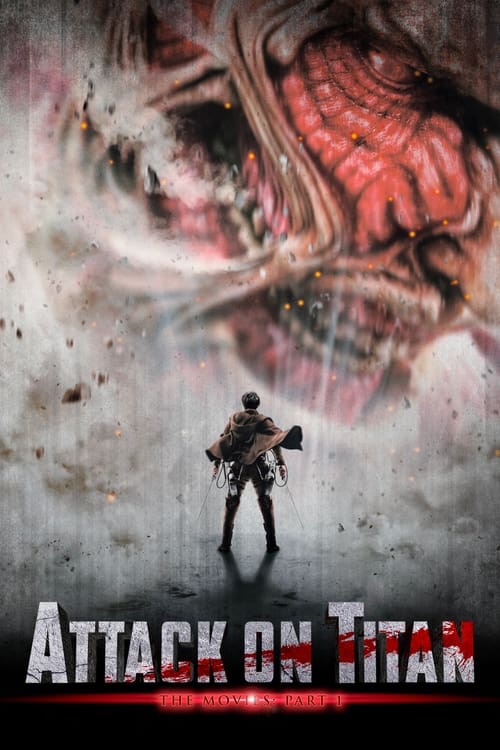
Attack on Titan (2015) is a Japanese-language superhero film adapted from Manga, directed by Shinji Higuchi and starring Haruma Miura and Kiko Mizuhara. The film is a standalone production outside any shared cinematic universe and was released by Toho. Audience rating: 5.6/10.
What is Attack on Titan (2015) about?
In a world where giant humanoid Titans prey on humans, the last of humanity huddles behind giant walls. A young man joins the military to avenge his mother's death. Based on Hajime Isayama's manga.
Released in 2015, Attack on Titan was directed by Shinji Higuchi and produced under the Toho banner. The film occupies a significant place within the Independent — telling a self-contained story outside of shared-continuity superhero franchises.
The film features lead performances from Haruma Miura, Kiko Mizuhara, Kanata Hongo, among others, anchoring a story that adapts characters first brought to life in Manga. Its source material gives the film a foundation rooted in decades of published storytelling, which Higuchi and the creative team interpret through a cinematic lens.
The film's 5.6 audience rating indicates a mixed response. Even so, it holds interest as part of the broader Independent catalogue and for how it fits into the lineage of Manga-based cinema.
What happens in Attack on Titan (2015)? — Full Plot
In an alternate world devastated by giant humanoid Titans, humanity has retreated behind a series of massive 50-meter walls. For 100 years, the walls have provided protection — but humanity has lost most of its cultural memory of the outside world. Eren Yeager (Haruma Miura), his adopted sister Mikasa Ackerman (Kiko Mizuhara), and his friend Armin Arlert (Kanata Hongo) live in the Trost District, the wall-adjacent military zone.
The peace ends when the Colossal Titan — a 60-meter humanoid creature — appears suddenly and breaches the outermost wall. The Titan invasion causes chaos; thousands of civilians are killed by smaller Titans that pour through the wall breach. Eren's mother is among the casualties. Eren swears revenge against all Titans and decides to join the military's Survey Corps, the only unit that ventures outside the walls.
Two years later, Eren, Mikasa, and Armin have joined the military training corps. Their training prepares them for Titan combat using the 3D maneuver gear. The training includes swordwork against Titan-shaped training dummies; the franchise's commitment to depicting the 3D maneuver gear authentically is widely cited as one of its most effective creative choices.
The training is interrupted by the second Titan invasion. The Colossal Titan appears again, breaching another wall section. Smaller Titans pour through the breach; Eren and his squad are deployed to combat. The battle features 3D maneuver gear choreography and practical-and-CGI Titan effects; Eren is eaten by a Titan during the confrontation. His friends believe him dead.
Eren reappears during the battle — transformed into a Titan himself, fighting the other Titans. The revelation is the franchise's primary plot pivot; Eren has Titan-shifting abilities that allow him to transform between human and Titan forms. The discovery complicates the franchise's primary narrative; Eren's transformation is the franchise's most cinematically composed plot beat.
The film ends with the survivors learning that the Titans are not random monsters — they have human intelligence and may be the result of an ancient genetic-engineering program. The franchise's mythology gradually expands across the film's runtime, setting up revelations for the sequel Attack on Titan: End of the World (also 2015). The film's tonal commitment to depicting moral complexity authentically is recognized as the franchise's most distinctive creative element.
Who stars in Attack on Titan (2015)?
Find Attack on Titan (2015) on Amazon
Watch Attack on Titan on Prime Video, browse the original Manga source material, and discover Blu-rays, soundtracks, and related merchandise on Amazon.
As an Amazon Associate, I earn from qualifying purchases. Link clicks do not affect editorial coverage — see our disclaimer.
What are some facts about Attack on Titan (2015)?
Attack on Titan released in 2015, placing it within the 2010s era of comic book cinema — a decade that saw superhero films become the dominant force at the global box office.
Directed by Shinji Higuchi, the film was produced by Toho and adapts source material from Manga.
The principal cast features Haruma Miura and Kiko Mizuhara, with key supporting roles played by Kanata Hongo, Satomi Ishihara.
The film belongs to Independent — an independent / standalone production, not tied to a shared cinematic universe.
Attack on Titan carries an audience rating of 5.6 — a mixed reception that highlights the divisive nature of superhero film adaptations.
The Manga source material for Attack on Titan has been in continuous publication for decades, giving filmmakers a rich well of storylines, character arcs, and iconography to draw upon.
Modern superhero films like this one use a mix of practical effects and digital VFX, with entire sequences often shot against volume walls or LED stages pioneered by shows like The Mandalorian.
Attack on Titan is catalogued on Movies on Comics among our collection of 164 comic book films spanning 48 years of cinema — from Richard Donner's 1978 Superman to the present day.
💬 Reader Comments