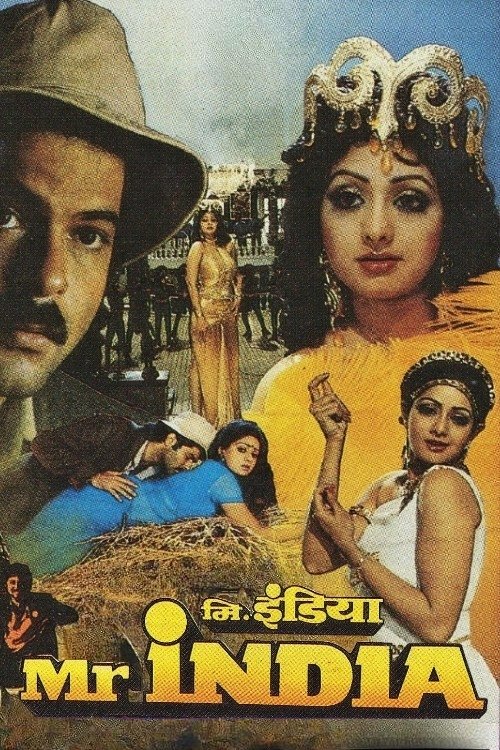
Mr. India (1987) is a Hindi-language superhero film, directed by Shekhar Kapur and starring Anil Kapoor and Sridevi. The film is a standalone production outside any shared cinematic universe and was released by Narsimha Enterprises. Audience rating: 8.0/10.
What is Mr. India (1987) about?
A kind-hearted man who runs an orphanage inherits a device that makes him invisible, which he uses as the costumed hero Mr. India to battle the evil crime lord Mogambo.
Released in 1987, Mr. India was directed by Shekhar Kapur and produced under the Narsimha Enterprises banner. The film occupies a significant place within the Independent — telling a self-contained story outside of shared-continuity superhero franchises.
The film features lead performances from Anil Kapoor, Sridevi, Amrish Puri, among others, anchoring a story that adapts characters first brought to life in Independent. Its source material gives the film a foundation rooted in decades of published storytelling, which Kapur and the creative team interpret through a cinematic lens.
With an audience rating of 8.0, Mr. India is generally praised as a strong entry in the superhero genre — its strengths in storytelling, performance, and production design regularly cited by viewers.
What happens in Mr. India (1987)? — Full Plot
The film opens in Mumbai with the introduction of Arun Verma (Anil Kapoor), a young middle-class violinist who has been operating a small private orphanage for street children at his Mumbai-suburb residence. Arun's daily life involves balancing his musical-instrument-instruction professional commitments with his ongoing-responsibility-management of the orphanage's accumulated dozen children. His financial situation is precarious; the orphanage's continued operation has been substantially-funded through Arun's musical-instruction earnings, with frequent shortfalls requiring his coordinated emergency-borrowing arrangements from neighborhood community members.
Arun's living situation is further complicated by his rental-tenant arrangement with the young journalist Seema Sahni (Sridevi), who has been renting a small upstairs room at Arun's Mumbai-suburb residence. Seema's coordinated professional-journalist-investigations have been focused on the broader Mumbai criminal-syndicate organization led by Mogambo (Amrish Puri), a stylized comic-book-villain whose international-criminal-network has been quietly destabilizing the broader Indian-national-administrative system. Seema's coordinated emotional-engagement with Arun, despite their initial antagonistic-relationship development, becomes the picture's primary romantic-relationship throughline.
Mogambo's coordinated criminal-syndicate operates from a private island base whose coordinated geographical isolation provides substantial protection from Indian-government investigative pursuit. The villain's coordinated visual-presentation includes elaborate-uniform-and-makeup arrangements, an enormous-scale private throne-room, an extensive accumulated coordinated-private-army of black-uniformed coordinated-criminal-operatives, and his coordinated catchphrase 'Mogambo khush hua' (Mogambo is pleased), which became one of Indian cinema's most-quoted villain-character phrases of the 1980s era. Mogambo's broader strategic objective is the destabilization of India's coordinated national-administrative system pending his coordinated personal seizure of broader-national-political authority.
The picture's primary supernatural-mechanism is introduced through Arun's coordinated discovery of a small mechanical-device that had been developed by his deceased scientist-father. The device, an invisibility-watch-mechanism whose coordinated activation produces complete-visual-invisibility for the wearer, had been Professor Verma's coordinated multi-decade research achievement. The Professor's coordinated death decades earlier had been the result of Mogambo's coordinated criminal-syndicate-operatives' coordinated assassination, with the device's coordinated whereabouts having been preserved through coordinated-deliberate concealment until Arun's eventual discovery. Arun's coordinated activation of the device provides his coordinated supernatural-combat-aptitude foundation.
Arun's coordinated initial-deployment of the invisibility-device is structured as quietly-experimental coordinated-civilian-utility-investigation. His coordinated continued-deployment gradually evolves toward coordinated-active-vigilante combat-engagement as he witnesses Mogambo's broader-criminal-syndicate operations affecting his immediate Mumbai-neighborhood civilian community. His coordinated invisibility-device deployment allows him to coordinate combat-engagement with Mogambo's accumulated operatives without his coordinated-personal-identity-recognition risk; he adopts the coordinated public-identity Mr. India for his coordinated vigilante-activity-public-positioning.
Seema Sahni's coordinated journalistic-investigation of Mogambo's broader criminal-syndicate gradually intersects with Arun's coordinated Mr. India vigilante-activities. Her coordinated personal-recognition of Mr. India's coordinated supernatural-invisibility-aptitude becomes the picture's primary middle-act throughline. Their coordinated developing professional-and-romantic relationship is complicated by Arun's coordinated continued-personal-concealment of his Mr. India identity; her coordinated independent investigative-research is substantially-complementary to his coordinated vigilante combat-engagement.
The picture's middle-act establishes the broader-narrative-throughlines through coordinated supporting-character introductions. The orphanage children's coordinated continued residence at Arun's Mumbai-suburb residence provides the picture's primary emotional foundation; the children's coordinated extensive-screen-time involvement provides the picture with substantial broader-character-development emotional content. Several individual orphanage-children become coordinated-supporting-character figures whose individual-character-relationships with Arun produce additional dramatic developments across the broader-narrative.
Mogambo's coordinated strategic-response to the emerging Mr. India vigilante-activity-threat involves the coordinated-systematic-investigation of Mumbai-area civilian-community members. The investigation's coordinated targeting includes Arun's Mumbai-suburb residence; Mogambo's coordinated-operatives discover the orphanage's existence and the broader Verma-family-residence's coordinated-presence. The picture's primary middle-act crisis involves the coordinated-kidnapping of multiple orphanage-children by Mogambo's coordinated-operatives, with the children being transported to Mogambo's coordinated private-island-base for coordinated-leverage-against-Mr. India political-strategic-positioning.
The picture's third-act extended action sequence involves Arun's coordinated infiltration of Mogambo's coordinated private-island-base. His coordinated invisibility-device-deployment allows him to penetrate the broader-base-perimeter without coordinated-direct-combat-engagement; the broader-base-interior infiltration provides the picture's primary extended-action setpiece. Seema Sahni's coordinated parallel-arrival at the broader-base, achieved through her coordinated independent-investigative work, provides the picture's secondary parallel-narrative throughline. The coordinated-orphanage-children's coordinated-presence at the broader-base-interior provides the picture's primary emotional-stakes foundation.
Arun's coordinated final-confrontation with Mogambo provides the picture's primary climactic action-and-emotional-throughline resolution. Mogambo's coordinated-realization of Arun's coordinated invisibility-device-mechanism allows him to coordinate counter-strategic-deployment of coordinated infrared-detection equipment whose coordinated operational-frequency can identify the invisibility-device-wearer's coordinated physical-presence despite the visual-invisibility. The coordinated-detection-equipment-deployment substantially complicates Arun's coordinated combat-engagement-strategy; his coordinated final-stage-victory requires the coordinated-strategic-environmental-engagement of Mogambo's coordinated personal-throne-room across the broader-base-interior.
The picture's emotional climax involves the coordinated-emergence of Mogambo's coordinated continued-criminal-syndicate operations into the broader-public-administrative-knowledge. Mogambo's coordinated personal-defeat-and-elimination through coordinated-thermal-pressure deployment provides the picture's primary villain-resolution; his coordinated catchphrase 'Mogambo khush hua' becomes the picture's most-quoted closing-villain-statement. The picture's epilogue establishes the new status quo: the orphanage children are coordinated-returned to Arun's Mumbai-suburb residence; the broader-criminal-syndicate is coordinated-eliminated through Indian-government coordinated-administrative response; Arun and Seema's coordinated-personal-relationship is coordinated-formalized through their coordinated-public-engagement. Mr. India grossed approximately ₹100 million globally on a ₹35 million budget, an enormous commercial success that became one of the most-significant Indian-cinema commercial-and-cultural achievements of the late 1980s.
Anil Kapoor's lead performance as Arun Verma / Mr. India was widely cited as career-defining work that consolidated his position as one of the era's most-significant Indian-cinema lead actors. Sridevi's Seema Sahni performance was widely praised as one of the era's most-effective Indian-cinema female-lead-character interpretations; her coordinated chemistry with Anil Kapoor and her coordinated independent-character-development across the broader-narrative provided the picture with substantial emotional foundation. Amrish Puri's Mogambo villain performance became one of Indian cinema's most-iconic individual villain-character contributions; the actor's coordinated commitment to the role's broader-stylized-comic-book-villain register established the broader Indian-cinema-villain performance-template that subsequent productions have substantially-incorporated. Director Shekhar Kapur's coordinated commitment to the broader-superhero-genre-narrative-development sensibility, including the picture's coordinated extensive-visual-effects work and coordinated extensive-musical-number sequences, was widely cited as one of the era's most-significant industrial-practice precedents for Indian-cinema commercial-superhero-genre productions. The picture's enduring cultural significance includes its coordinated continued-foundational-influence on subsequent Indian commercial-superhero productions across multiple decades; the picture's coordinated continued-popular-quotation across Indian-cinema-cultural retrospectives substantially-amplified its broader continued-cultural-presence. The picture's musical-numbers, including the popular Hawa Hawai sequence performed by Sridevi, became some of the most-recognizable Indian-cinema musical-number sequences of the 1980s era; the broader-musical-soundtrack album sales substantially exceeded the broader-Indian-cinema-musical-soundtrack-album sales benchmarks of the era. Salim-Javed's coordinated screenplay-development, though their established writing partnership had been coordinating-its-dissolution during the broader-Mr. India-production-period, was widely cited as the broader-picture's primary narrative-foundation. The picture's coordinated children's-character development across the broader-orphanage-residential context was widely cited as one of the most-emotionally-effective Indian-cinema children's-character-development efforts of the era. The picture's coordinated theatrical-runtime, substantially-extended at over three hours including coordinated-multiple intermission-and-musical-number sequences, was widely cited as one of the era's most-comprehensive Indian-cinema commercial-feature productions. Amrish Puri's continued accumulated dramatic-villain-performance trajectory across the broader Indian-cinema-industry, including his coordinated continued multi-decade engagement with multiple coordinated continued villain-character contributions across the broader Indian-cinema-commercial-cinema productions, was substantially-amplified by his coordinated Mogambo-performance accumulated cultural-impact. The picture's coordinated continued widespread-broadcast across multiple coordinated Indian-television-network-distribution patterns substantially-extended its broader continued-audience-reach across multiple coordinated continued-decades of Indian-cinema-cultural-landscape-influence. The picture's coordinated extended-runtime three-hour-plus theatrical-presentation included coordinated extensive musical-number sequences and coordinated extensive dramatic-development sequences; the picture's coordinated continued-cultural-reference value within the broader Indian-cinema-cultural-landscape continues to be substantial across multiple subsequent-decades. The picture remains widely-referenced within Indian-cinema-and-popular-culture retrospectives as one of the foundational works of the modern Indian-cinema commercial-superhero-genre.
Who stars in Mr. India (1987)?
Find Mr. India (1987) on Amazon
Watch Mr. India on Prime Video, and discover Blu-rays, soundtracks, and related merchandise on Amazon.
As an Amazon Associate, I earn from qualifying purchases. Link clicks do not affect editorial coverage — see our disclaimer.
What are some facts about Mr. India (1987)?
Mr. India released in 1987, placing it within the 1980s era of comic book cinema — a decade that helped establish the superhero film as a viable major-studio genre.
Directed by Shekhar Kapur, the film was produced by Narsimha Enterprises and adapts source material from Independent.
The principal cast features Anil Kapoor and Sridevi, with key supporting roles played by Amrish Puri, Satish Kaushik.
The film belongs to Independent — an independent / standalone production, not tied to a shared cinematic universe.
Mr. India carries an audience rating of 8.0 — a strong critical benchmark that few comic book films have achieved.
The Independent source material for Mr. India has been in continuous publication for decades, giving filmmakers a rich well of storylines, character arcs, and iconography to draw upon.
Earlier comic book films relied heavily on physical sets, miniatures, and in-camera effects — the VFX approach modern audiences take for granted had not yet matured.
Mr. India is catalogued on Movies on Comics among our collection of 162 comic book films spanning 48 years of cinema — from Richard Donner's 1978 Superman to the present day.