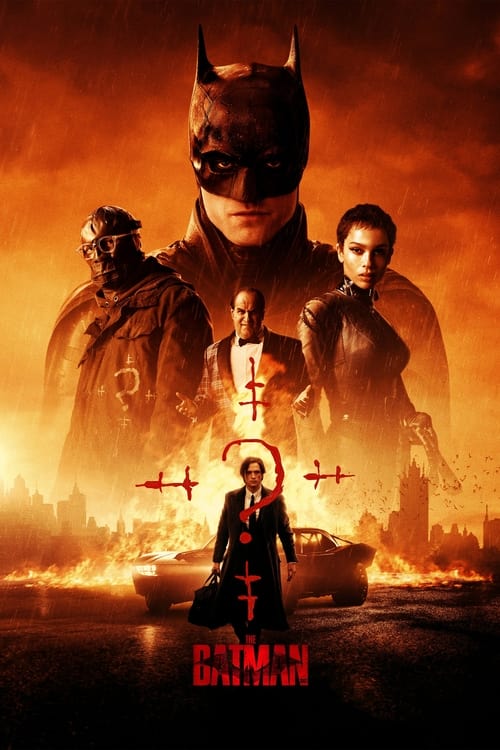
The Batman (2022) is a superhero film adapted from DC Comics, directed by Matt Reeves and starring Robert Pattinson and Zoe Kravitz. The film is a standalone production outside any shared cinematic universe and was released by Warner Bros.. Runtime: 2h 56m. Rated PG-13. Audience rating: 7.8/10.
What is The Batman (2022) about?
In his second year as Gotham's vigilante, Bruce Wayne hunts the Riddler — a serial killer targeting the city's elite — uncovering a web of corruption that reaches into his own family's legacy and forcing him to redefine what Batman should mean to Gotham.
Released in 2022, The Batman was directed by Matt Reeves and produced under the Warner Bros. banner. The film occupies a significant place within the Independent — telling a self-contained story outside of shared-continuity superhero franchises.
The film features lead performances from Robert Pattinson, Zoe Kravitz, Paul Dano, among others, anchoring a story that adapts characters first brought to life in DC Comics. Its source material gives the film a foundation rooted in decades of published storytelling, which Reeves and the creative team interpret through a cinematic lens.
With an audience rating of 7.8, The Batman is generally praised as a strong entry in the superhero genre — its strengths in storytelling, performance, and production design regularly cited by viewers.
What happens in The Batman (2022)? — Full Plot
Halloween night, Gotham. The camera lingers on a child trick-or-treater walking through a wet alley. Then the camera pulls back into a penthouse window where Mayor Don Mitchell Jr., a man in his fifties in shirtsleeves, is alone in his home office watching his son's pumpkin-carving from a security camera. A masked figure in a green ski mask and black tactical gear emerges from the shadows of Mitchell's apartment. The intruder is silent. He duct-tapes Mitchell's hands. He duct-tapes his mouth. He methodically beats him to death with a carpet hammer. He carves the word LIES into Mitchell's left cheek with a thumb-cutter. He writes a riddle on a card and addresses it: TO THE BATMAN. He waits for the body to be found.
Cut to Bruce Wayne — Robert Pattinson, hair stringy, eyes hollowed, in a tactical hood pulled over his head — narrating his journal in the back of a black 1970s Lincoln Continental. "They think I'm hiding in the shadows. But I am the shadows." It's Year Two of his Batman career. He's barely sleeping. He's barely eating. He's logged 600 nights of patrol. He's chasing every petty crime in Gotham with the kind of obsession that has the GCPD wondering if he's a vigilante or a mentally-unstable copycat killer. The Bat-signal in this film is a high-school-spotlight bouncing off the storm-cloud underside of Gotham. He sees it. He goes to work.
He arrives at Mitchell's penthouse murder scene. Lt. James Gordon — Jeffrey Wright, weary, the only clean cop in the GCPD — meets him at the elevator and walks him through the crime scene over the protests of every other cop on duty. There's a card on the floor next to the body addressed TO THE BATMAN with a riddle: "What does a liar do when he's dead? He lies still." The Riddler has begun his correspondence. Batman reads it on his tablet and looks at Gordon. "He wants me here. He left this for me specifically."
Iceberg Lounge, downtown Gotham. A waitress in a black dress and a gold bow tie threads through a packed nightclub. Selina Kyle — Zoë Kravitz, dark hair, sharp jaw, hustler — is searching for her missing roommate Annika. The Iceberg is run by Oz Cobblepot, a.k.a. the Penguin — Colin Farrell in a heavy facial prosthetic that makes him completely unrecognizable, with the speech of a Bronx-Italian thug, the gait of a wounded sailor, and the disposition of a man who knows he's two inches shorter and forty pounds lighter than every man he's ever feared. The Iceberg is owned by Carmine Falcone — John Turturro, in his sixties, mob boss of Gotham for thirty years, half-retired, smooth — and Oz is Falcone's number two. Selina knows them all. She lifts a leather satchel off a businessman's chair while Batman, in a black tactical helmet and aviator goggles, watches her from a fire escape across the street.
Police Commissioner Pete Savage's murder. The next morning, a second Riddler card arrives at the Gotham PD. Savage has been killed at home — his head sealed inside a rat-infested cage, the rats slowly devouring his face. Another body, another riddle, another card to Batman. Then a third — District Attorney Gil Colson is kidnapped from a courthouse and shows up at Mayor Mitchell's funeral wearing a duct-tape mask, an LED-collar bomb, a phone the Riddler is using to live-broadcast — and three sealed riddles in his hand. Colson is asked at the live funeral cameras to name "the rat" — the federal informant who brought down Salvatore Maroni's drug operation twenty years ago. Colson refuses. The collar detonates and takes Colson's head off in front of his ex-wife and child. The Riddler has been broadcasting the whole thing to a small online following of disaffected young men.
Batman and Gordon piece the case together. The murder weapon, the rat motif, the lies-cheek-carving — every victim was implicated in the cover-up of a federal drug informant from twenty years ago. The informant is the key. The Riddler is convinced the informant is hidden inside Gotham's elite. Batman and Gordon — operating outside any sanctioned investigation — break into the courthouse archives looking for Maroni-era files. They find a sealed document marked "R" referring to a high-level informant whose identity has been redacted from every record. Gordon mutters: "the rat is the highest-level snitch this city has ever produced. Whoever it is, he's been hiding in plain sight."
Catwoman is on a parallel investigation. Annika, her roommate, is dead in the trunk of a car — Selina finds the body in a parking garage. Carmine Falcone himself killed Annika because Annika was being blackmailed into giving up an old Falcone secret. Selina goes to Falcone's penthouse to seduce her way to information. She discovers, in the course of the evening, that Falcone is her own biological father — she's the product of an affair he had years ago. Selina and Batman, working in parallel through the city, eventually cross paths at Annika's body. They become reluctant partners. They infiltrate the Iceberg Lounge together for one of the most rewatchable urban-noir set pieces in the modern Batman canon.
Penguin chase. After Batman and Gordon get information out of Oz — about a drug ring Falcone is running through the Iceberg with the help of Mayor Mitchell's son Tom (Mitchell's death is starting to make sense) — Penguin escapes the Iceberg in a Bugatti Chiron and Batman pursues him in the Batmobile. The chase is the centerpiece of the film — a six-minute white-knuckle dash through Gotham's elevated highways shot in single steady-cam mid-vehicle takes. The Batmobile, in this film, is not the Tumbler or the Burton wing-shape but a low-slung 1968 muscle car with a jet-engine spoiler exposed in the back. Penguin's car hits a tanker truck which jackknifes across the freeway in front of him. The Batmobile drives THROUGH the fire vertically. Penguin's car crashes into a wall. Batman walks out of the flames in his coat and pulls Penguin out of the wreckage to a face full of upside-down sky.
Penguin spills under interrogation. Falcone is the rat. Twenty years ago, when then-District-Attorney candidate Thomas Wayne hired Falcone to threaten a journalist named Edward Elliot — Elliot was running a story exposing Thomas Wayne's wife Martha (Bruce's mother) as having a history of mental illness — Falcone killed Elliot instead of just threatening him. To clean up the murder, Falcone gave the FBI Sal Maroni in exchange for federal immunity. Thomas Wayne discovered the murder and was going to expose Falcone publicly. Two weeks later, Thomas and Martha Wayne were murdered in Crime Alley — by a mugger who turned out to be on Falcone's payroll. Falcone has been hiding in plain sight as Gotham's most beloved mob boss for thirty years, knowing he killed the city's most beloved billionaire's parents and got away with it. Batman, who has spent his entire adult life believing his parents were random crime victims, has just learned they were a corruption-cover-up casualty.
Bruce confronts Alfred — Andy Serkis, more soldier than butler in this iteration — about the Wayne family secret. Alfred admits he had known the truth for years. Thomas Wayne, before his death, had planned to come forward about Falcone but didn't get the chance. Bruce's worldview cracks. "My father was no hero." "He tried to be." "His complicity is what killed my mother." Bruce takes a knife and cuts the Wayne family's monogrammed signet ring off the chain around his neck. He's been wearing it since he was eight. He throws it across his father's old study.
The Riddler arrests himself. Batman and Gordon arrive at the address of Edward Nashton — a forensic accountant for a Wayne charity foundation who has been a quiet office worker for twelve years. They walk into his East End apartment and find Nashton (Paul Dano in glasses and a polo shirt) drinking coffee at a kitchen counter surrounded by photographs of the Wayne family pinned to the walls. He is calm. He surrenders. He has already done the work. Batman, in costume, faces him across the kitchen counter. Nashton tells Batman he's been a fan — he's followed the Bat-signal in the sky since he was a kid in St. Joseph's Orphanage. Bruce Wayne grew up rich and protected; Edward Nashton grew up in the corrupt Renewal Project's orphanages where the entire trust fund Thomas Wayne set up for orphans was siphoned by Falcone and Mitchell. "You and I, we're not so different. Same childhood, same family bombs. You just got to grow up rich." Falcone is killed by a Nashton sniper-acolyte at his next public appearance two hours later. Nashton goes to Arkham.
Then the Riddler's real plan triggers. He has been recruiting followers online for years — a community of disaffected young men radicalized by his livestreamed murders — and they've all already planted car bombs along Gotham's seawall and at Gotham Square Garden, where mayor-elect Bella Reál is celebrating her victory with ten thousand civilians inside. The bombs go off. The seawall collapses. Gotham floods. Reál's celebration arena is half-submerged in five minutes. The lights go out. Riddler's followers, in green ski masks, rush the floor of the arena to assassinate the mayor.
Batman, who has spent the entire film as an instrument of revenge, drops the vengeance act for the first time. He swings into the flooded arena on a grappling line. He kicks open the doors. He fights three Riddler acolytes by hand while their guns submerge in waist-high water. He pulls the mayor and her family to a high platform. He rallies the panicked civilians toward an evacuation route. He picks up a flare and leads two thousand survivors through the rising water out of the arena. The camera tracks him in a five-minute sequence shot through chest-high floodwater under emergency lights, a man finally being not the vengeance, but the hope. The Year Two Batman who was the city's serial killer finds in this single set piece what kind of Batman he actually wants to become.
Coda. Bruce Wayne wakes up in a Gotham General hospital bed three days later. He's been wounded in the arena rescue. Catwoman is in the room with him. She's packed. She's leaving the city for good. She offers him a ride to anywhere he wants. He won't go. He has a job to do. They kiss on the hospital roof in the rain. She drives away on her motorcycle into the morning fog. Bruce, in a Wayne Foundation T-shirt and his cape draped over a hospital chair, opens his journal and writes a final entry. "Vengeance won't change the past. Mine or anyone else's. I have to become more." He picks up the cowl. He puts it on. He walks out of the hospital. End movie. The Arkham post-credit scene where Nashton meets Keoghan's Joker plays under the credits roll.
Who stars in The Batman (2022)?
Find The Batman (2022) on Amazon
Watch The Batman on Prime Video, browse the original DC Comics source material, and discover Blu-rays, soundtracks, and related merchandise on Amazon.
As an Amazon Associate, I earn from qualifying purchases. Link clicks do not affect editorial coverage — see our disclaimer.
What are some facts about The Batman (2022)?
The Batman released in 2022, placing it within the 2020s era of comic book cinema — a decade that saw superhero films become the dominant force at the global box office.
Directed by Matt Reeves, the film was produced by Warner Bros. and adapts source material from DC Comics.
The principal cast features Robert Pattinson and Zoe Kravitz, with key supporting roles played by Paul Dano, Jeffrey Wright, Colin Farrell.
The film belongs to Independent — an independent / standalone production, not tied to a shared cinematic universe.
The Batman carries an audience rating of 7.8 — putting it in the solid-to-excellent tier of the genre.
The DC Comics source material for The Batman has been in continuous publication for decades, giving filmmakers a rich well of storylines, character arcs, and iconography to draw upon.
Modern superhero films like this one use a mix of practical effects and digital VFX, with entire sequences often shot against volume walls or LED stages pioneered by shows like The Mandalorian.
The Batman is catalogued on Movies on Comics among our collection of 164 comic book films spanning 48 years of cinema — from Richard Donner's 1978 Superman to the present day.
Easter Eggs & Hidden Details in The Batman (2022)
Matt Reeves built The Batman as a five-comic synthesis — drawing from Year One, Long Halloween, Dark Victory, Ego, and Zero Year simultaneously. The Riddler's marketing extended online, the Joker is hidden in the final scene, and the entire film uses real virtual-production technology.
Matt Reeves drew from five distinct Batman comics simultaneously: Frank Miller's Year One (1987), Jeph Loeb and Tim Sale's The Long Halloween (1996-97) and Dark Victory (1999-2000), Darwyn Cooke's Ego (2000), and Scott Snyder's Zero Year (2013-14).
Barry Keoghan appears as the unnamed Arkham prisoner Riddler talks to in the film's final sequence. He is officially credited as 'Unseen Arkham Prisoner.' A deleted scene showing his face directly was released later through the film's online marketing campaign.
The Riddler's website rataalada.com was a real, live alternate reality game launched as part of the film's marketing. Fans solved sequential live ciphers in real time over weeks, unlocking content. The final puzzle revealed Keoghan's deleted Joker scene.
The prosthetics and fat suit for Colin Farrell's Penguin required two to four hours of application every shoot day. Farrell is unrecognizable beneath the makeup — the transformation was so complete that test audiences initially asked whether the character was played by an unknown actor.
Reeves used ILM's StageCraft virtual production system — the same LED-wall technology pioneered on The Mandalorian — for major portions of the film. The technology allows real-time backgrounds to be rendered on stage rather than added in post.
The film's 'golden hour' lighting throughout was inspired by Wong Kar-wai's In the Mood for Love (2000) — Reeves's primary visual reference for tone and color.
Reeves's screenplay characterizes Bruce Wayne as an insomniac who cannot differentiate between his Batman persona and his 'recluse rockstar' public identity. The visual style — pale skin, dark under-eyes, hooded posture — reinforces the sleep-deprivation reading.
The first official look at Pattinson in the Batsuit was released on February 13, 2020 — moody, red-saturated test footage scored with Michael Giacchino's early version of the Batman theme. The release predated the film by over two years.
The first Batmobile design was officially revealed on March 4, 2020 — described by production as more streamlined than previous incarnations and reflecting the muscle-car aesthetic of 1970s American sedans.
John Turturro plays Gotham crime boss Carmine Falcone — the same character central to The Long Halloween and Year One. Turturro's understated performance was Reeves's deliberate alternative to a stylized 'gangster' read.
Jeffrey Wright is the first Black actor to play Lieutenant James Gordon in a major Batman film. Reeves cast Wright deliberately to avoid casting from existing Batman screen archives — Wright had no prior superhero genre association.
The film deliberately calls the facility 'Arkham State Hospital' rather than the comic-standard 'Arkham Asylum.' Reeves's choice grounds the institution in real American mental-health infrastructure language rather than gothic comic-book nomenclature.
Zoë Kravitz's Selina Kyle works at the Iceberg Lounge — Carmine Falcone's nightclub — rather than being introduced as a high-end thief. The structure echoes Catwoman's Long Halloween-era proximity to organized crime.
The rataalada.com puzzle site released sequential ciphers in the months before release. Each cipher solved publicly unlocked the next layer of content — and the deleted Joker scene was the campaign's final reward.
Pattinson's opening Batman monologue echoes Frank Miller's Batman: Year One (1987) — the comic that established Batman's first-year detective focus and the inner-monologue structure Reeves uses throughout the film.
💬 Reader Comments