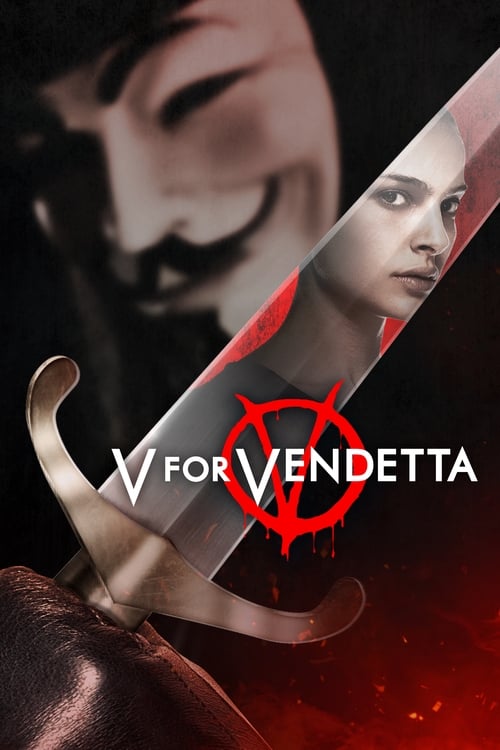
V for Vendetta (2006) is a superhero film adapted from DC Comics, directed by James McTeigue and starring Hugo Weaving and Natalie Portman. The film is part of the DC Classic and was released by Warner Bros.. Runtime: 2h 12m. Rated R. Audience rating: 8.1/10.
What is V for Vendetta (2006) about?
In a fascist future Britain, a masked revolutionary known only as V embarks on a campaign of anarchistic attacks against the authoritarian government, enlisting a young woman named Evey.
Released in 2006, V for Vendetta was directed by James McTeigue and produced under the Warner Bros. banner. The film occupies a significant place within the DC Classic — contributing to the ongoing narrative and mythology of that cinematic universe.
The film features lead performances from Hugo Weaving, Natalie Portman, Stephen Rea, among others, anchoring a story that adapts characters first brought to life in DC Comics. Its source material gives the film a foundation rooted in decades of published storytelling, which McTeigue and the creative team interpret through a cinematic lens.
With an audience rating of 8.1, V for Vendetta is generally praised as a strong entry in the superhero genre — its strengths in storytelling, performance, and production design regularly cited by viewers.
What happens in V for Vendetta (2006)? — Full Plot
A dystopian England, circa 2032. The country is ruled by Norsefire, a far-right authoritarian political party led by Chancellor Adam Sutler (John Hurt, in heavy aged prosthetics evoking 1984's Big Brother). Civil liberties have been suspended for over a decade. Homosexuality is criminalized; Muslims and other religious minorities have been disappeared into government detention camps. State media broadcasts unmitigated propaganda. The film's opening 8 minutes establish the political-allegorical world-building through a series of montage sequences depicting Norsefire's surveillance state, the disappeared populations, and the government-controlled BTN news broadcasts.
Evey Hammond (Natalie Portman) — a 22-year-old British Television Network production assistant — is walking home from work after curfew when she is detained by the Fingermen, Norsefire's secret police. The Fingermen prepare to rape her. She is rescued by V (Hugo Weaving), a masked vigilante wearing the iconic Guy Fawkes mask. V has been planning a guerrilla campaign against Norsefire for years. He brings Evey to a nearby rooftop and detonates the Old Bailey courthouse with synchronized fireworks-and-explosives — a deliberately theatrical attack timed to coincide with the date November 5 (Guy Fawkes Night, the canonical British holiday commemorating the 1605 attempted assassination of King James I).
The Norsefire government investigates V relentlessly. Chief Inspector Eric Finch (Stephen Rea) is assigned to track him. We learn through Finch's investigation that V was created by the government itself — Subject IX, a former inmate of the Larkhill detention center, where Norsefire conducted experiments on prisoners in the early 2020s. The Larkhill experiments were intended to develop biological weapons; Subject IX was one of approximately 50 test subjects. The experiments killed all the other subjects. V's mutation was the only successful outcome — he developed enhanced healing, reflexes, and pain tolerance through the genetic experimentation. The Larkhill program was canonically responsible for engineering the St. Mary's virus that killed approximately 80,000 British citizens — the staged terrorist attack that Norsefire used to justify its initial seizure of power.
Evey, having sheltered with V in his underground lair (a Victorian-themed sanctuary filled with banned books, banned art, and pre-Norsefire memorabilia), eventually becomes V's protégé. V kidnaps and tortures her himself to break her of her fear of the government — a deliberately-controversial creative choice that has been widely debated. Evey believes she is being interrogated by Norsefire's secret police for months. She is shaved bald, repeatedly subjected to mock-execution, and tortured psychologically. The interrogation breaks her psychologically; she emerges with a fundamentally-different relationship to fear. She reveals at the end of the torture sequence that V was her interrogator the entire time. The choice was Wachowski-directors' deliberate creative interpretation of Alan Moore's canonical V-trains-Evey storyline.
V's investigation reveals the full Norsefire conspiracy. Specifically: Sutler personally architected the St. Mary's virus attack as a false-flag operation to consolidate political power. Multiple Norsefire officials — including Bishop Anthony Lilliman, Dr. Delia Surridge, and Conrad Heyer (Norsefire's broadcasting chief) — were all involved in the Larkhill experiments and the broader St. Mary's deception. V methodically tracks down each conspirator and kills them — using deliberately theatrical methods (poisonings, ritual murders, public executions) calculated to maximize political symbolism.
Dr. Delia Surridge — the Larkhill medical researcher who had personally treated V during the experiments — is one of V's targets. Their confrontation in her home is the film's most-emotionally-complex single sequence. Delia recognizes V immediately. She has been quietly tormented by guilt about the Larkhill experiments for years. She does not resist V's vengeance; she accepts the poison he administers and dies peacefully. The sequence is the only V-confronting-a-target scene where the victim accepts death rather than fighting. Delia's diary entries (which Inspector Finch later reads) become V's testimony evidence — the canonical document that would eventually expose the entire Norsefire conspiracy.
Inspector Finch, increasingly disturbed by the evidence his investigation has been uncovering, begins to suspect Norsefire's true history. He reads Delia Surridge's diary. He confronts Sutler privately about the Larkhill experiments. Sutler dismisses him. Finch realizes he is now a Norsefire enemy as well. He continues his investigation but with shifted loyalties — he is no longer hunting V but rather understanding him. The Finch character arc has been widely cited as the film's most-emotionally-substantive single development; Stephen Rea's performance has been widely praised by critics.
Sutler, increasingly unstable, orders Norsefire to seize total power. The government broadcasts a state-of-emergency declaration suspending all remaining civil liberties. Evey delivers V's recorded testimony — exposing the entire government conspiracy at Larkhill — to the BTN state broadcaster. The footage broadcasts during Norsefire's state-of-emergency declaration. The conspiracy is exposed publicly. The Norsefire government begins to collapse from internal dissent. Citizens across England begin to wear Guy Fawkes masks in symbolic protest. The fallen-mask uprising becomes the film's central political-allegorical moment.
V, on the morning of November 5, 2032 (the canonical Guy Fawkes Day), prepares his final attack. He has been planning to detonate the Houses of Parliament using a Tube car loaded with explosives — completing what Guy Fawkes had failed to do in 1605. He encounters Chief Inspector Finch at the underground Tube tunnels. Finch, having decided to assist V's mission, allows him to proceed. V is fatally shot by Norsefire's commanding general Peter Creedy (Tim Pigott-Smith) during the final confrontation. V kills Creedy and his entire commando force before collapsing. He returns to his underground lair to die in Evey's arms.
Evey, alone with V's body, completes V's plan. She loads V's body onto the Tube car along with the explosives. She sends the car toward Parliament. The car explodes in the Underground tunnel directly beneath the Houses of Parliament. Parliament collapses in a controlled implosion. The Norsefire government, broadcasting via BTN, is effectively rendered powerless. Citizens across England — wearing Guy Fawkes masks — march on the destroyed Parliament site, removing their masks one by one. The visual moment — democracy reasserted through anonymous solidarity — has been widely cited as one of the most-iconic political-cinema moments of the 2000s.
The film's epilogue. The mask-removal sequence reveals the cast of characters from throughout the film — Finch, Delia, Sutler's daughter, the disappeared homosexuals, the disappeared Muslims — all having been killed by Norsefire over the years. Their post-mortem appearance among the Guy Fawkes-masked crowd represents the political-revolutionary act of remembering the victims of authoritarian violence. The film closes with Evey's voice-over: V was the idea, the people are the mask, the revolution is the system. The narrative ambiguity of V's individual identity vs. his political symbol is canonically preserved.
Commercial and critical aftermath. V for Vendetta grossed $134 million worldwide on a $54 million production budget — modest commercial success. Critics responded with widely positive reviews (Rotten Tomatoes 73%); the film became the standard by which Alan Moore comic adaptations are measured. The Guy Fawkes mask became a global protest symbol following the film's release — used by the hacker collective Anonymous (founded 2003 but adopting the mask in 2008), the Occupy Wall Street movement (2011), and various subsequent anti-authoritarian protest movements. The mask's commercial sales increased approximately 1,000% in the years following the film's release. The Wachowskis (writing the adaptation under their pre-transition names) and director James McTeigue have not collaborated on a similarly-political project since.
Who stars in V for Vendetta (2006)?
Find V for Vendetta (2006) on Amazon
Watch V for Vendetta on Prime Video, browse the original DC Comics source material, and discover Blu-rays, soundtracks, and related merchandise on Amazon.
As an Amazon Associate, I earn from qualifying purchases. Link clicks do not affect editorial coverage — see our disclaimer.
What are some facts about V for Vendetta (2006)?
V for Vendetta released in 2006, placing it within the 2000s era of comic book cinema — a decade that marked the modern superhero cinema revolution.
Directed by James McTeigue, the film was produced by Warner Bros. and adapts source material from DC Comics.
The principal cast features Hugo Weaving and Natalie Portman, with key supporting roles played by Stephen Rea, John Hurt.
The film belongs to DC Classic — the classic DC film era — predating the connected-universe model.
V for Vendetta carries an audience rating of 8.1 — a strong critical benchmark that few comic book films have achieved.
The DC Comics source material for V for Vendetta has been in continuous publication for decades, giving filmmakers a rich well of storylines, character arcs, and iconography to draw upon.
Films from this era combined practical stunts with the rising CGI industry — many sequences would be impossible with either technology alone.
V for Vendetta is catalogued on Movies on Comics among our collection of 164 comic book films spanning 48 years of cinema — from Richard Donner's 1978 Superman to the present day.
Easter Eggs & Hidden Details in V for Vendetta (2006)
Alan Moore's second disowned adaptation. The deep cuts include Hugo Weaving's mask commitment and the Guy Fawkes mask's eventual cultural takeover.
Hugo Weaving wore the Guy Fawkes mask for every scene of V for Vendetta — even during off-camera moments. He reportedly never removed the mask in the presence of his fellow actors. Director James McTeigue confirmed in 2006 commentary that this was a deliberate Weaving choice to preserve the mask's identity-anonymous quality.
The Guy Fawkes mask designed for V for Vendetta became, within a decade of the film's release, the global symbol of the Anonymous hacktivist movement. Warner Bros. reportedly earned more in licensing royalties from the protest movement than from the original film.
Natalie Portman shaved her head on-camera during a torture sequence — a moment of genuine physical commitment widely cited as the film's most-celebrated character moment. The single-take shave was directed by James McTeigue using multiple cameras.
The Wachowskis — then known as 'the Wachowski Brothers,' having written and directed the Matrix films — wrote V for Vendetta's screenplay. The Wachowskis were also producers. Their commitment to the political-thriller register was widely cited as the film's strongest creative element.
The Larkhill detention center sequences — where V was experimented on — were a deliberate echo of Nazi concentration-camp experimentation. The Wachowskis cited Holocaust films as their primary tonal references.
Stephen Rea's Chief Inspector Finch — initially V's pursuer, eventually his sympathetic counterpart — was widely cited as the franchise's most-restrained antagonist performance. Rea's commitment to portraying Finch as a moral institutional actor was widely praised.
The Norsefire government — the film's dystopian authoritarian regime — was widely cited as a deliberate Tony Blair-era political critique. The Wachowskis' anti-authoritarian message was widely covered by entertainment media.
The film's climactic Parliament building's explosion was widely cited as a deliberate symbolic gesture. The Wachowskis' commitment to the explosion's symbolic value was the film's most-discussed creative choice.
Stephen Fry — known primarily for British TV comedy and satire — cameos as Gordon Deitrich. Fry's commitment to playing a character whose satirical work parallels the film's larger anti-authoritarian themes was widely praised.
V for Vendetta grossed $134 million globally on a $54 million budget — modest commercial success that grew through home-video and political-cultural impact.



💬 Reader Comments