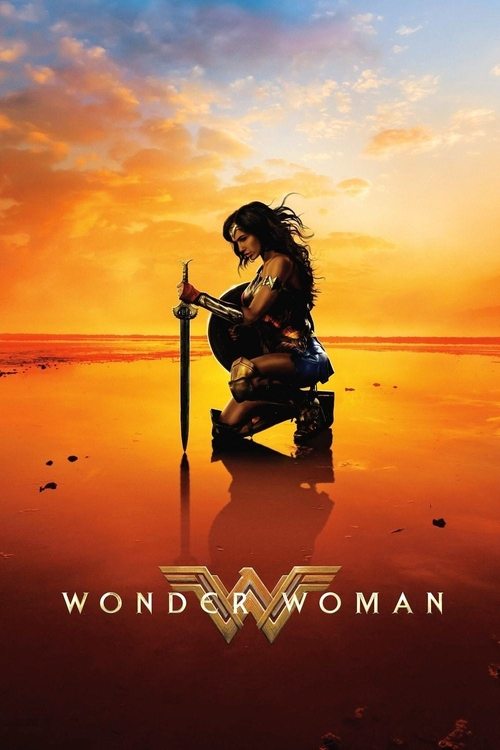
Wonder Woman (2017) is a superhero film adapted from DC Comics, directed by Patty Jenkins and starring Gal Gadot and Chris Pine. The film is part of the DCEU and was released by Warner Bros.. Runtime: 2h 21m. Rated PG-13. Audience rating: 7.4/10.
What is Wonder Woman (2017) about?
Diana, princess of the Amazons, trained to be an unconquerable warrior, leaves her island home after an Allied spy crash-lands on their shores and tells of a great war in the outside world.
Released in 2017, Wonder Woman was directed by Patty Jenkins and produced under the Warner Bros. banner. The film occupies a significant place within the DCEU — contributing to the ongoing narrative and mythology of that cinematic universe.
The film features lead performances from Gal Gadot, Chris Pine, Connie Nielsen, among others, anchoring a story that adapts characters first brought to life in DC Comics. Its source material gives the film a foundation rooted in decades of published storytelling, which Jenkins and the creative team interpret through a cinematic lens.
Its 7.4 rating reflects a film that divided audiences — appreciated for its ambition and spectacle by some, criticized for pacing and execution by others. Its place in the genre remains a frequent discussion point.
What happens in Wonder Woman (2017)? — Full Plot
Modern-day Paris. A glass-walled office in the Louvre Museum. Diana Prince — six feet tall, white-streaked sunglasses, a curator's lanyard — opens a hand-delivered package from Wayne Enterprises. Inside is a sepia photograph in a brass-cornered frame: a 1918 black-and-white print showing Diana herself, in Wonder Woman armor, standing on a Belgian mud-road next to four men in WWI uniforms. The handwritten card from Bruce Wayne thanks her for letting him develop the original glass plate. She runs her thumb across the photograph. The film cuts back to her childhood. The entire next two hours are the story of how that photograph was taken.
Themyscira. An island hidden inside a domed warp-field somewhere in the southern Mediterranean, where the Amazon people — created by Zeus from clay and breath to be guardians and counterbalance to the war-god Ares — have lived for three thousand years untouched by men or time. Queen Hippolyta tells eight-year-old Diana the founding myth at bedtime: Zeus created humanity to be loving and curious. His son Ares grew jealous and poisoned mankind's hearts with hatred. The gods went to war with Ares over Earth's soul. Ares killed every Olympian except Zeus, who used his last strength to wound Ares and create the Amazons as the antidote — a race of immortal women trained to defend mankind and, if Ares ever rose again, to kill him. Zeus left them a god-killing sword inside a tower at the center of the island. Hippolyta did not tell her daughter that Diana herself was not made from clay. She lies because the truth is more dangerous than the lie.
Diana grows up training secretly. Her aunt General Antiope — Hippolyta's sister, the Amazons' military commander — takes Diana under her wing despite the queen's standing order that Diana never see combat. By the time Diana is in her late twenties (which on Themyscira means she's been alive for several mortal lifetimes, time stops oddly here), she can outfight every soldier on the island, including Antiope. In one training duel, Antiope draws her sword in earnest. Diana, cornered, blasts a wave of energy out of her crossed bracers and knocks her aunt twenty meters back. The Amazons stare. Hippolyta is horrified. The energy means Diana is not a clay-creation. Diana is something else.
Then a plane crashes through the dome. It's 1918, in the world outside. Captain Steve Trevor — Allied Intelligence officer flying a stolen German recon plane back to Allied lines with a Doctor Poison notebook in his coat — has accidentally pierced Themyscira's invisibility field on his pursuit course. The plane plunges into the bay. Diana, training on the cliffs, dives off and pulls Steve out of the wreckage in the surf. He's the first man she's ever seen. She stares at him. He stares back. "Wow." Above them, on the ocean, a German destroyer that was chasing Trevor crashes through the same dome. Fifty German marines hit the beach with rifles and machine guns. The Amazons mobilize on horseback with bows. The two-army beach battle is shot by Patty Jenkins and choreographer Damon Caro in three-camera continuous takes — Amazons leaping off horse-bridges to slam swords down on rifle-bearing marines, Antiope sliding under bullets to fire three arrows in a single motion. The Amazons win, but Antiope takes a bullet meant for Diana and dies on the sand. Hippolyta cradles her sister. The first Amazon casualty in three thousand years.
The Amazons interrogate Steve with the Lasso of Hestia — a coiled gold rope from one of Zeus's heirloom artifacts that compels truth from anyone bound by it. Steve tells them, against his own will: World War One. Four years of trench warfare. Twenty-five million dead. A German general named Erich Ludendorff is about to deploy a new chemical weapon — a mustard gas designed by a German chemist named Dr. Maru, codenamed Doctor Poison — that the Allies have no defense against. If he uses it on London, the war is functionally over and Germany wins. Steve was ferrying Maru's notebook back to Allied intelligence to give them a fighting chance.
Diana hears "chemical weapons" and "genocide" and "Ludendorff" and concludes the war must be Ares's doing. She steals the Godkiller sword from the central tower, takes the Lasso of Hestia, her Amazon armor and tiara and shield, and tells Hippolyta she's leaving. Her mother cannot stop her. "If you choose to leave, you may never return." "Who will I be if I stay?" She and Steve depart Themyscira on a small Amazon sailboat. Steve falls asleep against her shoulder in the moonlight. He explains awkwardly that he's, you know, above average. Diana, who has read every book on the island including all twelve volumes of Cleo's Treatises on Bodily Pleasures, is unimpressed. "Have you read all twelve volumes?" "I have. They concluded that men are essential for procreation but for pleasure, unnecessary." Steve laughs himself sick.
London, late 1918. Diana arrives in a foggy black-coal city wearing six feet of bright-blue Amazon battle armor, sword on her back, lasso on her hip, in broad daylight in Trafalgar Square. Steve hustles her into a coat and into a cab to meet his War Office liaison Sir Patrick Morgan, the British peace-cabinet representative trying to negotiate Germany's surrender at the bargaining table. Diana is introduced to Etta Candy, Steve's secretary — short, ginger, plump, hilariously practical — who takes Diana to a dressmaker for a 1918 corseted ensemble. Diana cannot move. "How can you fight in this?" "We use our principles." The shopping sequence is the film's best comedy, with Diana judging every Edwardian garment as either restrictive of motion or insulting to dignity. She finally settles on a wool skirt-suit, glasses, and her cloak hiding the sword and shield.
Steve takes Diana to a War Office meeting. The British generals refuse to allow her in the room. Steve, lying through his teeth, gets them in front of Sir Patrick. Diana proposes an extraction mission across the Belgian front lines to find Ludendorff's mustard gas factory and destroy it. The cabinet refuses. Sir Patrick — old, kindly, walking with a cane — quietly funds the mission off the books. Steve, Diana, and Etta hop a train to Belgium with three recruits Steve hired at a pub: Sameer the Moroccan polyglot spy, Charlie the Scottish sniper with shell-shock, and Chief the Blackfoot Native American smuggler who runs supplies across no man's land. The team is racially mixed, scarred, motley, and exactly the unit Steve has run on the back lines for years. Diana watches them eat dinner around a campfire and starts understanding what mankind is.
Belgian front, near Veld village. Steve's team arrives at the trench-line on a fall morning to find every village ahead of them under Ludendorff's army's boot — civilians forced into labor, food rations stripped, deathly typhoid. Steve tells Diana they can't help the village. They have to get to Ludendorff. They're a small unit. Diana climbs up the trench ladder. "I am willing to die in war for what is right." She steps over the top into open mud. "NO MAN'S LAND." The German machine-gun nest opens fire on her at three hundred meters. Diana pulls her shield. The bullets sing off the metal. She walks forward through plowed mud. Then she breaks into a run. Then a leap. She crosses No Man's Land alone in the sequence the entire trailer pivoted on — the bracer-deflect, the slow-motion shield raise, the moment Hans Zimmer's electric-cello score punches into the brass theme. She breaks the German line. Steve and the team follow through the gap. Veld is liberated in twenty minutes. The villagers come out into the streets. There's a dance that night in the square. Steve dances with her. There's snow. A photographer takes their picture — the photograph the entire film opens on. Steve and Diana sleep together off-screen.
Steve's intel: Ludendorff is at a gala at a Belgian estate that night, hosting German high command. Diana, in evening dress with the sword hidden up her hip, walks into the gala. She finds Ludendorff in the ballroom. He's tall, handsome, cold. She's certain he's Ares. She follows him into the cellar. They fight. He's enhanced — he's been dosing himself with the same chemical compound Dr. Maru developed for the gas, which gives him superhuman strength — but Diana matches him. She runs him through with the Godkiller sword and pins him to the wall. The world holds its breath. The war does not end. The sky does not open. The German guns three miles down the front line continue to fire. The Earth keeps turning. She is wrong. Ludendorff was a man. Ares is not Ludendorff. Diana stands in the cellar holding a corpse on her sword and stares at her hands. She doesn't understand.
Steve catches up to her. He explains that the gas weapon was loaded onto a German bomber at an airfield two miles east, set to take off in ten minutes with destination Allied front lines. There's no way to disarm the bomber's payload without crashing it. She refuses to come with him. She says humanity isn't worth saving. He kisses her. She turns to leave.
Then the temperature drops. Sir Patrick Morgan walks out of the shadows behind her. The old British peace-cabinet member who funded the mission. His cane begins glowing red. His voice deepens by two octaves. He drops the cane. He is Ares. He's been Sir Patrick the entire war — manipulating the cabinet, escalating the conflict, planting Ludendorff and Doctor Maru as instruments, working both sides of the negotiating table. He explains, calmly, that humans are inherently terrible and that he's only the catalyst for their natural instinct. "They are corrupt. Weak. Cruel as I am. They don't deserve your protection. They deserve nothing but death." He shows her psychic projections of every WWI battlefield's worst moment. He suggests Diana kill Dr. Maru with her own hand. Maru is fleeing the bomber-loading airfield in a Mercedes. Diana stands over Maru with the Godkiller sword raised. She looks at the woman cowering in the mud. She remembers Steve's face dancing in Veld. She lowers the sword. She walks past Maru.
Ares attacks. He throws Diana into a stone wall. He breaks the Godkiller sword in half. He laughs. "The sword is not the godkiller, princess. You are." Diana, the daughter of Zeus, has been the weapon all along. Meanwhile, Steve runs across the airfield to the bomber, climbs into the cockpit, and takes off with the mustard-gas cargo on board. He flies it ten thousand feet up over the airfield. He looks back at Diana on the ground through the cockpit window. He pulls his pistol. He shoots into the gas containers in the bomb bay. The bomber explodes in the sky and the gas neutralizes in the flash. Steve dies in the explosion. Diana, on the ground, screams. She rises off the ground and into the sky like she's just remembered how. She slams Ares into a building. She channels lightning out of the sky into her bracers. She throws his own godlightning back at him. Ares disintegrates into a pillar of ash on the airfield concrete. The German troops above ground, no longer under Ares's psychic compulsion, surrender. The war ends, by armistice, eleven days later.
Cut back to modern-day Paris. Diana stares at the photograph in the Louvre office. She knows what it is now. She knows who Steve was. She picks up a laptop. She writes an email to Bruce Wayne thanking him for restoring the photograph. Her last line: "Saving the world has been my mission, and the work of a hundred lifetimes. I am Diana of Themyscira, daughter of Hippolyta. Your fight is mine." She closes the laptop. She walks out of the Louvre into a Paris evening, lifts off the cobblestones, and flies into the sky in slow motion in the full Wonder Woman armor as the credits roll over Sia's To Be Human. The film's last shot is Wonder Woman as a Greek goddess silhouette against the Eiffel Tower.
Who stars in Wonder Woman (2017)?
Find Wonder Woman (2017) on Amazon
Watch Wonder Woman on Prime Video, browse the original DC Comics source material, and discover Blu-rays, soundtracks, and related merchandise on Amazon.
As an Amazon Associate, I earn from qualifying purchases. Link clicks do not affect editorial coverage — see our disclaimer.
What are some facts about Wonder Woman (2017)?
Wonder Woman released in 2017, placing it within the 2010s era of comic book cinema — a decade that saw superhero films become the dominant force at the global box office.
Directed by Patty Jenkins, the film was produced by Warner Bros. and adapts source material from DC Comics.
The principal cast features Gal Gadot and Chris Pine, with key supporting roles played by Connie Nielsen, Robin Wright.
The film belongs to DCEU — the DC Extended Universe, Warner Bros' connected superhero continuity.
Wonder Woman carries an audience rating of 7.4 — putting it in the solid-to-excellent tier of the genre.
The DC Comics source material for Wonder Woman has been in continuous publication for decades, giving filmmakers a rich well of storylines, character arcs, and iconography to draw upon.
Modern superhero films like this one use a mix of practical effects and digital VFX, with entire sequences often shot against volume walls or LED stages pioneered by shows like The Mandalorian.
Wonder Woman is catalogued on Movies on Comics among our collection of 164 comic book films spanning 48 years of cinema — from Richard Donner's 1978 Superman to the present day.
Easter Eggs & Hidden Details in Wonder Woman (2017)
Patty Jenkins's direction marked a turning point for the DCEU. The deep cuts include the No Man's Land 17-day shoot and Jenkins's status as the first woman to direct a major superhero film.
Patty Jenkins became the first woman to direct a major superhero film. Wonder Woman became the first female-led superhero film to gross over $400 million domestically — a landmark for studio confidence in female-fronted comic-book films.
The 'No Man's Land' walk-through-machine-gun-fire sequence took 17 days of filming. Gal Gadot performed most of the walking on her own. The original test cut had the sequence shortened — Patty Jenkins refused to allow it. The sequence became the most-clipped scene of any 2017 superhero film.
Chris Pine's casting as Steve Trevor was a deliberate homage to traditional Reagan-era leading-man masculinity — clean-cut, brave, sacrificial. The character's death — sacrificing himself to destroy the Dr. Maru plane — was the film's emotional centerpiece.
Gal Gadot was 5 months pregnant during principal photography. The production accommodated her pregnancy with carefully-staged stunt work and clever camera angles. Gadot has publicly stated she was determined to complete the role on schedule despite the physical challenges.
In Wonder Woman comics, the character's origin is typically set in WWII (1940s). The film's deliberate setting in WWI (1914-1918) was a Jenkins-Snyder creative choice — moving the origin to a more historically-distant era that would feel less politically charged.
The opening Themyscira beach battle — Amazons fighting German naval forces — used 100% practical horses, with no CGI substitution. The Greek-island setting was achieved through careful location scouting in southern Italy. The sequence required two weeks of horse-riding rehearsals.
Sir Patrick Morgan — David Thewlis's mild-mannered British politician — being revealed as Ares (the God of War) was the franchise's most-discussed twist. Thewlis's casting was kept officially secret until release; fan speculation ran extensive.
Throughout the film, Diana is shown flying or floating in ways that are deliberately ambiguous. Her flight ability was canonically uncertain; Jenkins has said in interviews she wanted to preserve the character's mystery rather than firmly establishing the rules. Diana's flight was established more definitively in subsequent DC Universe appearances.
Lucy Davis's Etta Candy — Steve's secretary — became a fan favorite. Davis's commitment to the supporting role anchored the film's lighter moments. The character has not returned in subsequent Wonder Woman films.
Hans Zimmer composed the Wonder Woman theme, building on the franchise's broader DCEU soundtrack work. The theme has been widely cited as one of the most-recognized superhero themes since John Williams's Superman.

💬 Reader Comments