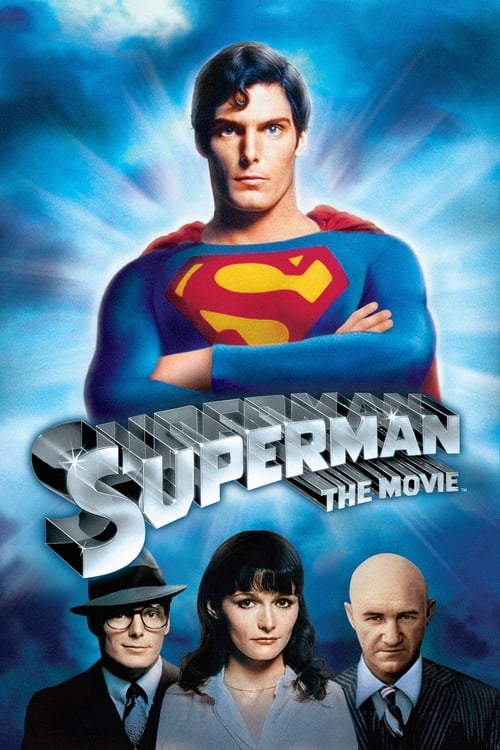
Superman (1978) is a superhero film adapted from DC Comics, directed by Richard Donner and starring Christopher Reeve and Margot Kidder. The film is part of the DC Classic and was released by Warner Bros.. Runtime: 2h 23m. Rated PG. Audience rating: 7.3/10.
What is Superman (1978) about?
The last son of Krypton, raised as Clark Kent in rural Kansas, discovers his extraordinary powers and moves to Metropolis to become Superman — facing his first great nemesis, the cunning Lex Luthor.
Released in 1978, Superman was directed by Richard Donner and produced under the Warner Bros. banner. The film occupies a significant place within the DC Classic — contributing to the ongoing narrative and mythology of that cinematic universe.
The film features lead performances from Christopher Reeve, Margot Kidder, Gene Hackman, among others, anchoring a story that adapts characters first brought to life in DC Comics. Its source material gives the film a foundation rooted in decades of published storytelling, which Donner and the creative team interpret through a cinematic lens.
Its 7.3 rating reflects a film that divided audiences — appreciated for its ambition and spectacle by some, criticized for pacing and execution by others. Its place in the genre remains a frequent discussion point.
What happens in Superman (1978)? — Full Plot
We open on the doomed planet Krypton — a crystalline alien civilization rendered in eerily-white interiors and cosmic-blue exteriors. Jor-El (Marlon Brando, in white robes and luminescent crystal headpiece) addresses the Kryptonian Council in the planet's High Court. He warns them that Krypton's core has been destabilizing for years and that the planet will explode within weeks. The Council refuses to listen; they have been ignoring his warnings for months. As a final act before the planet's destruction, Jor-El sentences three traitors — General Zod (Terence Stamp), Ursa, and Non — to imprisonment in the Phantom Zone, a mystical dimensional prison from which they cannot escape. The sentencing is the franchise's first canonical introduction to the Phantom Zone.
Jor-El and his wife Lara (Susannah York) prepare their infant son Kal-El for emergency evacuation. Krypton is hours from destruction. They place the baby in a crystalline rocket-ship pre-programd with a single destination: Earth. The ship's onboard Kryptonian-AI will educate Kal-El during the 3-year journey through space about his Kryptonian heritage, his cosmic responsibilities, and his eventual mission to serve as Earth's protector. As the rocket launches into the cosmos, Krypton explodes behind it. The Krypton sequences are filmed with elaborate practical-set construction at Pinewood Studios; the destruction sequence is one of the franchise's most-iconic single visual moments.
The rocket lands in a Kansas wheat field near Smallville. Jonathan Kent (Glenn Ford) and Martha Kent (Phyllis Thaxter) — a childless farming couple in their fifties — discover the rocket and the infant Kal-El inside. They adopt him, naming him Clark, raising him as their own son. The film's middle act follows Clark's adolescence: discovering his superhuman abilities (super-strength, super-speed, x-ray vision, flight), suppressing them under his father Jonathan's strict guidance, and dealing with his developing differentness from his Smallville peers. The Kansas sequences are filmed with deliberately-pastoral cinematography that contrasts with the cosmic-Krypton aesthetic.
Jonathan Kent dies of a heart attack in the family farmhouse — a death Clark cannot prevent despite his superhuman abilities. The sequence is the franchise's foundational thesis: Clark's powers cannot save those he loves from mortality. The lesson informs his eventual decision to dedicate his abilities to broader human service rather than personal-life-protection. Clark, now 18, travels to the Arctic with a crystal fragment from his Kryptonian rocket. The crystal grows into the Fortress of Solitude — a vast crystalline cathedral-like structure that serves as Clark's connection to his Kryptonian heritage. Inside the Fortress, Jor-El's recorded consciousness educates Clark about his cosmic mission for the next 12 years.
Clark, now 30, moves to Metropolis (a fictional metropolis combining elements of New York, Chicago, and other American urban centers). He adopts the Clark Kent secret identity — a mild-mannered reporter at the Daily Planet newspaper, wearing horn-rimmed glasses to obscure his canonical Kryptonian-strong features. He is hired by the Planet's senior editor Perry White (Jackie Cooper). He meets his canonical love interest Lois Lane (Margot Kidder), an aggressive senior reporter who is completely fooled by Clark's glasses-and-stutter disguise. The film's depiction of Lois as a confident, ambitious journalist rather than a typical damsel-in-distress was widely cited as ahead of its time for 1978 cinema.
Lex Luthor (Gene Hackman) — a brilliant criminal mastermind operating from a Manhattan underground subway-lair beneath the city — has been plotting a series of escalating crimes for months. His latest scheme: intercept two U.S. nuclear missiles, redirect them to specific tectonic-fault destinations across the United States, and detonate them simultaneously. The resulting earthquake will sink California's coastal regions into the Pacific Ocean. Luthor has been quietly purchasing Nevada desert real estate in anticipation that — after the California earthquake — his desert holdings will become the new American Pacific coast. The plan is both megalomaniacal and ironically capitalist.
Luthor recruits two henchmen for the operation: Otis (Ned Beatty, in comic-relief mode) and Eve Teschmacher (Valerie Perrine, in a sympathetic-secondary role). They infiltrate U.S. nuclear weapons facilities and redirect the missiles. Superman intercepts both missiles in flight. He stops the first missile from reaching its destination. He cannot stop both simultaneously; the second missile detonates in the San Andreas Fault. The resulting California earthquake triggers exactly the destruction Luthor had planned — coastal collapse, multi-state damage, and approximately 2 million civilian casualties. Lois Lane dies in an earthquake-related car accident while reporting on the catastrophe.
Superman, in grief, flies above the Earth at high altitude. He reverses the planet's rotation by flying at superluminal speeds in the opposite direction — canonically reversing time itself by approximately 15 minutes. The temporal reversal undoes Lois's death and the earthquake's destruction. The choice was Richard Donner's deliberate creative deviation from typical superhero conventions; the time-reversal mechanic became one of Superman's foundational franchise abilities. The sequence has been widely cited as both visually spectacular and narratively-problematic — critics widely debated whether time-reversal canonically undermines the broader film's stakes. The choice remains one of the franchise's most-debated single creative decisions.
The film's epilogue. Lex Luthor is arrested and imprisoned. The U.S. military awards Superman various honors. The Daily Planet's readership has been dramatically increased due to Lois's exclusive interview with Superman (Lois had been the first journalist to publish a Superman feature interview). Clark Kent returns to his daily mild-mannered reporter routine. The film's final scene shows Superman flying high above Earth at sunset, looking down at the planet he has chosen to protect. The pose has been widely cited as one of the foundational visual moments in superhero cinema — Christopher Reeve's specific facial expression and body language established the canonical 'Superman in flight' visual template that would be referenced across multiple subsequent superhero films.
The film's cultural impact. Superman (1978) is widely cited as the foundational text of modern superhero cinema. Its $300 million worldwide gross — the highest-grossing superhero film of its decade — proved that superhero films could be commercially viable mainstream cinema rather than B-movie genre work. Richard Donner's direction established the genre's serious-cinema register that would inform Sam Raimi's Spider-Man (2002), Christopher Nolan's Batman Begins (2005), and the broader 21st-century superhero film canon. John Williams's musical score — including the iconic 'Superman Theme' — became the franchise's foundational musical signature.
The film's broader cinematic legacy. Christopher Reeve's performance as Clark Kent / Superman is widely considered one of the most-influential single-character portrayals in superhero film history. His specific approach — embracing both the mild-mannered Clark Kent's social awkwardness and the heroic Superman's noble gravity — established the canonical Superman cinematic template. Reeve's death in 2004 (following his 1995 horseback-riding accident that left him quadriplegic) was widely mourned across the global superhero film community. Reeve's son Will Reeve has subsequently appeared in The Flash (2023)'s multiverse-cameo sequence, reprising his father's role through digital-resurrection technology.
The film's production challenges. Superman (1978) had been in production for over 4 years before its theatrical release. The original director was Guy Hamilton (best known for the James Bond franchise); Hamilton departed the project after 6 months. Richard Donner was hired as the replacement director. Donner has stated in interviews that the production was 'one of the most-challenging' of his career due to the complex Krypton-set construction, the Christopher Reeve casting controversy (multiple A-list actors were considered before Reeve was selected), and the studio's pressure to produce a commercial blockbuster. The production's $55 million budget was extraordinarily large for a 1978 release — equivalent to approximately $230 million in 2025 dollars.
Who stars in Superman (1978)?
Find Superman (1978) on Amazon
Watch Superman on Prime Video, browse the original DC Comics source material, and discover Blu-rays, soundtracks, and related merchandise on Amazon.
As an Amazon Associate, I earn from qualifying purchases. Link clicks do not affect editorial coverage — see our disclaimer.
What are some facts about Superman (1978)?
Superman released in 1978, placing it within the 1970s era of comic book cinema — a decade that helped establish the superhero film as a viable major-studio genre.
Directed by Richard Donner, the film was produced by Warner Bros. and adapts source material from DC Comics.
The principal cast features Christopher Reeve and Margot Kidder, with key supporting roles played by Gene Hackman, Marlon Brando.
The film belongs to DC Classic — the classic DC film era — predating the connected-universe model.
Superman carries an audience rating of 7.3 — putting it in the solid-to-excellent tier of the genre.
The DC Comics source material for Superman has been in continuous publication for decades, giving filmmakers a rich well of storylines, character arcs, and iconography to draw upon.
Earlier comic book films relied heavily on physical sets, miniatures, and in-camera effects — the VFX approach modern audiences take for granted had not yet matured.
Superman is catalogued on Movies on Comics among our collection of 164 comic book films spanning 48 years of cinema — from Richard Donner's 1978 Superman to the present day.
Easter Eggs & Hidden Details in Superman (1978)
Richard Donner's 1978 film proved the superhero genre could be taken seriously. The deep cuts include Brando's record salary and Christopher Reeve's 30-pound muscle gain.
Christopher Reeve was a relatively-unknown stage actor when cast as Superman. He gained approximately 30 pounds of pure muscle over four months, working with bodybuilder David Prowse (who played Darth Vader in the original Star Wars). Reeve played Superman across four films from 1978 to 1987.
Marlon Brando's brief Krypton appearance as Jor-El was the highest single-actor expenditure in the film's $55 million budget. Brando demanded $3.7 million for two weeks of filming plus a percentage of profits. The cosmic Krypton sets added another $1.3 million.
Superman flying around Earth at the climax to reverse time and save Lois Lane was Richard Donner's specific creative choice. The studio reportedly resisted the abstract physics; Donner committed to the sequence anyway.
Marlon Brando refused to memorize most of his Jor-El dialogue. He reportedly read his lines off cue cards positioned throughout the set. The technique was an extension of Brando's late-career working style.
John Williams composed the Superman theme, which remains widely cited as the most-iconic superhero theme in cinema. The theme has been referenced and quoted across decades of subsequent superhero films.
Gene Hackman's Lex Luthor — a bald, scheming, mid-century criminal mastermind — became the franchise's defining villain interpretation. The character returned in Superman II (1980) and Superman IV (1987).
Margot Kidder's Lois Lane was deliberately more confident, more career-driven, and more imperfect than previous comic-book renderings. The choice was Donner's creative commitment to making Lois feel like a real journalist.
The Krypton sequences were the first major scenes filmed during production. The choice was a deliberate Donner strategy to lock in the film's serious tonal register before moving to the more comedic Metropolis sequences.
Superman (1978) grossed $300 million globally on a $55 million budget — the highest-grossing superhero film of its decade. The success directly enabled Superman II (1980) and the entire franchise.
Christopher Reeve's commitment to the dual identity — Clark Kent's awkwardness contrasted with Superman's confidence — became the franchise's defining technique. Every subsequent Superman actor has been measured against Reeve.


💬 Reader Comments