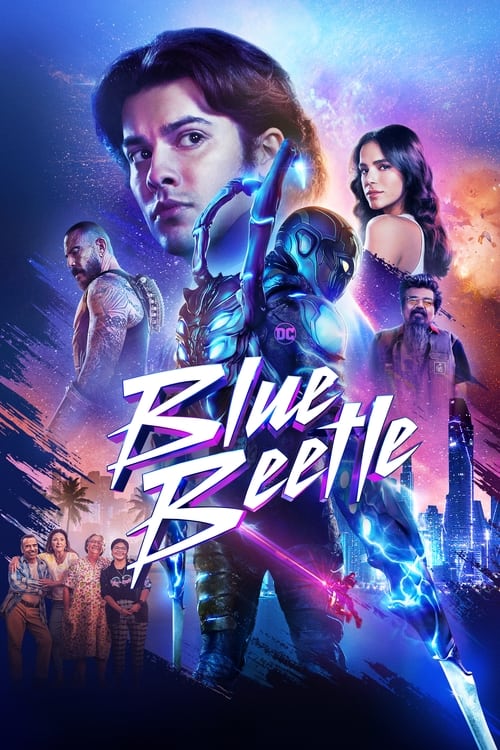
Blue Beetle (2023) is a superhero film adapted from DC Comics, directed by Angel Manuel Soto and starring Xolo Maridueña and Bruna Marquezine. The film is part of the DCEU and was released by Warner Bros.. Runtime: 2h 7m. Rated PG-13. Audience rating: 6.4/10.
What is Blue Beetle (2023) about?
Recent college graduate Jaime Reyes unexpectedly bonds with an ancient and mysterious alien relic called the Scarab, giving him a powerful suit of armor that changes his life forever.
Released in 2023, Blue Beetle was directed by Angel Manuel Soto and produced under the Warner Bros. banner. The film occupies a significant place within the DCEU — contributing to the ongoing narrative and mythology of that cinematic universe.
The film features lead performances from Xolo Maridueña, Bruna Marquezine, Susan Sarandon, among others, anchoring a story that adapts characters first brought to life in DC Comics. Its source material gives the film a foundation rooted in decades of published storytelling, which Soto and the creative team interpret through a cinematic lens.
The film's 6.4 audience rating indicates a mixed response. Even so, it holds interest as part of the broader DCEU catalogue and for how it fits into the lineage of DC Comics-based cinema.
What happens in Blue Beetle (2023)? — Full Plot
Palmera City, a fictional Mexican-influenced American coastal city — a stand-in for a place between Miami and Mexico City. Jaime Reyes (Xolo Maridueña, 22 years old) returns home from college with a fresh law degree, ready to support his family. He's the first college graduate in three generations of the Reyes family. His parents — Alberto (Damián Alcázar, the patient mechanic father) and Rocio (Elpidia Carrillo, the warm matriarch) — have been working multiple jobs to afford Jaime's tuition. His sister Milagro (Belissa Escobedo, 24, sharper than Jaime and unimpressed by his idealism) picks him up at the airport. The opening twenty minutes establish the Reyes family with documentary-style intimacy — three generations under one roof in a small house, plus the eccentric Uncle Rudy (George Lopez) and the matriarchal Nana (Adriana Barraza). The home feels lived-in. It is also being lost.
The family has received an eviction notice. Their landlord — Kord Industries, the privately-held military contractor that owns most of Palmera City — has sold the lot for redevelopment. The family has 90 days to vacate. Alberto is too proud to tell Jaime; Rocio breaks the news the night of his return. Jaime, fresh out of law school, doesn't yet have a job. The next morning, he applies for a maid-service position at the Kord Industries family compound to earn quick rent money. He and Milagro arrive together; Milagro is hired on the cleaning crew, Jaime is assigned to clean the Kord-family's private mansion. The mansion is a brutalist coastal estate; Jaime is told never to enter the private wings. Within an hour, he disobeys.
Jaime accidentally witnesses a fight between Victoria Kord (Susan Sarandon, in icy CEO mode) and her niece Jenny Kord (Bruna Marquezine, in tactical gear). Jenny has just stolen something from Victoria's research vault — a small carved-stone box with an etched scarab-beetle symbol. Jenny is being chased by Kord Industries security. Jaime, hidden behind a serving cart, watches the confrontation. Jenny escapes through a service corridor with the stolen box. Victoria, having seen Jaime witness the theft, has him fired on the spot. He leaves the mansion humiliated and unemployed. Jenny finds him in the staff parking lot. She presses the box into his hands. She tells him not to open it — and to keep it safe for 24 hours until she can retrieve it. Then she vanishes. Jaime, confused, drives home with the artifact in his backpack.
The family dinner that night is loud and crowded. Jaime is hiding the box from everyone. Milagro, of course, finds it within fifteen minutes. The Reyes family — Alberto, Rocio, Milagro, Rudy, Nana, and Jaime — gather around the kitchen table to examine the strange artifact. Despite Jenny's warning, the box opens itself when Jaime touches it. The Scarab — a sentient alien biotechnology with deep blue-and-gold coloring — emerges and bonds with Jaime's spine. The bonding is violent and immediate. Jaime is encased in a Blue Beetle exo-suit within thirty seconds. The suit lifts him off the floor, accidentally smashes through the kitchen ceiling, and launches him into the upper atmosphere of Palmera City. The family watches in shock. Rudy, who is a paranoid conspiracy theorist with home-built tech equipment, immediately starts believing this is an alien invasion.
Jaime, suspended at 30,000 feet in a suit he has no idea how to control, panics. The Scarab — which has its own AI personality named Khaji-Da — speaks directly to Jaime through his mind. Khaji-Da has been bonded with multiple hosts across centuries; it has tactical combat protocols ready to deploy. It also has a moral problem: Khaji-Da's default protocols are to kill anyone threatening the host. Jaime, who has spent four years studying constitutional law, refuses to allow lethal-force interventions. The first ten minutes of his time as Blue Beetle is a moral negotiation with his own suit about what level of force is acceptable. The suit eventually settles for non-lethal combat options. Jaime returns to Palmera City and lands in the family backyard.
Victoria Kord has been hunting the Scarab for decades. Her ex-brother-in-law Ted Kord — Jenny's father, the previous Blue Beetle from the late 1990s — discovered the Scarab during an archaeological expedition in Mesoamerica and bonded with it briefly before his death. Ted's death has been officially recorded as an industrial accident; Victoria, the film implies, was responsible. Victoria intends to weaponize the Scarab's biotechnology for military-contractor sales — specifically, she has been building a prototype mass-produced Scarab-derived combat suit called OMAC (One-Man Army Corps), which the U.S. military has agreed to purchase if Victoria can finalize the design. The OMAC project requires extracting the Scarab from Jaime's spine.
Victoria mobilizes Kord Industries' private security force, led by Carapax (Raoul Trujillo) — a former Guatemalan soldier whose body has been augmented with Kord Industries cybernetic implants. Carapax is also a Scarab-derived test subject; he is functionally Victoria's enforcer and prototype simultaneously. Kord security tracks Jaime to the Reyes family home that night. They forcibly enter the house, beat Alberto unconscious during the raid (he later dies of a heart attack induced by the trauma), and abduct Jaime. Victoria captures the family separately as leverage. Jaime is brought to Victoria's island research compound off the Palmera City coast. Milagro, Rocio, Nana, Rudy, and Jenny coordinate the rescue plan from a hidden warehouse.
Alberto's death is the film's emotional turning point. The Reyes family — gathered in the warehouse — has fifteen minutes of grief processing before they have to plan the rescue. Nana, who has been quietly observing throughout the film, reveals her own backstory: she fought as a guerrilla in 1960s Mexican revolutionary movements and has substantial combat experience. She has been hiding her past from the family for decades. Nana takes operational command of the rescue. The family — Milagro driving, Rudy operating tech, Jenny providing Kord-Industries inside knowledge, Rocio on logistics, and Nana on tactical command — boards Rudy's converted school bus and heads for the Kord island. The Reyes family rescue mission has become the film's primary action sequence.
Kord Industries' island headquarters. Jaime is in a Scarab-extraction laboratory; Victoria is preparing the OMAC transfer procedure. Khaji-Da has been suppressed by Kord Industries' electromagnetic-pulse equipment. The family arrives in a coordinated multi-vector assault. Rudy provides electronic-countermeasure support from the bus; Nana leads the ground assault with Milagro and Jenny; Rocio handles logistics and getaway-coordination. The family fights through Kord Industries' security force. The action choreography is deliberately grounded and family-driven — no individual member is the hero, the entire family functions as a coordinated unit. The sequence is widely cited as the film's strongest single setpiece.
Jaime is freed. Khaji-Da reactivates. The Blue Beetle is back online with significantly more emotional clarity now that Jaime has processed his father's death. Carapax confronts Jaime in the laboratory; the fight is brutal and personal. Carapax — having been weaponized by Victoria and trapped in his own augmented body — is functionally a tragic figure rather than a pure villain. Jaime, through Khaji-Da's emotional-spectrum scanning, recognizes Carapax's trauma and refuses to kill him. He instead destroys Carapax's cybernetic-implant control mechanisms; Carapax, freed, turns on Victoria and kills her. The OMAC project is destroyed. Victoria is dead. Carapax escapes to disappear into Central America.
The film's epilogue. The Reyes family returns to Palmera City. Their home is destroyed — Kord Industries flattened it during the initial raid. The family pools resources to buy a new house, with help from Jenny Kord (who has inherited the Kord Industries assets following Victoria's death). The new home is a more-modest house in a different Palmera City neighborhood. The Reyes family is closer than before, even with Alberto's absence. Jaime, now permanently bonded to Khaji-Da, continues to operate as Blue Beetle. The film's final scene shows the Reyes family at a kitchen table together — Nana at the head of the table, having reclaimed her family-matriarch role. Jaime drives off to begin his Blue Beetle activities.
The mid-credits scene shows Jenny Kord receiving a transmission from her father Ted Kord, who is canonically alive after all — having been held captive for decades. The scene was specifically engineered as setup for a Blue Beetle sequel where Ted Kord (the original Blue Beetle) would return. The post-credits scene is more comedic: Rudy demonstrating his home-built tech equipment to Khaji-Da, with Khaji-Da responding sarcastically in Spanish. The post-credits comedy beat became one of the film's most-quoted moments.
Commercial and critical aftermath. Blue Beetle grossed $130 million worldwide on a $104 million production budget — modest commercial success but well below industry expectations. The film became the last DCEU theatrical release before James Gunn's DCU reset officially launched. Critically, Blue Beetle was well-received (Rotten Tomatoes 78%); critics widely praised the film's commitment to a Latino-American family-centric superhero narrative and director Ángel Manuel Soto's deliberate cultural specificity. Xolo Maridueña's Jaime Reyes is the only DCEU character announced as continuing into the new DCU. James Gunn has confirmed a Blue Beetle sequel is in development for the new continuity, with Maridueña reprising the lead role.
Who stars in Blue Beetle (2023)?
Find Blue Beetle (2023) on Amazon
Watch Blue Beetle on Prime Video, browse the original DC Comics source material, and discover Blu-rays, soundtracks, and related merchandise on Amazon.
As an Amazon Associate, I earn from qualifying purchases. Link clicks do not affect editorial coverage — see our disclaimer.
What are some facts about Blue Beetle (2023)?
Blue Beetle released in 2023, placing it within the 2020s era of comic book cinema — a decade that saw superhero films become the dominant force at the global box office.
Directed by Angel Manuel Soto, the film was produced by Warner Bros. and adapts source material from DC Comics.
The principal cast features Xolo Maridueña and Bruna Marquezine, with key supporting roles played by Susan Sarandon, George Lopez.
The film belongs to DCEU — the DC Extended Universe, Warner Bros' connected superhero continuity.
Blue Beetle carries an audience rating of 6.4 — a middling reception but one that hasn't prevented its cultural footprint.
The DC Comics source material for Blue Beetle has been in continuous publication for decades, giving filmmakers a rich well of storylines, character arcs, and iconography to draw upon.
Modern superhero films like this one use a mix of practical effects and digital VFX, with entire sequences often shot against volume walls or LED stages pioneered by shows like The Mandalorian.
Blue Beetle is catalogued on Movies on Comics among our collection of 164 comic book films spanning 48 years of cinema — from Richard Donner's 1978 Superman to the present day.





💬 Reader Comments