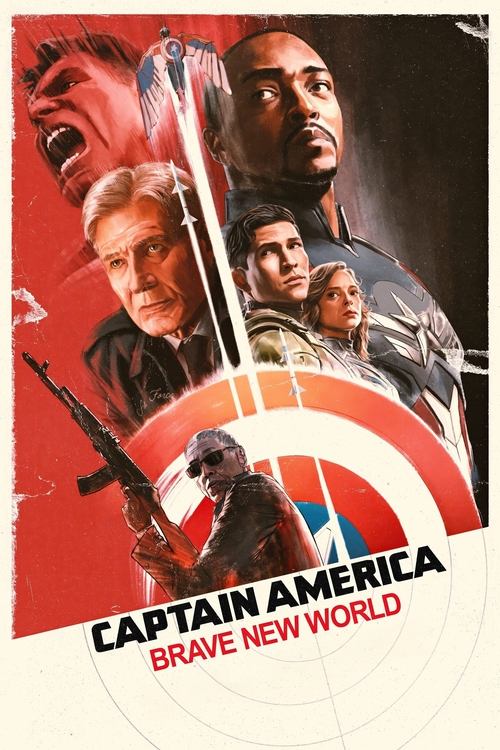
Captain America: Brave New World (2025) is a superhero film adapted from Marvel Comics, directed by Julius Onah and starring Anthony Mackie and Harrison Ford. The film is part of the MCU and was released by Marvel Studios. Runtime: 1h 58m. Rated PG-13. Audience rating: 6.0/10.
What is Captain America: Brave New World (2025) about?
Sam Wilson, now as the new Captain America, finds himself caught in an international incident and must uncover the nefarious plot behind a sinister conspiracy.
Released in 2025, Captain America: Brave New World was directed by Julius Onah and produced under the Marvel Studios banner. The film occupies a significant place within the MCU — contributing to the ongoing narrative and mythology of that cinematic universe.
The film features lead performances from Anthony Mackie, Harrison Ford, Danny Ramirez, among others, anchoring a story that adapts characters first brought to life in Marvel Comics. Its source material gives the film a foundation rooted in decades of published storytelling, which Onah and the creative team interpret through a cinematic lens.
The film's 6.0 audience rating indicates a mixed response. Even so, it holds interest as part of the broader MCU catalogue and for how it fits into the lineage of Marvel Comics-based cinema.
What happens in Captain America: Brave New World (2025)? — Full Plot
Sam Wilson (Anthony Mackie) has been Captain America for roughly a year. The film opens with him on a rescue mission in Mexico, leading his new partner Joaquin Torres (Danny Ramirez) — now operating as the new Falcon — against a black-market arms ring run by mercenary Sidewinder (Giancarlo Esposito). The opening sequence is a deliberate showcase: no super-soldier serum, no Asgardian relic, no Wakandan tech beyond Sam's vibranium-laced wingsuit. Onah films the rescue as a straight commando operation, and the film's first emotional beat is Sam refusing to kill Sidewinder — pointedly choosing arrest over execution, the first scene that defines what kind of Cap he intends to be.
On returning to Washington, Sam is summoned to the White House by newly-elected US President Thaddeus 'Thunderbolt' Ross (Harrison Ford, recasting the character from the late William Hurt). Ross is the same man who hunted Bruce Banner in 2008 and the same man who delivered the Sokovia Accords in 2016; he has spent the intervening decade rehabilitating his public image and has won the presidency on a platform of international cooperation. He invites Sam to the White House for what he describes as a goodwill summit between five global powers to formalise the international claim over the Tiamut Crater — the partially-emerged celestial body left in the Indian Ocean at the end of Eternals (2021), which has since proved to contain a previously-unknown indestructible metal called Adamantium.
The summit becomes a public-relations stage. Five nations — the United States, Japan, France, India and a returning Mexican delegation — are scheduled to sign a treaty allocating Adamantium mining rights. Sam attends with his old friend Isaiah Bradley (Carl Lumbly), the long-suppressed African-American super-soldier from the 1950s Korean War program who was retroactively pardoned by President Ross after the events of Falcon and the Winter Soldier. The presence of Isaiah — Sam's predecessor as a Black super-soldier and his moral anchor for the franchise — is a deliberate gesture; Sam wants the world to see Bradley in the front row of a presidential summit.
The summit is interrupted by an assassination attempt. Isaiah Bradley pulls a concealed pistol on President Ross and empties a clip into the stage. The Secret Service tackles Isaiah immediately; Ross, wearing a discreet vibranium-mesh undershirt that Sam himself helped engineer, survives the attack. Isaiah, in custody, has no memory of the attempt and no political motive. Sam, watching the footage, instantly recognisizs the cadence of his old friend's body language: Bradley was not acting under his own will. Someone has been triggering him with conditioning words, almost certainly using the same Hydra programming that controlled the Winter Soldier.
The investigation pulls Sam into the orbit of Samuel Sterns / The Leader (Tim Blake Nelson), a character last seen in 2008's The Incredible Hulk — bleeding gamma-irradiated blood from a forehead wound, having absorbed Banner's blood, and being escorted into Thunderbolt Ross's custody in the post-credits scene. The film reveals that Ross never released Sterns. For nearly two decades, Sterns has been kept in a black-site cell under the Pentagon, fed a steady diet of classified intelligence in exchange for his cooperation as a research asset. His mutation has continued: he now has a green-tinged enlarged skull, telepathic-adjacent pattern-recognition abilities, and complete recall of every conversation he has ever heard. Sterns is the one who programd Isaiah Bradley. Sterns has been programming dozens of people.
Sterns's motive is revenge. He has spent twenty years in a basement, used as a human computer, and he intends to destroy Ross publicly. The Isaiah assassination is the opening move of a larger plan: Sterns has also seeded conditioning triggers into Ross himself. Ross, who has been suffering from increasingly severe stress-related heart trouble across the film, is on an experimental medication that Sterns secretly designed. The pill is doing what it claims — controlling Ross's blood pressure — but it is also slowly altering his neurochemistry to mirror the gamma-induced rage response Sterns has spent two decades studying.
Sam and Joaquin track Sterns's mole network to a research facility called Camp Echo One, where Ross is scheduled to host a follow-up summit with the Japanese delegation. The film's centerpiece action sequence is a chase across a rebuilt White House lawn: Sam, in the Captain America wingsuit, dogfights with a squadron of Japanese F-18s whose pilots have been chemically triggered by Sterns to attack the President's helicopter. Sam talks the Japanese commander down mid-flight using his vibranium-amplified comms — Onah uses the sequence as a thesis statement, an action set-piece where Captain America wins by talking rather than punching.
But Sterns's true endgame is Ross himself. At the Camp Echo One summit, the experimental medication finally tips President Ross's neurochemistry past the trigger threshold. In front of the world's news cameras, Ross undergoes a violent gamma transformation: skin reddening, musculature ballooning, the iconic 'Red Hulk' transformation from the comics. President Ross becomes Red Hulk live on global television, in the middle of a press conference, in the presence of foreign heads of state. The visual is the film's centerpiece: Ford's face stretching, the suit shredding, the security detail scattering, the red giant turning and roaring at the cameras.
Sam, weighing the optics of fighting a sitting US president on live television, sends Joaquin and the Secret Service out to evacuate the press pool and chooses to engage Red Hulk alone. The Washington Monument battle that follows is the film's headline sequence: Captain America with no super-soldier serum, vibranium shield and wingsuit only, against a fifteen-foot gamma-irradiated President. Sam wins the fight through endurance and verbal de-escalation — Ford gives Ross moments of lucidity between rages, and Sam uses each lucid window to remind Ross of his daughter Betty (referenced but unseen in the film), of the Sokovia Accords mistakes he has tried to atone for, and of the office he holds. Ross calms, deflates, and collapses on the Monument's lawn, sobbing.
Ross resigns the presidency in the film's epilogue. He is taken into protective custody, awaiting trial for the unauthorised detention of Samuel Sterns. Sterns is captured and returned to a maximum-security facility, though his closing scene — staring directly into the camera and reciting fragments of dialogue from across the entire film — suggests his telepathic-adjacent surveillance is not over. Sam, in his final scene, formally inducts Joaquin Torres as the official MCU Falcon. Isaiah Bradley is publicly exonerated and given a posthumous-equivalent ceremony at the Smithsonian's Captain America exhibit, now finally including his story alongside Steve Rogers's.
The post-credits scene takes Sam into a fortified TVA-style chamber where Sterns, his hands bound, calmly tells Sam that he is 'not the only one watching'. The camera pans up to a holographic display of star charts that show the location of an unknown world beyond Earth — a world that, in dialogue, Sterns calls 'where they are coming from'. The line is the film's first explicit setup for the cosmic threat Marvel has been positioning at the center of Avengers: Doomsday. Brave New World ends with Sam, in the Captain America suit, leaving the Pentagon to address the press — a Black Captain America stepping up to a podium to brief the country on a threat the country does not yet know is coming. Onah keeps the camera on Mackie's face.
Who stars in Captain America: Brave New World (2025)?
Find Captain America: Brave New World (2025) on Amazon
Watch Captain America: Brave New World on Prime Video, browse the original Marvel Comics source material, and discover Blu-rays, soundtracks, and related merchandise on Amazon.
As an Amazon Associate, I earn from qualifying purchases. Link clicks do not affect editorial coverage — see our disclaimer.
What are some facts about Captain America: Brave New World (2025)?
Captain America: Brave New World released in 2025, placing it within the 2020s era of comic book cinema — a decade that saw superhero films become the dominant force at the global box office.
Directed by Julius Onah, the film was produced by Marvel Studios and adapts source material from Marvel Comics.
The principal cast features Anthony Mackie and Harrison Ford, with key supporting roles played by Danny Ramirez, Tim Blake Nelson.
The film belongs to MCU — the Marvel Cinematic Universe — the highest-grossing film franchise of all time.
Captain America: Brave New World carries an audience rating of 6.0 — a middling reception but one that hasn't prevented its cultural footprint.
The Marvel Comics source material for Captain America: Brave New World has been in continuous publication for decades, giving filmmakers a rich well of storylines, character arcs, and iconography to draw upon.
Modern superhero films like this one use a mix of practical effects and digital VFX, with entire sequences often shot against volume walls or LED stages pioneered by shows like The Mandalorian.
Captain America: Brave New World is catalogued on Movies on Comics among our collection of 164 comic book films spanning 48 years of cinema — from Richard Donner's 1978 Superman to the present day.
Easter Eggs & Hidden Details in Captain America: Brave New World (2025)
The first solo Captain America film with Anthony Mackie as Sam Wilson. The deep cuts include Tim Blake Nelson's 17-year Leader return and Harrison Ford's MCU debut.
Tim Blake Nelson's Samuel Sterns / The Leader was last seen in The Incredible Hulk (2008) being injected with Banner's blood. The character had not appeared in any MCU film for 17 years. His return as the primary antagonist was widely cited as one of the franchise's most-impressive long-game payoffs.
Harrison Ford replaced the late William Hurt as President Thaddeus 'Thunderbolt' Ross. Hurt had played the character since The Incredible Hulk (2008) until his March 2022 death. Ford's casting was widely cited as the year's most-significant MCU casting change.
Anthony Mackie's Sam Wilson became the first Black actor to lead a solo Captain America film. The character's promotion from sidekick to titular lead was the most-consequential MCU torch-passing of the post-Endgame era.
President Ross's transformation into Red Hulk — the cosmic adversary's variant Hulk form — was the franchise's most-anticipated transformation. The character had been seeded since The Incredible Hulk (2008). The Red Hulk emerges during a politically-televised event.
Carl Lumbly's Isaiah Bradley — the 1950s Black Captain America — returned for the film. The character's brief appearance in Falcon and the Winter Soldier Disney+ series had established his disillusionment with the U.S. government. Brave New World expanded his role.
Multiple alien artifacts appearing on Earth following the events of Eternals (2021)'s celestial emergence drive the film's central conflict. The Cosmic-emergence aftermath was widely cited as the franchise's broader Phase 5 anchor.
Danny Ramirez's Joaquin Torres — established in Falcon and the Winter Soldier — formally became the new Falcon as Sam's sidekick. The character's promotion completed the Captain America-team rebuild.
Liv Tyler returned as Betty Ross — her first MCU appearance since The Incredible Hulk (2008). The character's relationship with the Leader's anti-Avengers conspiracy was widely covered in pre-release marketing.
The film introduces Sabra — Marvel's first explicit Israeli superhero. The character's inclusion was widely covered by entertainment media as Marvel's most-deliberate cultural-representation expansion.
Brave New World grossed $415 million globally — modest commercial success and the first MCU film of 2025. Critics responded warmly to the franchise's commitment to the Captain America mantle transition.
💬 Reader Comments