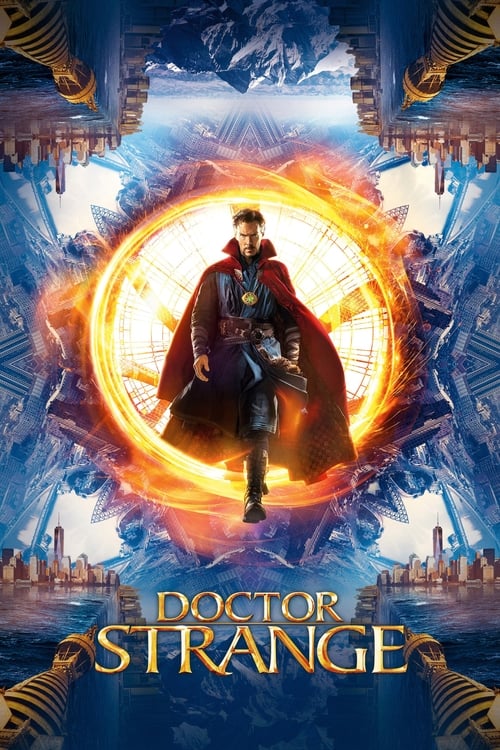
Doctor Strange (2016) is a superhero film adapted from Marvel Comics, directed by Scott Derrickson and starring Benedict Cumberbatch and Chiwetel Ejiofor. The film is part of the MCU and was released by Marvel Studios. Runtime: 1h 55m. Rated PG-13. Audience rating: 7.5/10.
What is Doctor Strange (2016) about?
After a career-ending accident, a brilliant surgeon embarks on a journey of healing that leads him to the mystic arts — and a calling to protect the world from forces beyond imagination.
Released in 2016, Doctor Strange was directed by Scott Derrickson and produced under the Marvel Studios banner. The film occupies a significant place within the MCU — contributing to the ongoing narrative and mythology of that cinematic universe.
The film features lead performances from Benedict Cumberbatch, Chiwetel Ejiofor, Rachel McAdams, among others, anchoring a story that adapts characters first brought to life in Marvel Comics. Its source material gives the film a foundation rooted in decades of published storytelling, which Derrickson and the creative team interpret through a cinematic lens.
With an audience rating of 7.5, Doctor Strange is generally praised as a strong entry in the superhero genre — its strengths in storytelling, performance, and production design regularly cited by viewers.
What happens in Doctor Strange (2016)? — Full Plot
Kathmandu, Nepal. A monastery known as Kamar-Taj on a hill above the city. A pale-faced English-speaking sorcerer named Kaecilius — Mads Mikkelsen, eyeshadow smudged, scarred eyelid, twin fanatic daggers — steps out of an opening doorway-portal into the monastery's library, where the head librarian is alone with his books. Kaecilius decapitates him with a folded blade and steals two pages from a chained occult tome called the Book of Cagliostro. The Ancient One — Tilda Swinton, bald, robed, ageless — chases him out into the streets of Kathmandu. The fight tears the city apart. Kaecilius and his Zealots can fold real space itself like origami, lifting buildings into vertical alleys, walking on the underside of streets, swinging through cracks in physics. The Ancient One can do it too but slightly better. She corners him in a kaleidoscoping mirror-dimension fold. Then Kaecilius opens a sling-ring portal home to wherever he came from and escapes with the pages. The Ancient One straightens, breathing hard. "Mordo. Bring me the next mistake."
New York. Doctor Stephen Strange, MD, PhD, on a Manhattan operating room. He's a neurosurgeon. He's the neurosurgeon — top of his field, perfect record, in his late forties, with three patents to his name and a permanent reservation at every Michelin spot south of Houston. He performs a craniectomy on a coma patient while listening to a Spotify playlist of 1980s power-pop and quizzing his anesthesia team on the trivia. ("Year. Song. Artist. Now.") He saves the coma patient and walks out into the locker room high-fiving his attending Christine Palmer — his ex, the ER trauma surgeon, the only person in the hospital who still likes him. He drives a sky-blue Lamborghini to a black-tie gala in Battery Park.
On the New Jersey Turnpike at eight p.m., distracted by a phone call from his junior on a new craniospinal case, Strange takes a left turn at sixty-five miles per hour and goes over the guard rail at the head of the Tappan Zee Bridge. The Lamborghini tumbles four hundred feet down a wooded ravine and lands roof-down in a shallow river. Strange survives, but he wakes up in a Mt. Sinai hospital bed three days later with stainless-steel pins through every joint of both hands. Eleven hours of microsurgery. Christine, who pulled him from the wreck herself, walks him through the X-rays. His hands shake uncontrollably for the rest of his life. He cannot hold a coffee cup, let alone perform brain surgery. He spends every dollar of his fortune on every experimental hand-restoration program in the United States and Switzerland. Seven surgeries, none work. He turns on Christine — "don't bring me your charity, get out" — and burns the only relationship he had left. He's left in a cheap hotel room in Queens at thirty-eight years old, broke, in chronic pain, the brilliance he built his identity on rotting in his fingers.
He's at a New York Library researching forearm prosthetics when he hears about Jonathan Pangborn — a paraplegic since a logging accident in 2011, walking again as of last year, no surgery on record. Strange tracks him down to a basketball court in Brooklyn. Pangborn is playing pickup. He tells Strange he was the same — confined to a wheelchair, suicidal — until he found a Kathmandu mystical school called Kamar-Taj. They taught him to mend his own broken spine with what they called "the mystic arts." Strange, atheist, laughs in his face. Pangborn shrugs. "Open your eye to mysteries we cannot rationally explain. I was you." Strange spends his last fourteen hundred dollars on a coach-class flight to Kathmandu.
Kamar-Taj, Kathmandu. Strange spends ten days hiking around the city asking street vendors for directions. A mugging in an alley leads to a tall, polite, robed man named Karl Mordo intervening with a stick — Mordo strikes a single Zen blow and four muggers go flying. Mordo walks Strange to a brown door in the back of a market alley and the door opens onto a sunny stone courtyard the size of a city block. Inside, dozens of disciples in robes are practicing kata. The Ancient One sits at the head of a low table. Strange — irritable, broken-fingered, suspicious — explains he's here for the science. The Ancient One smiles. She slaps him on the forehead with one finger. Strange's astral self separates from his body. He drifts upward through the Kamar-Taj courtyard, then through the rooftop, then through the atmosphere, then through the planet, then through every parallel dimension in turn — vast crystal lattices, fractal worlds, an underwater city, a star-shape of pure light, the Dark Dimension's purple smoke — all of it shown to him in a thirty-second LSD-trip sequence the Marvel Studios animation budget had been saving up for. "Forget everything that you think you know. Open your eye." She slaps his face back into his own body. He hits the courtyard floor sweating. "Teach me."
Training. Strange spends what's implied to be roughly a year at Kamar-Taj learning sling-ring portal magic, Mirror Dimension folds, astral projection, the conjuring of soul-weapons. Mordo is his cheerful, principled instructor. Wong, the new librarian who replaced the man Kaecilius killed, lets Strange into the restricted texts after the doctor demonstrates a perfect photographic memory. ("I read the entire Book of the Vishanti in eight nights. I'll have read the rest of the restricted section by morning.") Strange masters slip-ring portals first — used as a teleportation device — and Mirror Dimension manipulation second. He learns to forge a magical whip out of pure photon energy from his bracer. He levitates. He floats. He becomes, in the space of one training montage, the most talented student Kamar-Taj has graduated in two centuries.
He also discovers the order's hidden secret. While reading the restricted Book of Cagliostro, he sees the same time-loop spell Kaecilius used. He realizes the Ancient One has been pulling power from the Dark Dimension — the same realm Kaecilius worships — to extend her life centuries past natural. She is, by Kamar-Taj's own laws, a hypocrite. Strange confronts her quietly. She acknowledges it. She tells him "sometimes one must break the rules to serve the greater good." Mordo, overhearing, doesn't take it well. He has built his entire moral architecture on the Ancient One's rules. He says nothing. He stores it.
Kaecilius and his Zealots attack the New York Sanctum — one of three sanctums Kamar-Taj maintains around the world (London, Hong Kong, New York) to keep extradimensional threats from breaching Earth's reality. Strange portals into the Sanctum and lands in the middle of a sorcerous melee. Kaecilius kills the Sanctum's master. Strange, alone, fights three Zealots through the Sanctum's mansion. The fight wanders into the Mirror Dimension where physical laws don't apply — staircases sprout sideways, windows tile up the wall like an Escher engraving, floors fold in on themselves. The Cloak of Levitation — a sentient red garment hanging in a glass case in the Sanctum — sees Strange struggling, peels itself off the wall, and attaches itself to his shoulders mid-fight. The cloak then proceeds to defend Strange autonomously, wrapping a Zealot's face, snapping another's wrist, dragging Strange out of harm's way when he's stunned. Strange is now a Sorcerer Supreme apprentice with the franchise's most useful sidekick. Kaecilius and one surviving Zealot escape.
Mordo and Strange travel to defend the Hong Kong Sanctum next. Too late. Kaecilius has already taken Hong Kong and is using its now-opened Sanctum gateway to channel Dormammu's Dark Dimension energy directly into Earth. The city is in slow-motion collapse around them — buildings imploding upward, debris floating backward, citizens trapped mid-fall. The Ancient One arrives. She and Kaecilius and Strange and Mordo fight on collapsing skyscrapers in mid-air. Kaecilius runs the Ancient One through with a folded shard of Mirror Dimension. She falls.
Strange holds her in his arms on a glass roof of the Kowloon high-rise. Her astral form sits up. Through the astral-plane stitch, she tells Strange that he was always going to be the Sorcerer Supreme — she had foreseen it. She tells him that her fear of death is what kept her alive past her time. She tells him the world doesn't end because of bad people. It ends because of good ones who refuse to break their rules. She dies. Mordo, who was holding her other hand, hears every word. The seed of his betrayal in the sequel is planted in this exact scene.
Strange and Mordo, in Hong Kong, with the city's reality collapsing around them, have minutes before Earth is fully consumed by the Dark Dimension. Strange takes the Eye of Agamotto — a circular amulet around his neck containing one of the six Infinity Stones, specifically the Time Stone — and uses it to rewind the destruction. He runs time backward through Hong Kong while Kaecilius runs forward. He stops the city's destruction in mid-collapse and rewinds it past Kaecilius's initial entry to the Sanctum. Mordo is horrified — "the natural laws prohibit this" — but Strange isn't done. He casts a sling-ring portal, opens it into the Dark Dimension itself, walks through, and lands in the formless purple realm where the demon Dormammu — a faceless, eye-glaring entity the size of a galaxy — exists outside time.
Dormammu raises a planet-sized hand. "You have come to die. Your world is now my world." Strange spreads his arms. "Dormammu. I've come to bargain." Dormammu kills him with a single thumb-flick. Strange, in the rewind loop he's just activated, reappears. "Dormammu. I've come to bargain." Dormammu kills him again. Strange reappears. Again. Hundreds of times. Thousands. Strange tells Dormammu in each loop that he has trapped the demon in a time loop with him — the Time Stone's spell will recur for eternity unless Dormammu accepts his terms. Dormammu, who exists outside time and has never been bound by it, becomes infinitely furious in an infinite loop. After what for Dormammu is functionally millennia, he yields. "What do you want?" Strange's terms: Dormammu leaves Earth alone forever. Kaecilius and his Zealots are taken into the Dark Dimension with him. Dormammu accepts. The loop ends. Kaecilius and his men disintegrate up into Dormammu's hand and Strange falls back through the portal onto a Hong Kong rooftop intact.
Mordo, on the rooftop, watches Strange use the Time Stone to break natural law twice in one battle. He decides he's done. "This bill comes due. Always. A reckoning." He walks away from Strange and from Kamar-Taj without a backward glance. Strange takes the Sorcerer Supreme position at the New York Sanctum. He hangs his MD diploma on the wall next to the Eye of Agamotto. He's still got the hands. He's still got the cloak. He's still got Wong reluctantly bringing him books.
Mid-credits scene. Strange, in his New York Sanctum office, is at a desk pouring a beer for Thor — yes, Thor, in the same scene from Thor: Ragnarok (2017), a year before that film came out. Thor explains he's come to Earth looking for his missing father. Strange already has it covered: he tells Thor where Odin is (Norway, hiding incognito) and offers to portal Thor and Loki home as soon as they collect Odin. Thor: "It is so. so very British. Have you got any ginger ale?" Post-credits scene: Karl Mordo, no longer at Kamar-Taj, walks up to Jonathan Pangborn on a Brooklyn basketball court. Pangborn is dribbling like a man whose spine is whole. Mordo touches Pangborn's spine. He extracts the mystical energy Pangborn has been using to walk. Pangborn collapses to the asphalt screaming. Mordo's face is calm. "Too many sorcerers." He walks off into the city. Mordo is the next antagonist. (He has not yet returned, eight years later. Multiverse of Madness teased him without paying it off.)
Who stars in Doctor Strange (2016)?
Find Doctor Strange (2016) on Amazon
Watch Doctor Strange on Prime Video, browse the original Marvel Comics source material, and discover Blu-rays, soundtracks, and related merchandise on Amazon.
As an Amazon Associate, I earn from qualifying purchases. Link clicks do not affect editorial coverage — see our disclaimer.
What are some facts about Doctor Strange (2016)?
Doctor Strange released in 2016, placing it within the 2010s era of comic book cinema — a decade that saw superhero films become the dominant force at the global box office.
Directed by Scott Derrickson, the film was produced by Marvel Studios and adapts source material from Marvel Comics.
The principal cast features Benedict Cumberbatch and Chiwetel Ejiofor, with key supporting roles played by Rachel McAdams, Tilda Swinton.
The film belongs to MCU — the Marvel Cinematic Universe — the highest-grossing film franchise of all time.
Doctor Strange carries an audience rating of 7.5 — putting it in the solid-to-excellent tier of the genre.
The Marvel Comics source material for Doctor Strange has been in continuous publication for decades, giving filmmakers a rich well of storylines, character arcs, and iconography to draw upon.
Modern superhero films like this one use a mix of practical effects and digital VFX, with entire sequences often shot against volume walls or LED stages pioneered by shows like The Mandalorian.
Doctor Strange is catalogued on Movies on Comics among our collection of 164 comic book films spanning 48 years of cinema — from Richard Donner's 1978 Superman to the present day.
Easter Eggs & Hidden Details in Doctor Strange (2016)
Scott Derrickson came from horror and brought it to Marvel's most-visually-experimental film. The deep cuts include the Cumberbatch facial-injury reveal and the Time Stone's franchise-significance.
The Eye of Agamotto — Strange's green-jeweled amulet — is revealed to contain the Time Stone. This was the second MCU Infinity Stone reveal (after the Tesseract / Space Stone). The Time Stone's role pays off enormously in Infinity War (2018)'s 14,000,605-futures sequence and Strange's eventual sacrifice.
In the comics, the Ancient One is a male Tibetan sorcerer. Marvel cast Tilda Swinton — a white English actress. Kevin Feige later acknowledged in interviews the studio had been worried about geopolitical complications with the Chinese market. The casting became a major industry casting-conversation about whitewashing.
Director Scott Derrickson previously made The Exorcism of Emily Rose (2005), Sinister (2012), and Deliver Us from Evil (2014) before Marvel. His horror background shaped the film's visual register: broken-mirror fractals, Inception-meets-Possession architecture, and body-horror moments. Derrickson left the franchise after a creative dispute with Marvel during pre-production on Multiverse of Madness (2022).
Strange's final defeat of Dormammu — by trapping them both in an infinite time-loop until Dormammu agrees to leave Earth alone — was a deliberately anti-climactic choice for a Marvel film. The technique (defeating a cosmic god through patient persistence) was widely cited as one of the franchise's most-original creative solutions.
Benedict Cumberbatch — known as a British accent specialist — performed the American accent throughout the film. His delivery was widely criticized at the time of release but has since aged into broader acceptance. Cumberbatch returns to the role across multiple subsequent films.
Benedict Wong's Wong was initially conceived as a brief supporting role. Wong's performance during table reads expanded the character's significance. Wong later became the Sorcerer Supreme in Endgame (2019), a major franchise role.
Strange's use of the Time Stone to reverse Hong Kong's destruction was the franchise's first explicit Infinity Stone manipulation. The sequence cost approximately $20M to render and was widely cited as the film's most-impressive visual achievement.
Stan Lee appears reading The Doors of Perception by Aldous Huxley aboard a bus while Strange chases Mordo through Hong Kong. The cameo was widely cited as Lee's most-Easter-egg-worthy MCU appearance.
The post-credits scene shows Mordo (Chiwetel Ejiofor) stripping a former student of his magical powers. The setup established Mordo as the eventual villain. The character has not yet returned in any subsequent Doctor Strange film — Marvel deliberately delayed the heel-turn payoff.
Marvel publicly stated Benedict Cumberbatch was the studio's only choice for Doctor Strange. Production was actually delayed to accommodate Cumberbatch's Sherlock filming schedule. The decision was widely cited as the franchise's most-deliberate single-actor commitment.

💬 Reader Comments