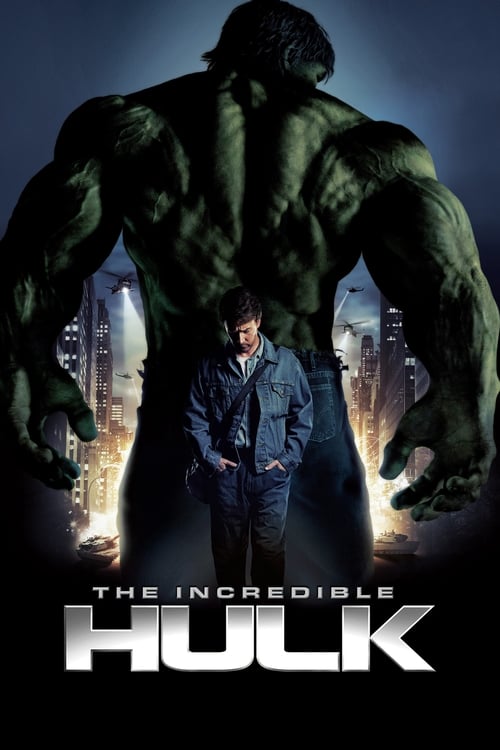
The Incredible Hulk (2008) is a superhero film adapted from Marvel Comics, directed by Louis Leterrier and starring Edward Norton and Liv Tyler. The film is part of the MCU and was released by Marvel Studios. Runtime: 1h 52m. Rated PG-13. Audience rating: 6.7/10.
What is The Incredible Hulk (2008) about?
Bruce Banner, hunted by a government general, must manage his curse and find a cure for his gamma-induced transformations, while a rival super-soldier experiment creates a new threat.
Released in 2008, The Incredible Hulk was directed by Louis Leterrier and produced under the Marvel Studios banner. The film occupies a significant place within the MCU — contributing to the ongoing narrative and mythology of that cinematic universe.
The film features lead performances from Edward Norton, Liv Tyler, Tim Roth, among others, anchoring a story that adapts characters first brought to life in Marvel Comics. Its source material gives the film a foundation rooted in decades of published storytelling, which Leterrier and the creative team interpret through a cinematic lens.
Its 6.7 rating reflects a film that divided audiences — appreciated for its ambition and spectacle by some, criticized for pacing and execution by others. Its place in the genre remains a frequent discussion point.
What happens in The Incredible Hulk (2008)? — Full Plot
Opening credits montage. The MCU's most-condensed origin story plays out in a four-minute speed-edit of opening titles. Bruce Banner (Edward Norton, in his only MCU role) is a young Culver University cellular-biology researcher in Virginia who has been recruited by General Thaddeus "Thunderbolt" Ross (William Hurt) for an experimental project. Ross has told Banner the program is intended to recreate the Captain America super-soldier serum to make American soldiers radiation-resistant. Banner has actually been working on cellular regeneration. In one breath-controlled experiment, Banner exposes himself to gamma rays in a Culver lab to test the regeneration protocol. The gamma dose is far higher than Banner had been told — Ross had actually been replicating Erskine's super-soldier serum using gamma radiation, hoping to create a Captain America without involving Banner's consent. Banner's body undergoes catastrophic cellular alteration. His heart rate spikes past 200 BPM. He transforms into the Hulk for the first time. The Hulk wrecks the lab, injures Betty Ross (Banner's girlfriend and the General's daughter), and nearly kills General Ross. Banner flees. The newspapers run shorts about a destructive accident at Culver. The film proper begins.
Five years later. Rio de Janeiro, Brazil. Bruce Banner has been on the run for five years across South America, hiding in the favelas under the alias David B. He works at the Pingo Doce soft-drink bottling plant in the harbor district. He has been studying with a martial-arts master called Hélio — Bruce has been learning meditation and breath control as a means to keep his heart rate below 200 BPM and prevent the Hulk transformation. He has not transformed in 158 days. He has been pen-paling with a contact he knows only as Mr. Blue — an American cellular biologist who has been corresponding with Banner over a secure channel about a possible cure. Mr. Blue has been requesting Banner's gamma-irradiated blood samples to develop an antidote.
The bottle. On Bruce's lunch break at the bottling plant, he accidentally cuts his hand on a glass shard while clearing a clog in a conveyor belt. A drop of his gamma-irradiated blood falls onto a soft-drink bottle moving along the production line. The bottle gets sealed, shipped, and bought by an elderly Milwaukee couple six months later who get violently ill from gamma exposure. The U.S. military traces the bottle's manufacturer to Pingo Doce in Rio. General Ross — who has been hunting Banner for five years through every U.S. military contact he has — gets a tip that Banner is in Rio.
Blonsky's commando team. Ross dispatches a Russian-born British military commando named Emil Blonsky (Tim Roth, late-forties, the most-decorated soldier in the British military's regular forces) and a small Black Ops squad to Rio with orders to capture Bruce Banner alive. Blonsky has been promised the same gamma-serum technology Banner was exposed to — Ross intends to recreate the Hulk's strength in a controllable special-ops soldier. Blonsky has agreed. The Blonsky squad raids the Pingo Doce plant after closing hours. Bruce, eating dinner in his small favela apartment, is alerted by a chase scene on the street outside. He runs through the back alleys of the favela. The chase is shot like a Bourne movie — handheld, frenetic, three-second cuts, a tracking pursuit through a single tile-roofed neighborhood. The chase ends in the loading dock of the Pingo Doce plant. Blonsky and the squad corner Bruce against a stack of plastic crates. His heart rate spikes past 200 BPM. He transforms into the Hulk for the first time onscreen — a green-skinned, nine-foot-tall, twelve-hundred-pound humanoid wrecking ball — and dispatches Blonsky's squad in thirty seconds. Blonsky himself is the only survivor — Hulk kicks Blonsky into a forklift across the bottling floor. Hulk escapes through the harbor.
Bruce flees to America. Bruce has lost contact with Hélio and the favela — he hops a cargo freighter across the Atlantic and rides a Greyhound bus from Mexico's border to Virginia. He's heading for Mr. Blue, whose address (after months of email correspondence) Bruce has identified as Culver University's cellular biology department. He arrives at Culver and finds Betty Ross is now a graduate-student professor at the same university where the accident happened. She has been mourning Bruce for five years. She has been dating a Culver psychiatrist named Leonard for the past year. Bruce, in beggar clothing and a baseball cap, sneaks onto campus to find Mr. Blue.
Bruce finds Betty. He sneaks into her office at Culver. They reunite. Betty had assumed Bruce was dead. She breaks up with her current boyfriend Leonard offscreen and joins Bruce in his escape from the campus. Together, they flee Culver knowing Ross will arrive within hours of the security alert. Betty takes Bruce to her family's cabin in upstate New York where they can lay low while she contacts Mr. Blue.
Helicopter battle. Ross's military helicopter unit raids the Culver campus the next morning. Blonsky, recovered from the Brazilian Hulk encounter, is in the lead helicopter — and he's been receiving incremental injections of the recreated super-soldier serum Ross has been developing. Blonsky is now twice as fast, twice as strong, and twice as durable as he was a week earlier. The helicopter spots Bruce and Betty on a Culver lawn. Helicopter gunfire forces Bruce to transform into the Hulk to shield Betty. The campus battle is the film's most-iconic action sequence — Hulk slamming military helicopters out of the sky, smashing tanks across the lawn, picking up Betty as she's about to be crushed by debris. Blonsky drops out of his helicopter and attacks Hulk in melee — Blonsky moves at supernatural speed thanks to the serum, dodges Hulk's punches, kicks Hulk in the face. Hulk catches Blonsky in mid-flight and stomps him with one massive foot. Blonsky's bones shatter. He survives only because the super-soldier serum has dramatically accelerated his healing. He's hospitalized.
Bruce and Betty escape into the woods after the Culver battle. Hulk reverts to Bruce. They sleep in the Catskills overnight and find a Greyhound bus station the next morning. They ride to New York City to meet Mr. Blue.
Mr. Blue. The contact is Dr. Samuel Sterns (Tim Blake Nelson, in glasses, pre-Leader makeup), a cellular biology professor at Grayburn University in Manhattan. Sterns has spent two years studying Bruce's blood samples — the same blood that contaminated the Pingo Doce bottle. He has developed what he believes is a stable antidote that will purge Bruce's body of the gamma radiation. He has also been quietly experimenting with synthesizing larger quantities of Bruce's blood to study the gamma's regenerative properties. Sterns admits to Bruce that he's been planning to publish the research and create pharmaceutical applications. Bruce, knowing the military would weaponize the research, demands Sterns destroy all the samples after curing him.
Sterns tests Bruce. Bruce undergoes a chemical-electrical antidote treatment in Sterns's basement lab. The treatment appears to work — Bruce can no longer transform into the Hulk. He's reportedly cured. Then Blonsky — who has been tracking Bruce through Betty's GPS-traceable cell phone for days — arrives at the basement lab with a small special-ops squad. Ross has authorized Blonsky to use any force necessary. Blonsky demands Sterns inject him with the same gamma-blood treatment. Sterns warns him: "With the level of gamma radiation in your blood right now, mixing it with what I'm about to give you, no one knows what would happen. A monstrosity." Blonsky doesn't care. He's been gradually dosing himself with the super-soldier serum for weeks and his body has been deteriorating. He demands the gamma dose anyway.
Blonsky becomes the Abomination. The lab injection takes effect within minutes. Blonsky's body transforms into a fifteen-foot-tall, jagged-boned, externally-spined gargoyle creature — the Abomination. His face has bony protrusions. His shoulders have armor-plated bone ridges. He cannot revert to human form. He has the Hulk's strength plus the super-soldier serum's intelligence and combat instincts. He's an apex predator. He smashes his way out of the Grayburn lab into the streets of midtown Manhattan and starts rampaging.
Sterns infected. During the chaos of Blonsky's transformation, a few drops of the gamma-irradiated blood Sterns synthesized falls onto a cut on Sterns's forehead. The blood absorbs into Sterns's brain tissue. Sterns's head begins swelling visibly. Sterns is becoming the Leader — a hyper-intelligent gamma-mutated villain established in the comics and finally paid off in Captain America: Brave New World (2025) seventeen years later. The seed is planted here.
Bruce, in the basement lab, is informed that Blonsky has gone Abomination and is destroying a Manhattan neighborhood. Bruce makes the choice he has been avoiding for five years: he asks Sterns to reverse the cure. He needs to be the Hulk. The cure is irreversible — Sterns can't restart the gamma in Bruce's body. But Bruce realizes he might still have residual gamma in his bloodstream from the partial cure. He runs out of the lab and jumps off a Manhattan high-rise rooftop. He free-falls forty stories. As he hits terminal velocity, his heart rate spikes past 200 BPM. The fall triggers the Hulk transformation as he hits the asphalt. The Hulk lands in a crater and stands up unhurt.
Harlem battle. Hulk and Abomination fight through Harlem's central park district. The fight is shot like a King Kong vs. Godzilla matchup — both creatures smashing through buildings, picking up cars, throwing concrete blocks at each other across two-block distances. The battle goes on for fifteen minutes. Betty Ross arrives via military helicopter. General Ross arrives. The military is unable to intervene because Abomination is too fast for ground fire and Hulk is too unpredictable. Eventually, Hulk gets Abomination in a chokehold with a length of chain ripped off a NYPD tank. Abomination is dying. Betty Ross runs to the fight scene and yells at Hulk to stop. Hulk listens to her. He drops Abomination. He turns to look at Betty. He doesn't speak. He gently raises one hand to her face. Betty touches his palm. Then Hulk turns and disappears into the woods. He decides he can't be near her anymore.
Coda. Bruce, weeks later, is in a small cabin in northern British Columbia, Canada. He's been alone for three weeks. He's been meditating. He activates a hidden electrocardiogram. He focuses. His heart rate climbs above 200 BPM. His eyes turn green. He smiles. He's chosen to control the Hulk transformation rather than try to suppress it. He's becoming an ally with his own monster. Cut to black.
Mid-credits. A bar somewhere in upstate New York. General Ross is drinking alone in his uniform. Tony Stark — Robert Downey Jr., in a suit, in his second MCU appearance after Iron Man (2008) — walks into the bar. The bartender hands Ross another whiskey. Stark sidles up next to him. "General, I'm sorry to hear about all of this." Ross stares at him. "This was a mistake." "I just heard. Now, what if I told you we were putting a team together?" Ross looks at him. "Who's we?" Cut to credits. The Avengers Initiative is officially being assembled six months before The Avengers (2012) starts pre-production. The MCU's interconnected universe pulled together in eight seconds of dialogue.
Who stars in The Incredible Hulk (2008)?
Find The Incredible Hulk (2008) on Amazon
Watch The Incredible Hulk on Prime Video, browse the original Marvel Comics source material, and discover Blu-rays, soundtracks, and related merchandise on Amazon.
As an Amazon Associate, I earn from qualifying purchases. Link clicks do not affect editorial coverage — see our disclaimer.
What are some facts about The Incredible Hulk (2008)?
The Incredible Hulk released in 2008, placing it within the 2000s era of comic book cinema — a decade that marked the modern superhero cinema revolution.
Directed by Louis Leterrier, the film was produced by Marvel Studios and adapts source material from Marvel Comics.
The principal cast features Edward Norton and Liv Tyler, with key supporting roles played by Tim Roth, William Hurt.
The film belongs to MCU — the Marvel Cinematic Universe — the highest-grossing film franchise of all time.
The Incredible Hulk carries an audience rating of 6.7 — a middling reception but one that hasn't prevented its cultural footprint.
The Marvel Comics source material for The Incredible Hulk has been in continuous publication for decades, giving filmmakers a rich well of storylines, character arcs, and iconography to draw upon.
Modern superhero films like this one use a mix of practical effects and digital VFX, with entire sequences often shot against volume walls or LED stages pioneered by shows like The Mandalorian.
The Incredible Hulk is catalogued on Movies on Comics among our collection of 164 comic book films spanning 48 years of cinema — from Richard Donner's 1978 Superman to the present day.
Easter Eggs & Hidden Details in The Incredible Hulk (2008)
Marvel's second film, almost forgotten. The deep cuts include Edward Norton's contractual dispute and Mark Ruffalo's eventual replacement.
Edward Norton was cast as Bruce Banner in 2007. He immediately demanded creative control over the script — a level of input typically given to writers/producers. Norton rewrote significant portions of the script during production. After release, Marvel publicly criticized Norton's lack of cooperation and refused to renew his contract.
Mark Ruffalo replaced Norton as Banner for The Avengers (2012). Ruffalo has since played Banner across multiple MCU films. The transition was widely cited as Marvel's first major casting reset.
Robert Downey Jr. cameos as Tony Stark in the post-film bar scene — approaching Thunderbolt Ross with a proposal. The cameo established the MCU's connective-tissue strategy that would define the entire franchise.
The Incredible Hulk grossed $263 million globally on a $150 million budget — modest commercial success but the lowest-grossing MCU film of Phase One. The film's mixed critical reception contributed to Norton's eventual replacement.
Hulk speaks his first word in MCU history — calling out Banner. The brief moment foreshadowed the much-greater Hulk vocalization that pays off in Thor: Ragnarok (2017) and beyond.
Tim Roth's Abomination — the film's primary antagonist — did not return to live-action MCU until She-Hulk: Attorney at Law (2022), 14 years later. The character has been retroactively integrated into the broader MCU canon.
Lou Ferrigno — who famously played the Hulk in the 1977 TV series — cameos as a security guard at Culver University. The cameo was a deliberate Marvel inside joke for older audiences.
Thunderbolt Ross references the original super-soldier serum that created Captain America. The reference was the franchise's first explicit Captain America mention — setting up Captain America: The First Avenger (2011).
Edward Norton reportedly produced an R-rated cut of the film with significantly more violent Hulk action. Marvel has not released the R-rated version. Norton has publicly stated his cut was 'more interesting' than the theatrical release.
Stan Lee cameos drinking a Brazilian soda spiked with Banner's blood — accidentally getting a brief Banner-blood enhancement. The cameo was Lee's first MCU cameo set outside the United States.
💬 Reader Comments